QUESTION IMAGE
Question
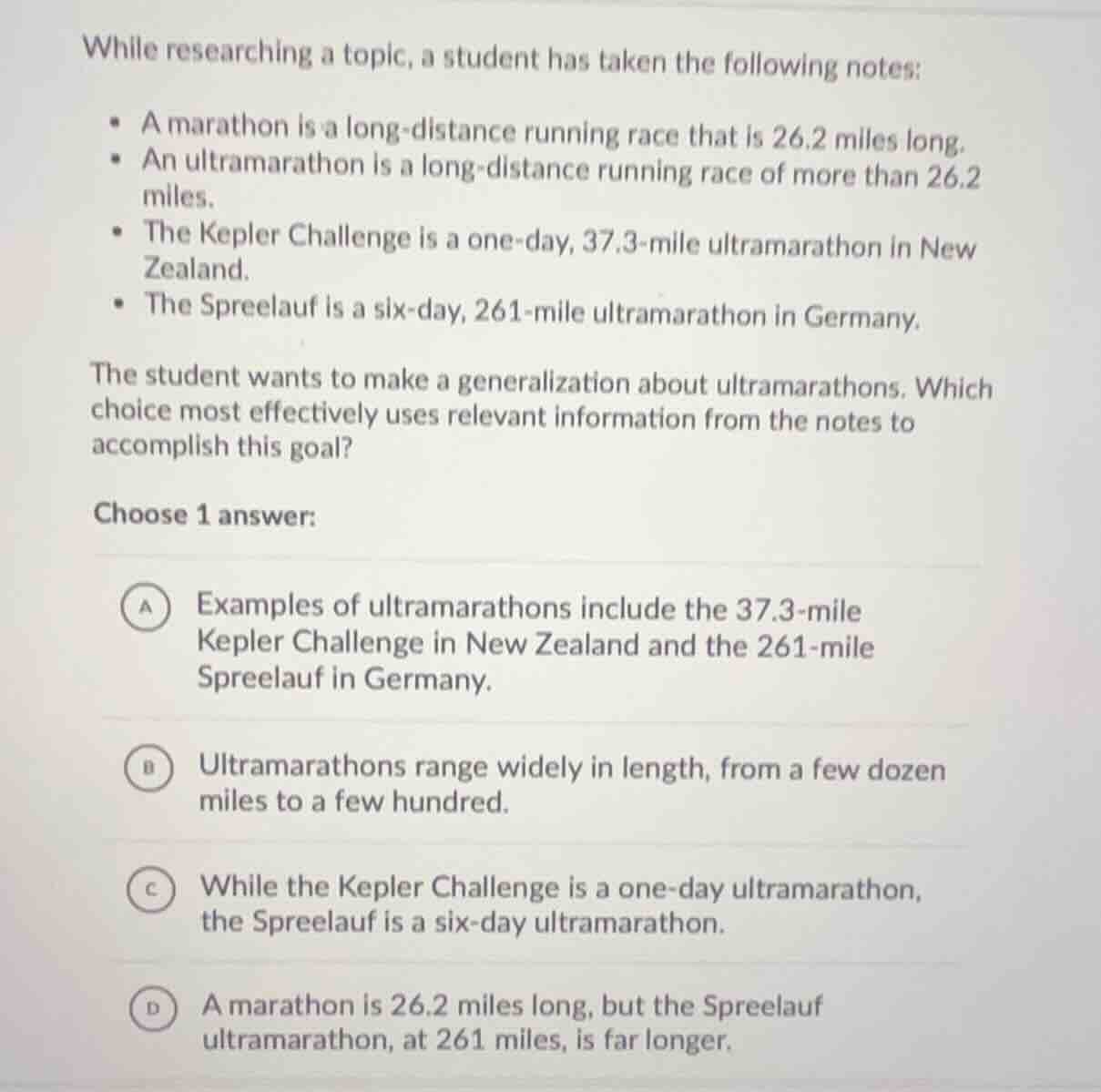
while researching a topic, a student has taken the following notes:
- a marathon is a long - distance running race that is 26.2 miles long.
- an ultramarathon is a long - distance running race of more than 26.2 miles.
- the kepler challenge is a one - day, 37.3 - mile ultramarathon in new zealand.
- the spreelauf is a six - day, 261 - mile ultramarathon in germany.
the student wants to make a generalization about ultramarathons. which choice most effectively uses relevant information from the notes to accomplish this goal?
choose 1 answer:
a examples of ultramarathons include the 37.3 - mile kepler challenge in new zealand and the 261 - mile spreelauf in germany.
b ultramarathons range widely in length, from a few dozen miles to a few hundred.
c while the kepler challenge is a one - day ultramarathon, the spreelauf is a six - day ultramarathon.
d a marathon is 26.2 miles long, but the spreelauf ultramarathon, at 261 miles, is far longer.
To make a generalization about ultramarathons, we need a statement that describes a common characteristic across ultramarathons. Option A just lists examples, not a generalization. Option C focuses on the duration of specific ultramarathons, not a general trait of ultramarathons. Option D compares a marathon to one ultramarathon, not generalizing about ultramarathons. Option B uses the lengths of the Kepler Challenge (37.3 miles) and Spreelauf (261 miles) to generalize that ultramarathons have a wide range of lengths, from a few dozen to a few hundred miles.

Snap & solve any problem in the app
Get step-by-step solutions on Sovi AI
Photo-based solutions with guided steps
Explore more problems and detailed explanations
B. Ultramarathons range widely in length, from a few dozen miles to a few hundred.