QUESTION IMAGE
Question
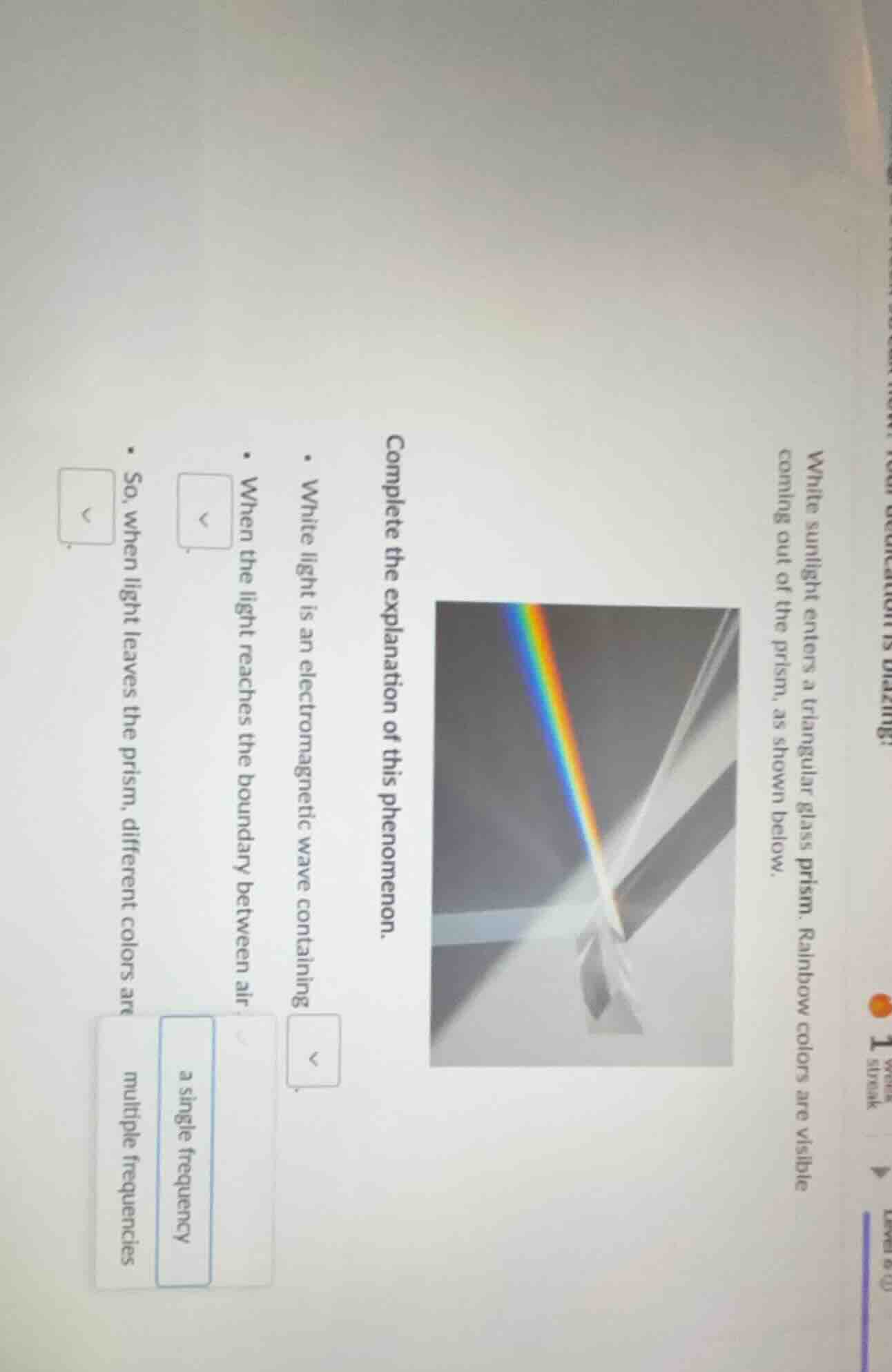
white sunlight enters a triangular glass prism. rainbow colors are visible coming out of the prism, as shown below.
complete the explanation of this phenomenon.
- white light is an electromagnetic wave containing
- when the light reaches the boundary between air
- so, when light leaves the prism, different colors are
options for the last blank: a single frequency, multiple frequencies
First blank (White light is an electromagnetic wave containing):
White light is composed of light of different colors (like red, orange, yellow, green, blue, indigo, violet), each with its own frequency. So it contains multiple frequencies. The option "a single frequency" is incorrect because white light is a combination of various colored lights with different frequencies.
When light travels from air (a less dense medium) to glass (a denser medium) at an angle (not along the normal), it undergoes refraction. Refraction is the bending of light as it passes from one medium to another with a different optical density. The light bends towards the normal when moving from air to glass. Also, since white light has multiple frequencies (colors), different colors bend by different amounts (dispersion starts here, but the main initial phenomenon at the air - glass boundary is refraction).
When the light leaves the prism (moving from glass to air), each color (with its own frequency) bends away from the normal. Since different colors had different amounts of bending when entering the prism (due to different refractive indices for different frequencies in glass), when they exit, they are separated (dispersed) and we see the rainbow colors. So different colors are separated (dispersed) as they leave the prism.

Snap & solve any problem in the app
Get step-by-step solutions on Sovi AI
Photo-based solutions with guided steps
Explore more problems and detailed explanations
multiple frequencies