QUESTION IMAGE
Question
why is the acceleration graph
part 3: rightward velocity and negative acceleration
go to: hyperlink http://www.physicsclassroom.com/mmedia/kinema
http://www.physicsclassroom.com/mmedia/kinema/pvna.html
read the paragraph explain “positive velocity and negative acceleration”
the \dot diagram\ and the graphs below. answer the questions relating to
diagram and graphs.
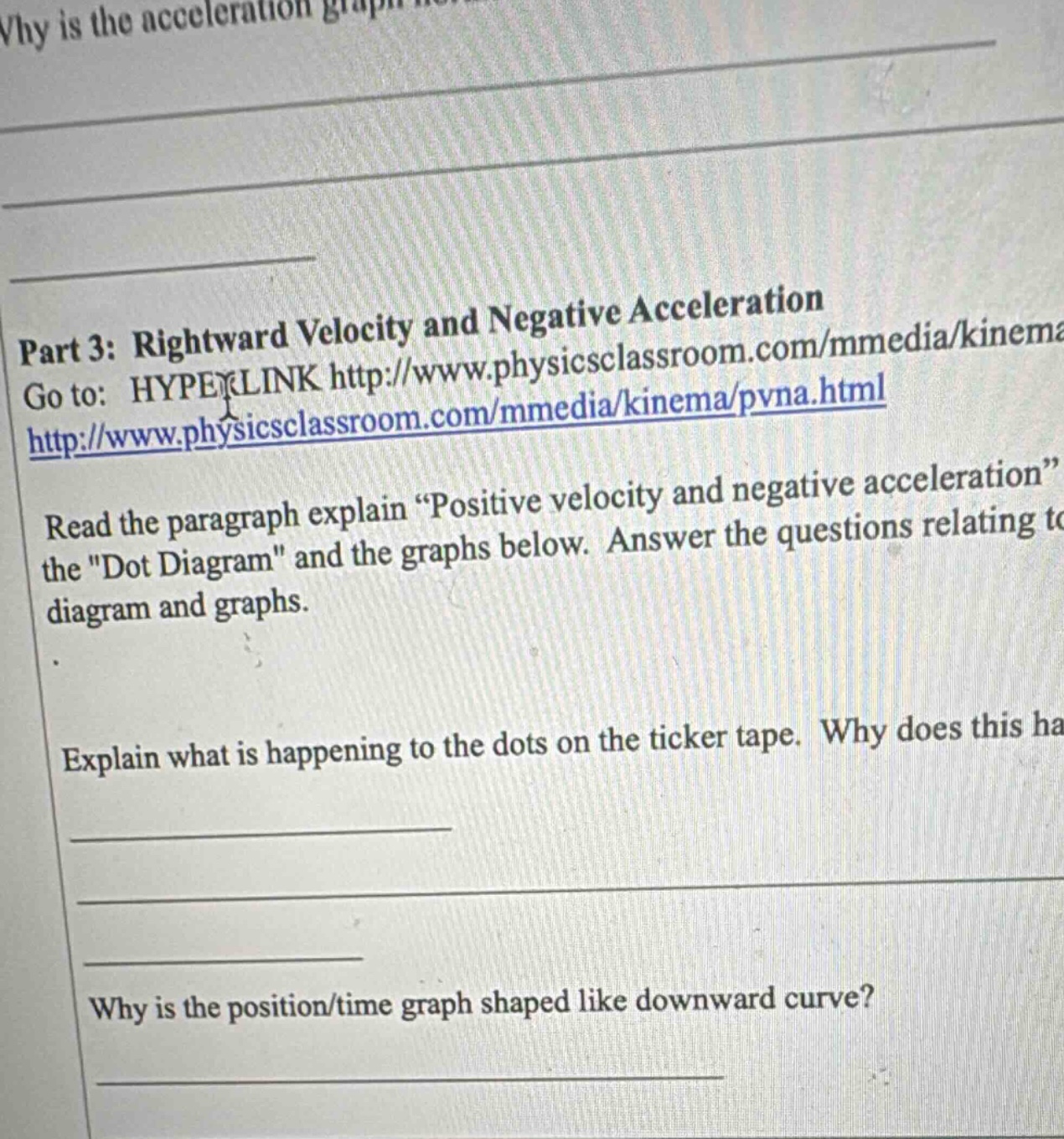
explain what is happening to the dots on the ticker tape. why does this ha
why is the position/time graph shaped like downward curve?
for "Explain what is happening to the dots on the ticker tape. Why does this happen?":
- Dot Spacing Analysis: In a ticker - tape setup for motion with rightward velocity and negative acceleration (deceleration), the dots are initially spaced far apart (indicating a relatively large velocity) and as time progresses, the distance between consecutive dots decreases.
- This is because the object is moving to the right (positive velocity direction) but its velocity is decreasing (negative acceleration). According to the definition of acceleration \(a=\frac{\Delta v}{\Delta t}\), when acceleration is negative and velocity is positive, the velocity is decreasing over time. Since the ticker tape marks positions at regular time intervals (\(\Delta t\) is constant), the displacement between consecutive dots \(\Delta x = v_{avg}\Delta t\). As the velocity \(v\) (and thus the average velocity \(v_{avg}\) over the time interval \(\Delta t\)) decreases, the displacement \(\Delta x\) between dots also decreases.
- Cause of the Phenomenon: The object is experiencing a net force opposite to its direction of motion (Newton's second law \(F = ma\), if \(a\) is negative and the object is moving right, the net force is to the left). This net force causes the object to slow down (decelerate) while still moving in the right - hand direction, leading to the decreasing spacing between the ticker - tape dots.
for "Why is the position/time graph shaped like a downward curve?":
- Position - Time Relationship: The position \(x\) of an object as a function of time \(t\) for an object with constant acceleration \(a\) is given by the equation \(x=x_0 + v_0t+\frac{1}{2}at^2\). In the case of rightward velocity (\(v_0>0\)) and negative acceleration (\(a < 0\)), the equation becomes \(x=x_0 + v_0t-\frac{1}{2}|a|t^2\).
- This is a quadratic equation in the form of \(y = Ax^2 + Bx + C\) (where \(y=x\), \(x = t\), \(A=-\frac{1}{2}|a|\), \(B = v_0\), and \(C=x_0\)). For a quadratic function \(y = Ax^2 + Bx + C\) with \(A<0\), the graph is a parabola that opens downward.
- The physical interpretation is that the object's velocity is decreasing as it moves right. The rate at which the position changes (the slope of the position - time graph, which is velocity) is getting smaller (less positive) over time. So, the curve of position vs. time bends downward because the velocity (slope) is decreasing.

Snap & solve any problem in the app
Get step-by-step solutions on Sovi AI
Photo-based solutions with guided steps
Explore more problems and detailed explanations
s:
- For "Explain what is happening to the dots on the ticker tape. Why does this happen?": The dots on the ticker tape are spaced increasingly closer together as time passes (while moving right). This happens because the object has a rightward velocity but a negative acceleration (deceleration), so its velocity decreases over time, leading to a smaller displacement between dots in each successive time interval.
- For "Why is the position/time graph shaped like a downward curve?": The position - time graph is a downward - opening curve (parabola) because the object has a positive initial velocity and a negative acceleration. The position function \(x(t)=x_0 + v_0t+\frac{1}{2}at^2\) (with \(a < 0\)) is a quadratic function with a negative coefficient for \(t^2\), which causes the graph to curve downward. Also, physically, the velocity (slope of the position - time graph) is decreasing as the object decelerates while moving right, leading to the downward curvature.