QUESTION IMAGE
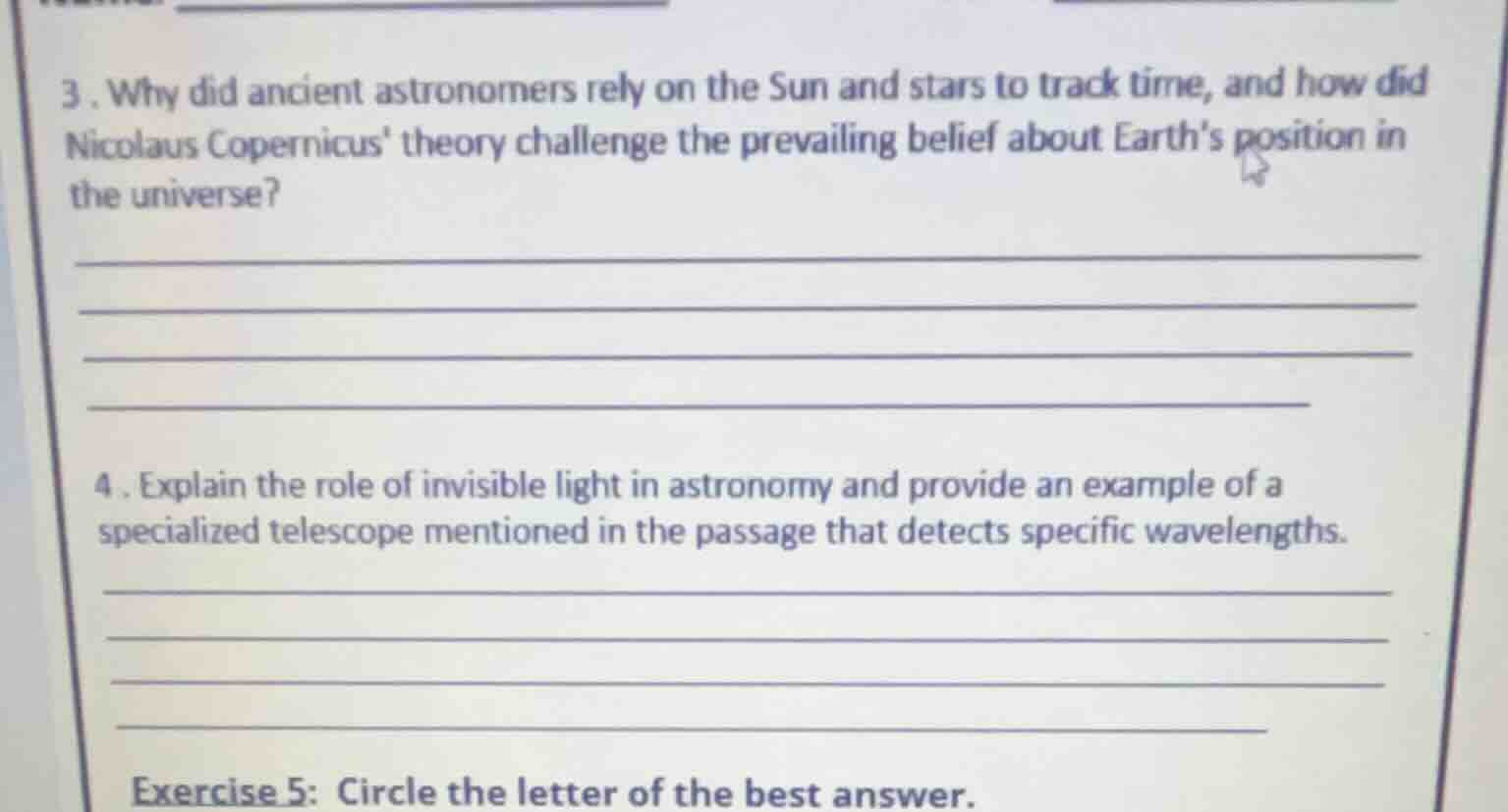
Question
- why did ancient astronomers rely on the sun and stars to track time, and how did nicolaus copernicus theory challenge the prevailing belief about earths position in the universe?
- explain the role of invisible light in astronomy and provide an example of a specialized telescope mentioned in the passage that detects specific wavelengths.
exercise 5: circle the letter of the best answer.
Brief Explanations
For Question 3:
- Ancient astronomers used the Sun and stars for timekeeping because these celestial bodies follow consistent, predictable cyclic patterns. The Sun's apparent daily and annual motion marked days, seasons, and years, while fixed stars' positions enabled tracking longer time periods and navigation.
- Nicolaus Copernicus' heliocentric theory challenged the prevailing geocentric model, which held Earth as the stationary center of the universe. Copernicus proposed that Earth and other planets orbit the Sun, shifting the cosmic center away from Earth and redefining humanity's place in the universe.
For Question 4:
- Invisible light (e.g., radio waves, X-rays, infrared) allows astronomers to observe celestial objects and phenomena that do not emit visible light, revealing details like stellar formation, black hole activity, and cosmic structure that would otherwise be unseen.
- A common example is the Hubble Space Telescope (which detects ultraviolet and infrared light alongside visible) or the Chandra X-ray Observatory, which detects X-ray wavelengths emitted by high-energy cosmic objects like neutron stars and galaxy clusters.

Snap & solve any problem in the app
Get step-by-step solutions on Sovi AI
Photo-based solutions with guided steps
Explore more problems and detailed explanations
Question 3:
- Ancient astronomers relied on the Sun and stars because their consistent, cyclic movements provided reliable, observable markers to measure days, seasons, and years.
- Copernicus' heliocentric theory challenged the dominant geocentric belief by arguing that Earth orbits the Sun, not the other way around, displacing Earth from the assumed center of the universe.
Question 4:
- Invisible light reveals celestial objects/phenomena that do not emit visible light, unlocking data about high-energy events, cold cosmic structures, and stellar evolution that visible light cannot show.
- An example is the Chandra X-ray Observatory, which detects X-ray wavelengths from high-energy sources like black holes and supernova remnants.