QUESTION IMAGE
Question
why?
deoxyribonucleic acid or dna is the molecule of heredity. it contains the genetic blueprint for life. for organisms to grow and repair damaged cells, each cell must be capable of accurately copying itself. so how does the structure of dna allow it to copy itself so accurately?
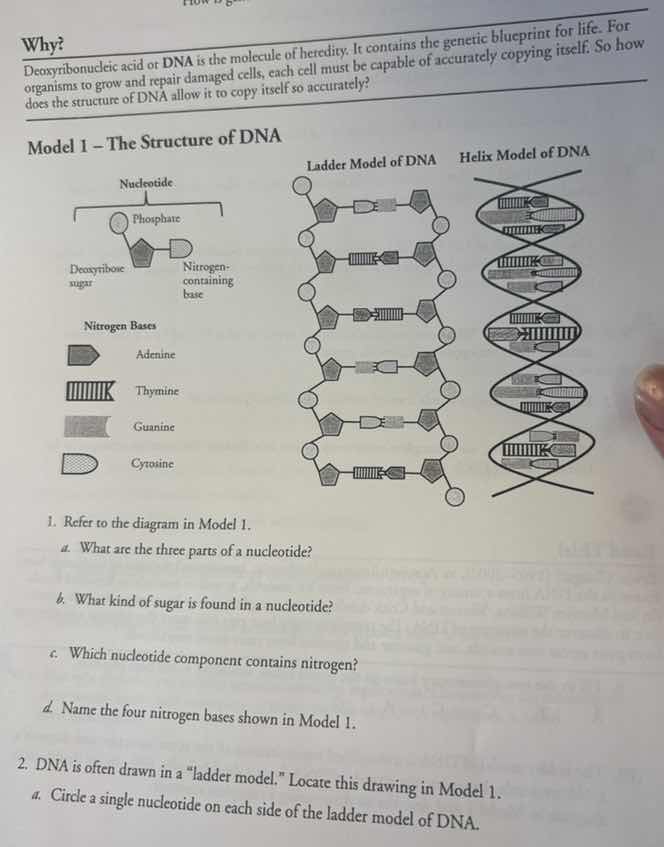
model 1 – the structure of dna
- refer to the diagram in model 1.
a. what are the three parts of a nucleotide?
b. what kind of sugar is found in a nucleotide?
c. which nucleotide component contains nitrogen?
d. name the four nitrogen bases shown in model 1.
- dna is often drawn in a “ladder model.” locate this drawing in model 1.
a. circle a single nucleotide on each side of the ladder model of dna.
Brief Explanations
- a. The diagram labels the three components that make up a nucleotide.
- b. The sugar in a nucleotide is explicitly labeled in the nucleotide diagram.
- c. One of the three nucleotide components is defined as nitrogen-containing.
- d. The nitrogen base key lists all four bases shown.
- a. A single nucleotide consists of a phosphate, deoxyribose sugar, and nitrogen base, which form one "rung" and its connecting "side" segment in the ladder model.

Snap & solve any problem in the app
Get step-by-step solutions on Sovi AI
Photo-based solutions with guided steps
Explore more problems and detailed explanations
- a. Phosphate, deoxyribose sugar, nitrogen-containing base
- b. Deoxyribose sugar
- c. Nitrogen-containing base
- d. Adenine, Thymine, Guanine, Cytosine
- a. (On the ladder model, circle one unit containing a circular phosphate, pentagonal deoxyribose sugar, and one of the four nitrogen bases on both the left and right sides of the ladder)