QUESTION IMAGE
Question
why?
how does sexual reproduction lead to genetic variation?
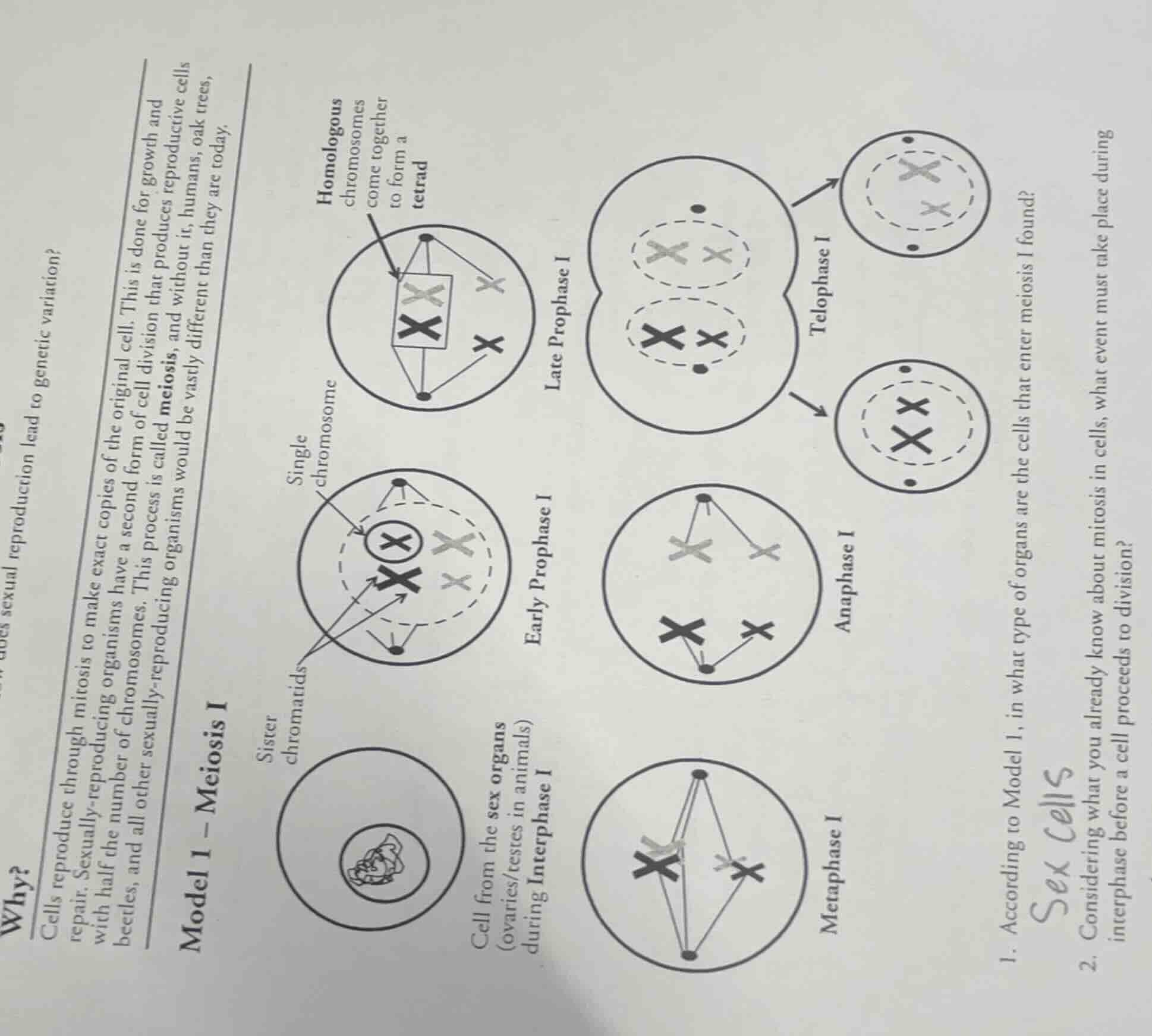
cells reproduce through mitosis to make exact copies of the original cell. this is done for growth and repair. sexually - reproducing organisms have a second form of cell division that produces reproductive cells with half the number of chromosomes. this process is called meiosis, and without it, humans, oak trees, beetles, and all other sexually - reproducing organisms would be vastly different than they are today.
model 1 – meiosis i
diagram of meiosis i stages: cell from the sex organs (ovaries/testes in animals) during interphase i, early prophase i, late prophase i, metaphase i, anaphase i, telophase i
- according to model 1, in what type of organs are the cells that enter meiosis i found?
- considering what you already know about mitosis in cells, what event must take place during interphase before a cell proceeds to division?
Question 1:
Meiosis I occurs in cells that are part of the reproductive system. In animals, the sex organs (gonads) are ovaries (in females) and testes (in males). These organs produce gametes (eggs and sperm) through meiosis. So the cells that enter meiosis I are found in the sex organs (ovaries or testes in animals).
In mitosis, interphase is the stage where the cell prepares for division. This includes DNA replication (where the genetic material is duplicated) and growth (the cell increases in size, produces necessary proteins and organelles). For a cell proceeding to division (either mitosis or meiosis, though here in the context of meiosis, the preparatory steps in interphase are similar in terms of DNA replication and growth), DNA replication must occur during interphase. This ensures that each daughter cell will have the correct amount of genetic material after division.

Snap & solve any problem in the app
Get step-by-step solutions on Sovi AI
Photo-based solutions with guided steps
Explore more problems and detailed explanations
The cells that enter meiosis I are found in the sex organs (ovaries/testes in animals).