QUESTION IMAGE
Question
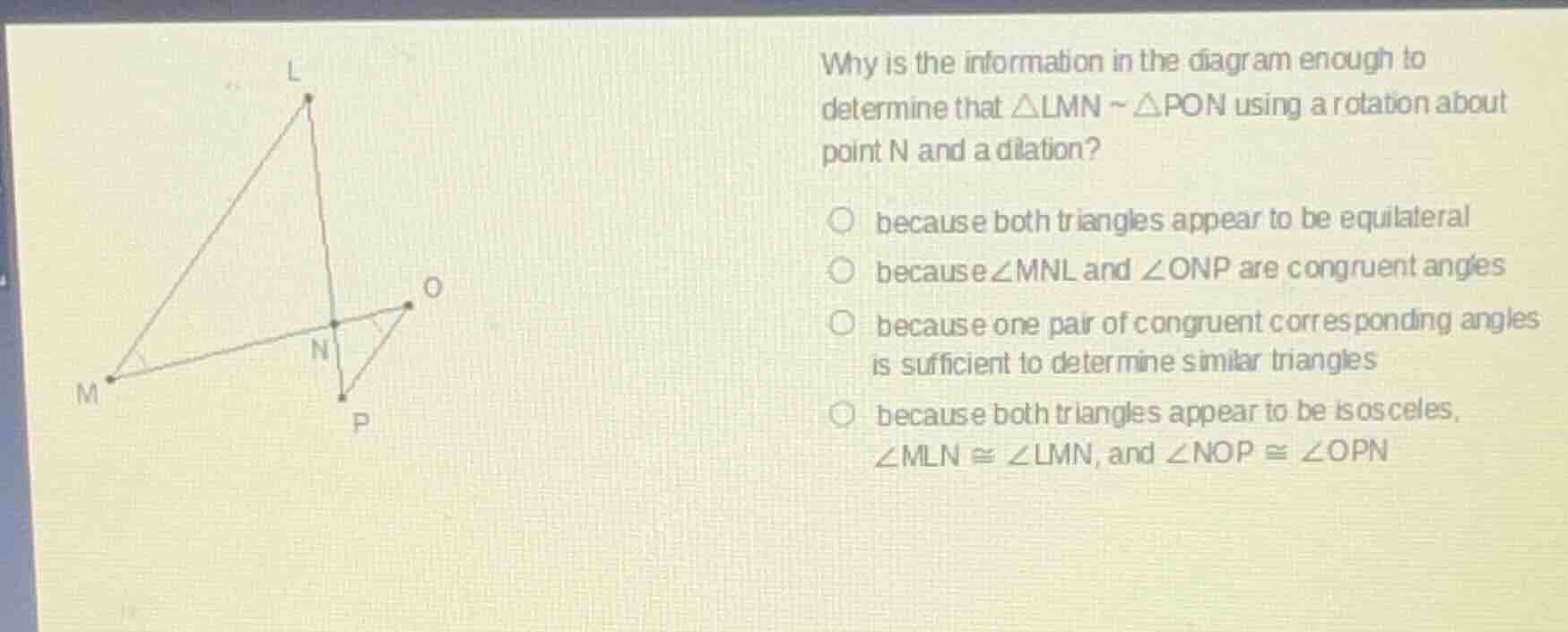
why is the information in the diagram enough to determine that $\triangle lmn \sim \triangle pon$ using a rotation about point n and a dilation? \
\bigcirc because both triangles appear to be equilateral \
\bigcirc because $\angle mnl$ and $\angle onp$ are congruent angles \
\bigcirc because one pair of congruent corresponding angles is sufficient to determine similar triangles \
\bigcirc because both triangles appear to be isosceles, $\angle mln \cong \angle lmn$, and $\angle nop \cong \angle opn$
First, $\angle MNL$ and $\angle ONP$ are vertical angles, so they are congruent. Additionally, the diagram marks $\angle LMN \cong \angle PON$. With two pairs of congruent corresponding angles, by the AA (Angle-Angle) Similarity Criterion, the triangles are similar. Rotating $\triangle PON$ about point $N$ aligns the congruent vertical angles, and a dilation scales it to match $\triangle LMN$. The option stating $\angle MNL$ and $\angle ONP$ are congruent, combined with the marked congruent angles, provides the necessary conditions for similarity via rotation and dilation.

Snap & solve any problem in the app
Get step-by-step solutions on Sovi AI
Photo-based solutions with guided steps
Explore more problems and detailed explanations
because $\angle$MNL and $\angle$ONP are congruent angles