QUESTION IMAGE
Question
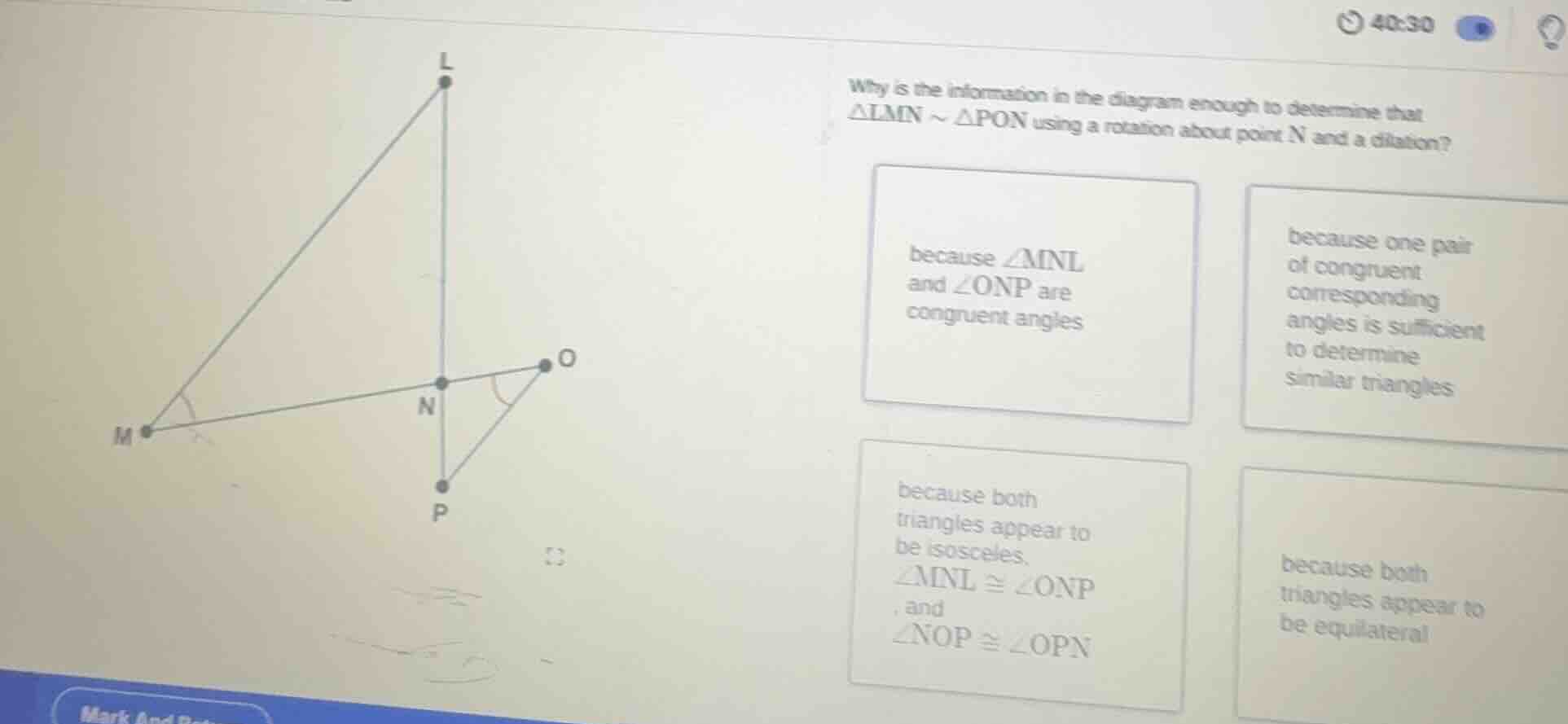
why is the information in the diagram enough to determine that \\(\triangle lmn \sim \triangle pon\\) using a rotation about point \\(n\\) and a dilation?\
\
- because \\(\triangle mnl\\) and \\(\angle onp\\) are congruent angles\
- because one pair of congruent corresponding angles is sufficient to determine similar triangles\
- because both triangles appear to be isosceles, \\(\angle mnl \cong \angle onp\\), and \\(\angle nop \cong \angle opn\\)\
- because both triangles appear to be equilateral
To determine similar triangles, we use the AA (Angle - Angle) similarity criterion. For $\triangle LMN$ and $\triangle PON$, we first look at the vertical angles $\angle MNL$ and $\angle ONP$. Vertical angles are always congruent, so $\angle MNL\cong\angle ONP$. Now, if we consider a rotation about point $N$ (which can align the sides around these angles) and then a dilation (to scale the triangle), we need to check the other angle. But actually, the key here is that $\angle MNL$ and $\angle ONP$ are congruent (vertical angles), and if we can establish another pair of congruent angles or proportional sides, but in the context of rotation and dilation (which preserves angle measures and scales sides proportionally), the congruence of $\angle MNL$ and $\angle ONP$ (vertical angles) is a start. The first option says "because $\angle MNL$ and $\angle ONP$ are congruent angles" which is correct as vertical angles are congruent, and this is a necessary condition for similarity when combined with rotation (to align the angles) and dilation (to scale the triangle). The other options are incorrect: one pair of congruent angles is not sufficient (AA needs two), assuming the triangles are isosceles or equilateral is not supported by the diagram, and we can't assume that from the given diagram.

Snap & solve any problem in the app
Get step-by-step solutions on Sovi AI
Photo-based solutions with guided steps
Explore more problems and detailed explanations
because $\angle MNL$ and $\angle ONP$ are congruent angles