QUESTION IMAGE
Question
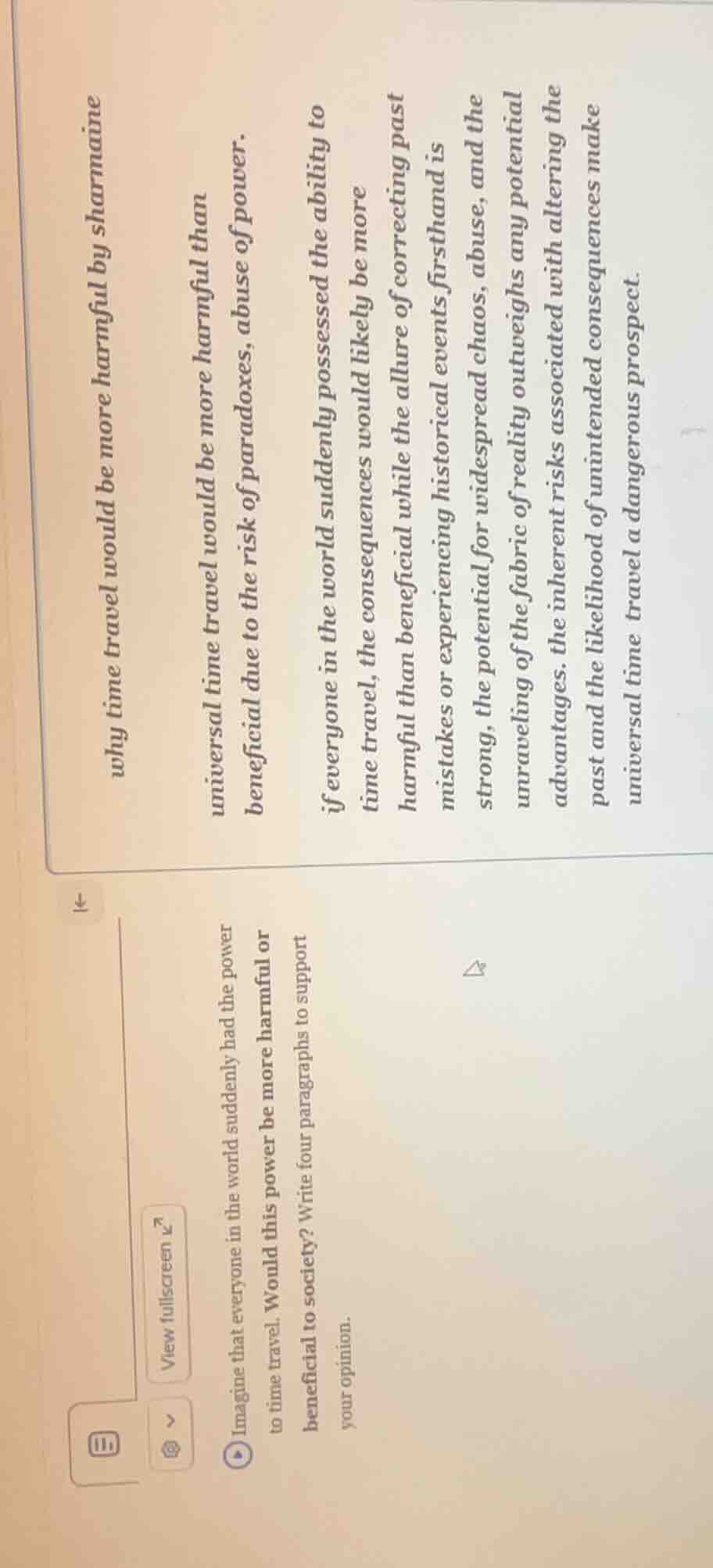
why time travel would be more harmful by sharmaine
universal time travel would be more harmful than beneficial due to the risk of paradoxes, abuse of power.
if everyone in the world suddenly possessed the ability to time travel, the consequences would likely be more harmful than beneficial while the allure of correcting past mistakes or experiencing historical events firsthand is strong, the potential for widespread chaos, abuse, and the unraveling of the fabric of reality outweighs any potential advantages, the inherent risks associated with altering the past and the likelihood of unintended consequences make universal time travel a dangerous prospect.
imagine that everyone in the world suddenly had the power to time travel. would this power be more harmful or beneficial to society? write four paragraphs to support your opinion.
- First, the core risk of paradoxes is addressed: altering the past to fix personal mistakes could erase the present existence of oneself or others, creating unresolvable logical and existential breakdowns.
- Second, the abuse of power is examined: individuals could use time travel to manipulate historical events for personal gain, such as altering elections, hoarding resources, or eliminating rivals, leading to widespread chaos and unfair power imbalances.
- Third, the fragility of reality is discussed: large-scale, uncoordinated changes to the past would unravel the shared fabric of reality, erasing collective cultural memory, scientific progress, and societal structures that rely on a consistent historical timeline.
- Finally, unintended consequences are highlighted: even well-meaning changes could trigger cascading, unforeseen harms (e.g., curing a historical figure's illness might lead to a worse global pandemic they unknowingly prevented), making the risks far outweigh any potential benefits of firsthand historical experience.

Snap & solve any problem in the app
Get step-by-step solutions on Sovi AI
Photo-based solutions with guided steps
Explore more problems and detailed explanations
Universal time travel would be far more harmful than beneficial to society.
The most immediate threat is the risk of catastrophic paradoxes. If individuals traveled back to fix personal or historical mistakes, they could inadvertently erase their own existence or undo critical societal progress—for example, preventing a key scientific discovery to avoid a personal tragedy would stunt global technological advancement. Such paradoxes would create unresolvable logical breakdowns that destabilize the very foundation of reality.
Beyond paradoxes, universal time travel would enable rampant abuse of power. Bad-faith actors could manipulate historical events for personal gain: altering election outcomes to install authoritarian leaders, hoarding valuable resources by accessing them before their discovery, or eliminating political rivals before they rise to influence. This would destroy the fairness and balance of global societies, concentrating power in the hands of those willing to exploit time travel for selfish ends.
Large-scale, uncoordinated time travel would also unravel the shared fabric of reality. Every change to the past, no matter how small, would ripple forward to alter cultural identities, collective memory, and societal structures. A world where history is constantly being rewritten would lack the stable, shared narrative that binds communities together, leading to widespread confusion, conflict, and the loss of accumulated human knowledge.
While the allure of experiencing or correcting history is strong, the inherent risks vastly outweigh any potential benefits. Unintended consequences are inevitable: even well-meaning attempts to improve the past could trigger cascading harms, such as curing a historical figure's illness only to allow a deadlier pandemic they unknowingly prevented. The combination of paradoxes, power abuse, reality unraveling, and unintended outcomes makes universal time travel an extraordinarily dangerous prospect for society.