QUESTION IMAGE
Question
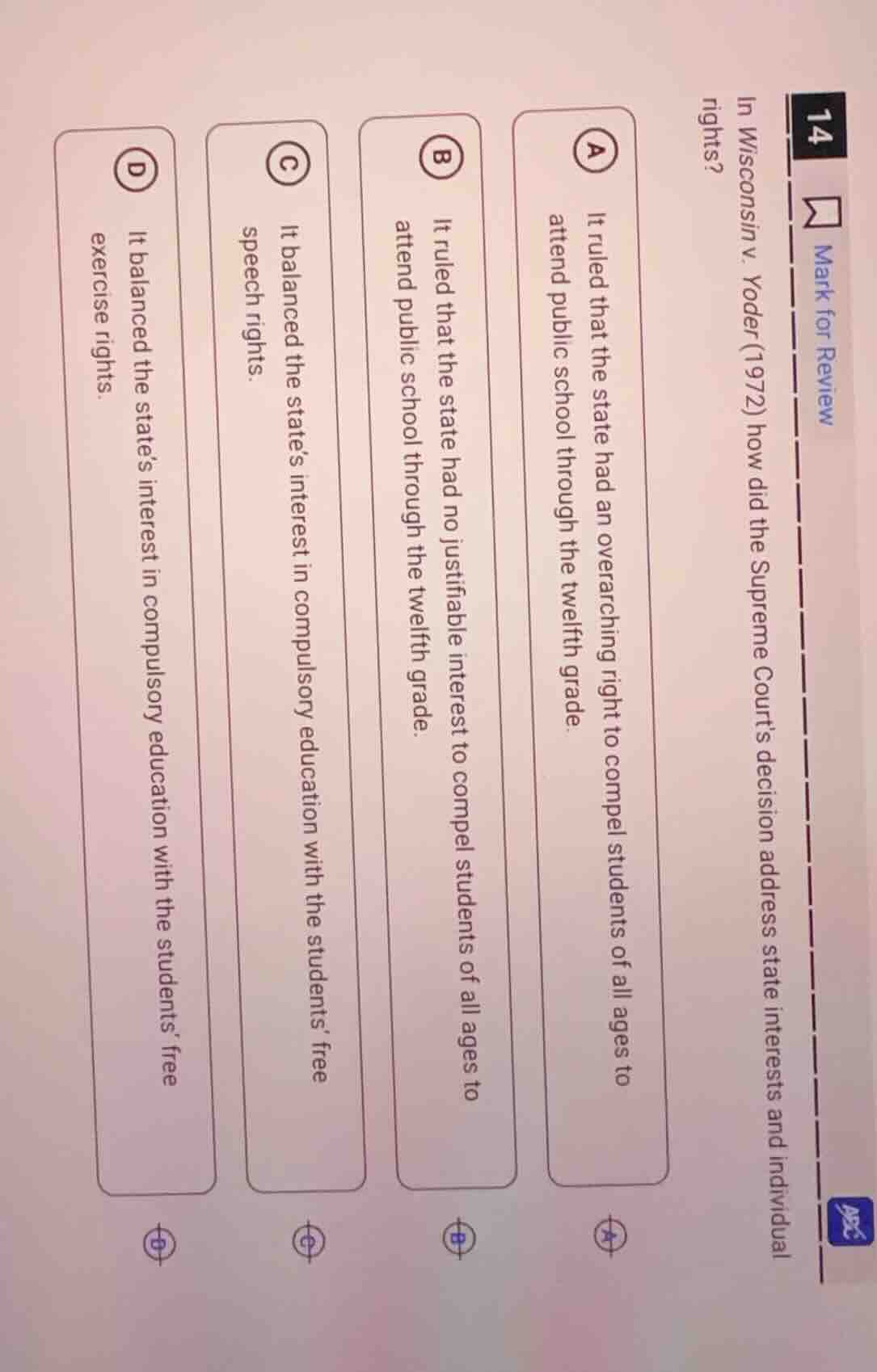
in wisconsin v. yoder (1972) how did the supreme court’s decision address state interests and individual rights?
a it ruled that the state had an overarching right to compel students of all ages to attend public school through the twelfth grade.
b it ruled that the state had no justifiable interest to compel students of all ages to attend public school through the twelfth grade.
c it balanced the state’s interest in compulsory education with the students’ free speech rights.
d it balanced the state’s interest in compulsory education with the students’ free exercise rights.
In Wisconsin v. Yoder (1972), the Supreme Court ruled that Amish students could be exempt from compulsory high school education beyond 8th grade. It balanced the state's interest in universal compulsory education against the Amish community's First Amendment free exercise of religion rights, holding the latter outweighed the state's interest for this specific group.

Snap & solve any problem in the app
Get step-by-step solutions on Sovi AI
Photo-based solutions with guided steps
Explore more problems and detailed explanations
D. It balanced the state's interest in compulsory education with the students' free exercise rights.