QUESTION IMAGE
Question
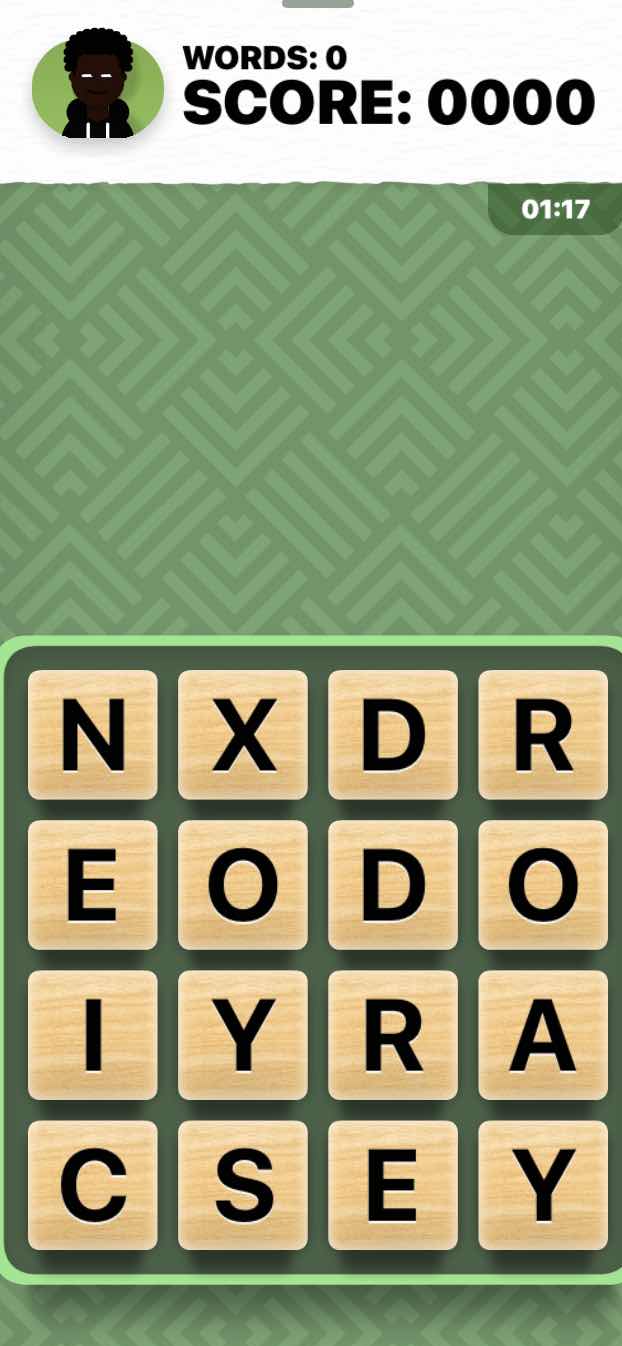
words: 0 score: 0000 01:17 n x d r e o d o i y r a c s e y
To solve this word - finding puzzle, we can look for words by checking the letters in the grid. Let's start with shorter words.
Step 1: Look for 2 - letter words
We check pairs of adjacent or connected letters. For example, we have "NO" (from the first row, first and third columns? Wait, no, let's check the grid again. The first row is N, X, D, R; second row E, O, D, O; third row I, Y, R, A; fourth row C, S, E, Y. Wait, maybe "DO" is a word. Let's see, in the second row, third and fourth columns: D and O. So "DO" is a valid 2 - letter word. Also, "NO" – first row first (N) and second row second (O) – N and O are connected? Wait, maybe the grid is a 4x4 grid, so we can move horizontally, vertically, or diagonally? Wait, maybe it's a word search where we can form words by connecting letters in any direction (adjacent, including diagonally). Let's try "DO" first. Then "OD" (second row second and third columns: O and D). "EO" (second row first and second: E and O). "YO" (third row second and second row fourth: Y and O? Wait, maybe I'm overcomplicating. Let's list some possible words:
- "DO": D (row 2, col 3) and O (row 2, col 4)
- "OD": O (row 2, col 2) and D (row 2, col 3)
- "EO": E (row 2, col 1) and O (row 2, col 2)
- "YO": Y (row 3, col 2) and O (row 2, col 4) – but are they adjacent? Y is in row 3, col 2; O is in row 2, col 4 – no, they are not adjacent. Maybe horizontal or vertical adjacency. So horizontal: same row, adjacent columns; vertical: same column, adjacent rows.
So horizontal in row 2: E, O, D, O – so EO, OD, DO, OO (but OO is not a valid English word). Vertical: column 1: N, E, I, C – NE, EI, IC. Column 2: X, O, Y, S – XO, OY, YS. Column 3: D, D, R, E – DD (invalid), DR, RE. Column 4: R, O, A, Y – RO, OY, AY.
Let's take "DO" as a start. Also, "RA" – row 3, col 3 (R) and row 3, col 4 (A) – RA. "AY" – row 3, col 4 (A) and row 4, col 4 (Y) – AY. "SE" – row 4, col 2 (S) and row 4, col 3 (E) – SE. "CS" – row 4, col 1 (C) and row 4, col 2 (S) – CS. "EI" – row 2, col 1 (E) and row 3, col 1 (I) – EI. "IR" – row 3, col 1 (I) and row 3, col 3 (R) – IR. "RY" – row 3, col 3 (R) and row 4, col 4 (Y) – RY. "SY" – row 4, col 2 (S) and row 4, col 4 (Y) – SY. "NE" – row 1, col 1 (N) and row 2, col 1 (E) – NE. "NX" – row 1, col 1 (N) and row 1, col 2 (X) – NX (not a valid word). "XD" – row 1, col 2 (X) and row 1, col 3 (D) – XD (invalid). "DR" – row 1, col 3 (D) and row 1, col 4 (R) – DR. "RE" – row 1, col 4 (R) and row 2, col 4 (O)? No, RE – R (row 1, col 4) and E (row 2, col 1)? No, vertical? R (row 1, col 4) and E (row 2, col 4)? No, E is in row 2, col 1. Wait, row 3, col 3 (R) and row 4, col 3 (E) – RE. Yes, that's vertical. So RE is a word.
Step 2: Look for 3 - letter words
Let's try to build 3 - letter words. For example, "DOE" – D (row 2, col 3), O (row 2, col 4), E (row 4, col 3). Are they connected? D (row 2, col 3), O (row 2, col 4) (horizontal), then E (row 4, col 3) – vertical from D? D is row 2, col 3; E is row 4, col 3 – two rows down, same column. So D - O - E: D (2,3), O (2,4), E (4,3) – is that a valid path? Maybe not, as the connection should be adjacent (including diagonally) in sequence. Let's try "EOD" – E (2,1), O (2,2), D (2,3) – horizontal in row 2. That's a valid 3 - letter word (EOD). "OOD" – O (2,2), O (2,4), D (2,3) – O (2,2) and O (2,4) are not adjacent, so no. "YOD" – Y (3,2), O (2,2), D (2,3) – Y (3,2) and O (2,2) are vertically adjacent (row 3 and row 2, same column), then O (2,2) and D (2,3) are horizontally adjacent. So Y - O - D: Y (3,2), O (2,2), D (2,3) – that's a valid path. So "YOD" is a…

Snap & solve any problem in the app
Get step-by-step solutions on Sovi AI
Photo-based solutions with guided steps
Explore more problems and detailed explanations
One of the words we can find is "DO" (formed by the letters D in row 2, column 3 and O in row 2, column 4). There are also other words like "RE" (R in row 3, column 3 and E in row 4, column 3), "EO" (E in row 2, column 1 and O in row 2, column 2), etc.