QUESTION IMAGE
Question
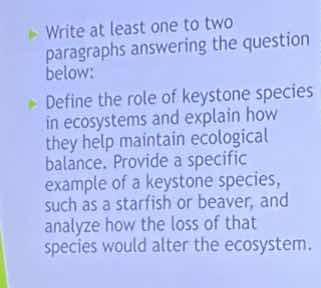
write at least one to two paragraphs answering the question below:
define the role of keystone species in ecosystems and explain how they help maintain ecological balance. provide a specific example of a keystone species, such as a starfish or beaver, and analyze how the loss of that species would alter the ecosystem.
A keystone species is a species that has a disproportionately large impact on its ecosystem relative to its abundance. Its role is to regulate the structure and function of the ecosystem, often by controlling the population of other species. For example, the sea otter is a keystone species in kelp forest ecosystems. Sea otters feed on sea urchins, which in turn graze on kelp. Without sea otters, sea urchin populations would explode, overgrazing the kelp and destroying the kelp forest habitat. This would lead to a decline in species that depend on the kelp, such as fish and invertebrates, disrupting the entire ecosystem's balance. Another example is the beaver, which creates wetlands by damming streams. These wetlands provide habitat for a variety of species, including amphibians, birds, and insects. The loss of beavers would reduce the number of wetlands, altering the hydrology of the area and negatively impacting the species that rely on these wetland habitats.

Snap & solve any problem in the app
Get step-by-step solutions on Sovi AI
Photo-based solutions with guided steps
Explore more problems and detailed explanations
A keystone species is a species that has a disproportionately large impact on its ecosystem relative to its abundance. Its role is to regulate the structure and function of the ecosystem, often by controlling the population of other species. For example, the sea otter is a keystone species in kelp forest ecosystems. Sea otters feed on sea urchins, which in turn graze on kelp. Without sea otters, sea urchin populations would explode, overgrazing the kelp and destroying the kelp forest habitat. This would lead to a decline in species that depend on the kelp, such as fish and invertebrates, disrupting the entire ecosystem's balance. Another example is the beaver, which creates wetlands by damming streams. These wetlands provide habitat for a variety of species, including amphibians, birds, and insects. The loss of beavers would reduce the number of wetlands, altering the hydrology of the area and negatively impacting the species that rely on these wetland habitats.