QUESTION IMAGE
Question
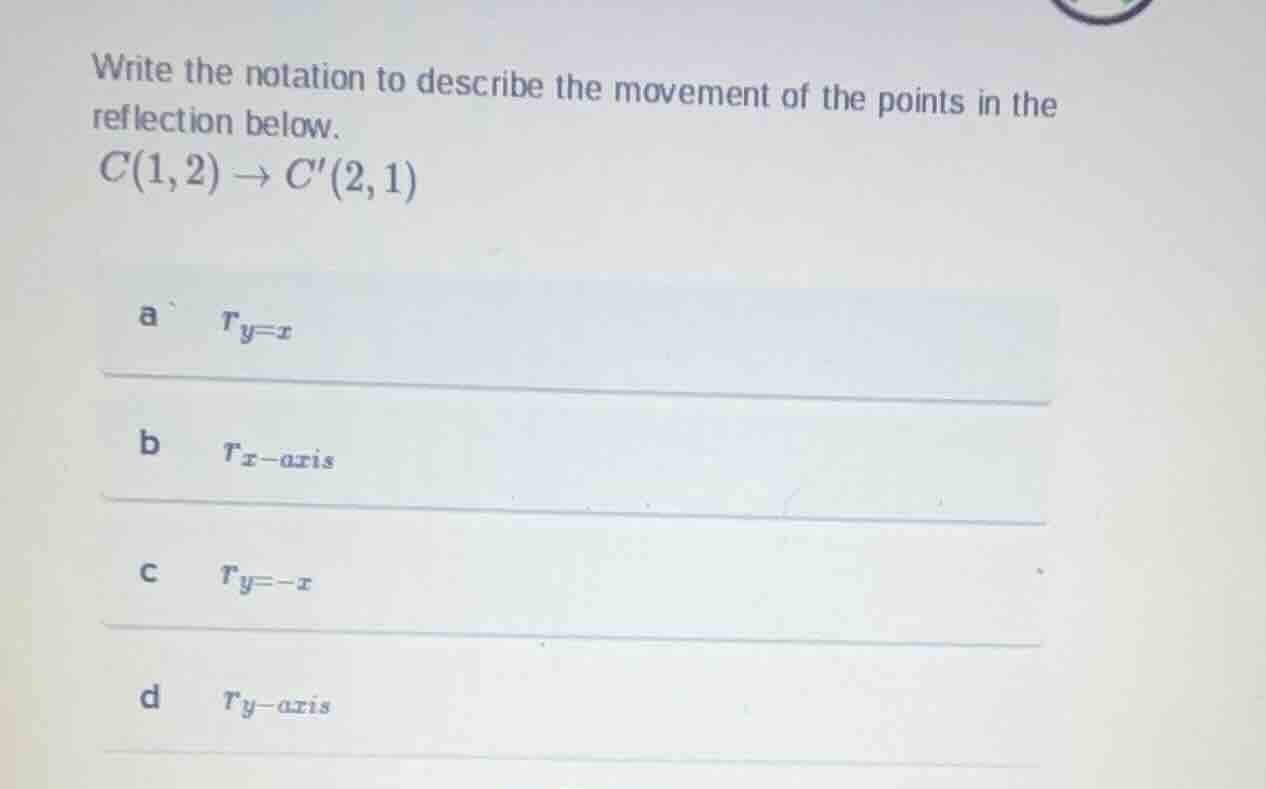
write the notation to describe the movement of the points in the reflection below. c(1,2)→c(2,1) a $r_{y = x}$ b $r_{x - axis}$ c $r_{y = -x}$ d $r_{y - axis}$
Brief Explanations
To determine the reflection notation, we analyze the transformation of point \( C(1,2) \) to \( C'(2,1) \). The reflection over the line \( y = x \) swaps the \( x \)- and \( y \)-coordinates of a point \((x,y)\) to \((y,x)\). For \( C(1,2) \), swapping the coordinates gives \( (2,1) \), which matches \( C' \).
- For reflection over the \( x \)-axis (\( r_{x\text{-axis}} \)), the transformation is \((x,y) \to (x, -y)\). Applying this to \( (1,2) \) would give \( (1, -2) \), not \( (2,1) \).
- For reflection over the line \( y = -x \) (\( r_{y=-x} \)), the transformation is \((x,y) \to (-y, -x)\). Applying this to \( (1,2) \) would give \( (-2, -1) \), not \( (2,1) \).
- For reflection over the \( y \)-axis (\( r_{y\text{-axis}} \)), the transformation is \((x,y) \to (-x, y)\). Applying this to \( (1,2) \) would give \( (-1, 2) \), not \( (2,1) \).
Thus, the correct reflection is over \( y = x \).

Snap & solve any problem in the app
Get step-by-step solutions on Sovi AI
Photo-based solutions with guided steps
Explore more problems and detailed explanations
a. \( r_{y=x} \)