QUESTION IMAGE
Question
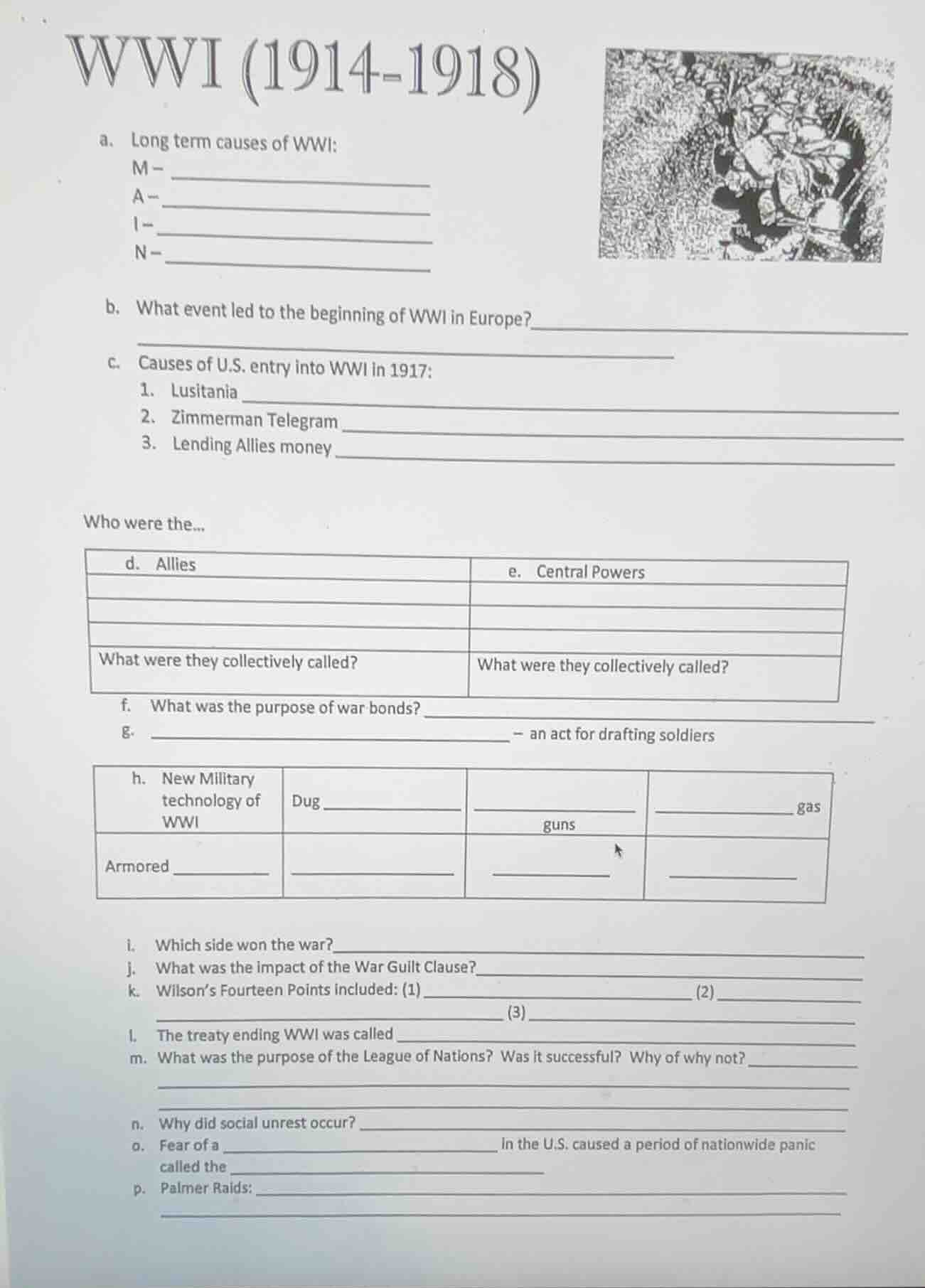
wwi (1914-1918)
a. long term causes of wwi:
m –
a –
i –
n –
b. what event led to the beginning of wwi in europe?
c. causes of u.s. entry into wwi in 1917:
- lusitania
- zimmerman telegram
- lending allies money
who were the...
d. allies
e. central powers
what were they collectively called?
what were they collectively called?
f. what was the purpose of war bonds?
g. – an act for drafting soldiers
h. new military technology of wwi
dug
guns
gas
armored
i. which side won the war?
j. what was the impact of the war guilt clause?
k. wilson’s fourteen points included: (1) (2)
(3)
l. the treaty ending wwi was called
m. what was the purpose of the league of nations? was it successful? why of why not?
n. why did social unrest occur?
o. fear of a in the u.s. caused a period of nationwide panic called the
p. palmer raids:
a. The M-A-I-N acronym stands for the four long-term causes of WWI.
b. This event was the immediate trigger that started the war.
c. Each listed factor pushed the U.S. to abandon neutrality.
d.-e. These were the two opposing military alliances in WWI.
f. War bonds were a financial tool for the war effort.
g. This was a U.S. federal law for military conscription.
h. These were key new weapons/tech of trench warfare.
i. The war concluded with the defeat of one alliance.
j. This clause assigned full blame for the war to one nation.
k. Wilson's points were a peace proposal framework.
l. This treaty formally ended the war in 1919.
m. The League was designed to prevent future wars.
n. Post-war hardships fueled public unrest.
o. This panic stemmed from anti-radical fears in the U.S.
p. These were government raids targeting radicals.

Snap & solve any problem in the app
Get step-by-step solutions on Sovi AI
Photo-based solutions with guided steps
Explore more problems and detailed explanations
a.
M - Militarism
A - Alliances
I - Imperialism
N - Nationalism
b. The assassination of Archduke Franz Ferdinand of Austria-Hungary (June 28, 1914, in Sarajevo)
c.
- Lusitania: The 1915 sinking of this British passenger ship by a German U-boat, killing 128 Americans, turned U.S. public opinion against Germany.
- Zimmerman Telegram: A 1917 secret German message to Mexico proposing an alliance against the U.S., which was intercepted and made public.
- Lending Allies money: The U.S. had provided massive loans to the Allies; an Allied defeat would have meant losing these funds.
d. Allies:
- Primary members: France, Great Britain, Russia (until 1917), United States (from 1917), Italy (from 1915)
- What were they collectively called? The Allied Powers (or Entente Powers)
e. Central Powers:
- Primary members: Germany, Austria-Hungary, Ottoman Empire, Bulgaria
- What were they collectively called? The Central Powers
f. To raise government funds to pay for the costs of World War I by borrowing money from citizens, with the promise of repayment with interest after the war.
g. Selective Service Act (1917)
h. New Military technology of WWI:
Dug trenches, machine guns, mustard/chemical gas
Armored tanks, airplanes/biplanes, submarines/U-boats, flamethrowers
i. The Allied Powers (Allies)
j. It forced Germany to accept full responsibility for causing WWI, which led to harsh reparations payments, territorial losses, and military restrictions against Germany; this resentment contributed to the rise of Nazi Germany and the outbreak of WWII.
k. Wilson’s Fourteen Points included: (1) Open diplomacy/no secret treaties (2) Freedom of the seas (3) Reduction of national armaments
l. Treaty of Versailles (signed in 1919)
m. Purpose: To promote international cooperation, resolve disputes peacefully, and prevent future global wars. It was not successful. The U.S. refused to join, it lacked enforcement power, and it failed to stop the rise of aggressive regimes in the 1930s, leading to WWII.
n. Social unrest occurred due to post-war economic hardships (inflation, unemployment), labor strikes over poor working conditions, tensions from rapid immigration, and political divisions over the war and socialism.
o. Fear of a communist/radical revolution in the U.S. caused a period of nationwide panic called the Red Scare
p. Palmer Raids: A series of 1919-1920 government raids led by Attorney General A. Mitchell Palmer that targeted suspected radicals, socialists, anarchists, and immigrants; thousands were arrested without proper warrants, and many immigrants were deported, violating civil liberties.