QUESTION IMAGE
Question
wwi introduction:
world war i, also known as the great war, started in 1914 after the assassination of archduke franz ferdinand of austria. his murder catapulted into a war across europe that lasted until 1918. during the four - year conflict, germany, austria - hungary, bulgaria and the ottoman empire (the central powers) fought against great britain, france, russia, italy, romania, canada, japan and the united states (the allied powers). thanks to new military technologies and the horrors of trench warfare, world war i saw unprecedented levels of carnage and destruction. by the time the war was over and the allied powers had won, more than 16 million people—soldiers and civilians alike—were dead.
why is it important to study wwi even though it took place over 100 years ago?
- militarism is the belief that a country should have a strong military capability and be prepared to use it aggressively to defend or promote its interests. leading up to world war i, imperial countries in europe were strong proponents of militarism. they spent more and more money on military technology, employing more troops, and training their soldiers. they found that to gain colonies it helped to be militarily superior to the people they colonized and the other industrialized countries they were competing
what is militarism? militarism is a belief of a country that should have a strong military capability
how could militarism cause wwi?
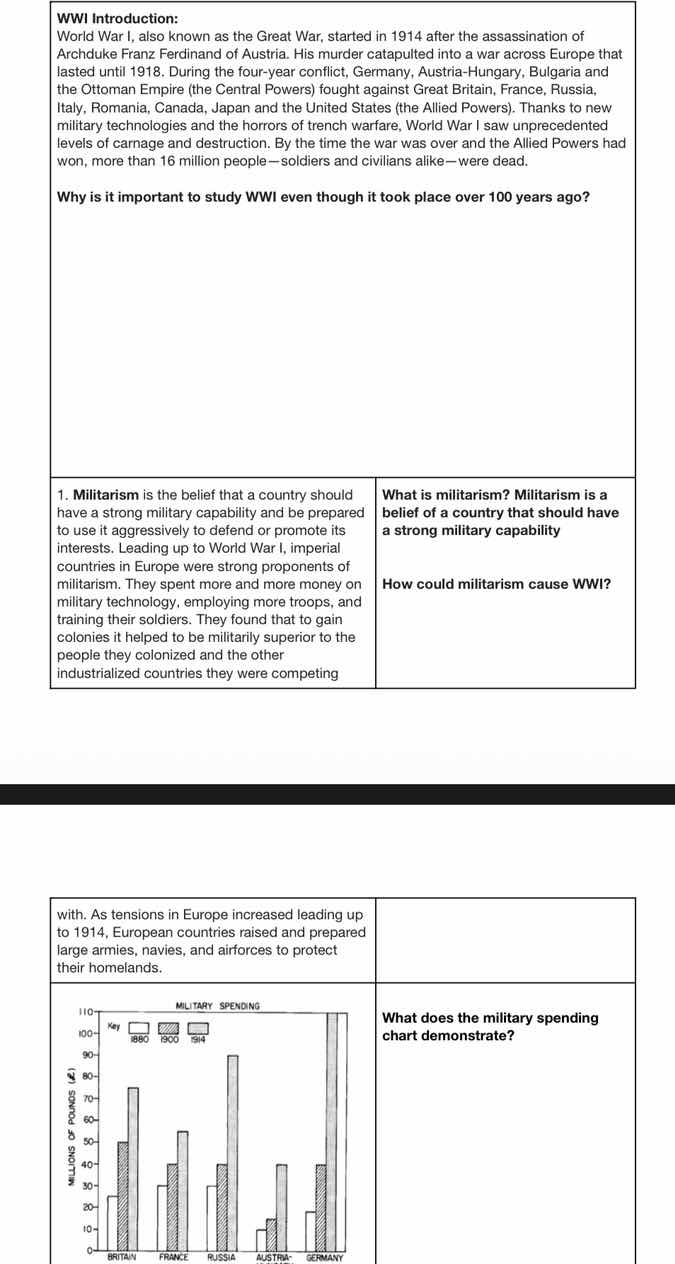
with. as tensions in europe increased leading up to 1914, european countries raised and prepared large armies, navies, and airforces to protect their homelands.
military spending
what does the military spending chart demonstrate?
- For "Why is it important to study WWI even though it took place over 100 years ago?":
WWI reshaped global political borders, created new nations, and laid the groundwork for WWII. It also spurred massive technological advancements in warfare, medicine, and communication that still impact modern society. Studying it helps understand the roots of modern international relations, conflict resolution, and the consequences of nationalism, militarism, and imperialism.
- For "How could militarism cause WWI?":
European nations' arms race and aggressive military posturing created a tense environment. When the assassination of Franz Ferdinand occurred, the strong military buildup meant countries had the forces and mindset to quickly escalate the conflict into a full-scale war, rather than resolving it diplomatically.
- For "What does the military spending chart demonstrate?":
The chart shows a sharp increase in military spending by major European powers (Britain, France, Russia, Austria-Hungary, Germany) between 1880 and 1914. This confirms the arms race driven by militarism, with all nations devoting more funds to their militaries, which heightened pre-war tensions.

Snap & solve any problem in the app
Get step-by-step solutions on Sovi AI
Photo-based solutions with guided steps
Explore more problems and detailed explanations
- Studying WWI is important because it shaped modern geopolitics, drove impactful technological progress, and provides critical lessons on the dangers of extreme nationalism, militarism, and imperialism, helping inform modern conflict resolution and international relations.
- Militarism caused WWI by fueling an intense European arms race, creating a hostile, tense atmosphere where a single diplomatic crisis (the assassination of Franz Ferdinand) could quickly escalate into a large-scale, global war due to nations' aggressive military preparedness and posturing.
- The military spending chart demonstrates that major European powers drastically increased their military expenditures between 1880 and 1914, proving the militarism-fueled arms race that heightened pre-WWI tensions.