QUESTION IMAGE
Question
x-linked recessive traits
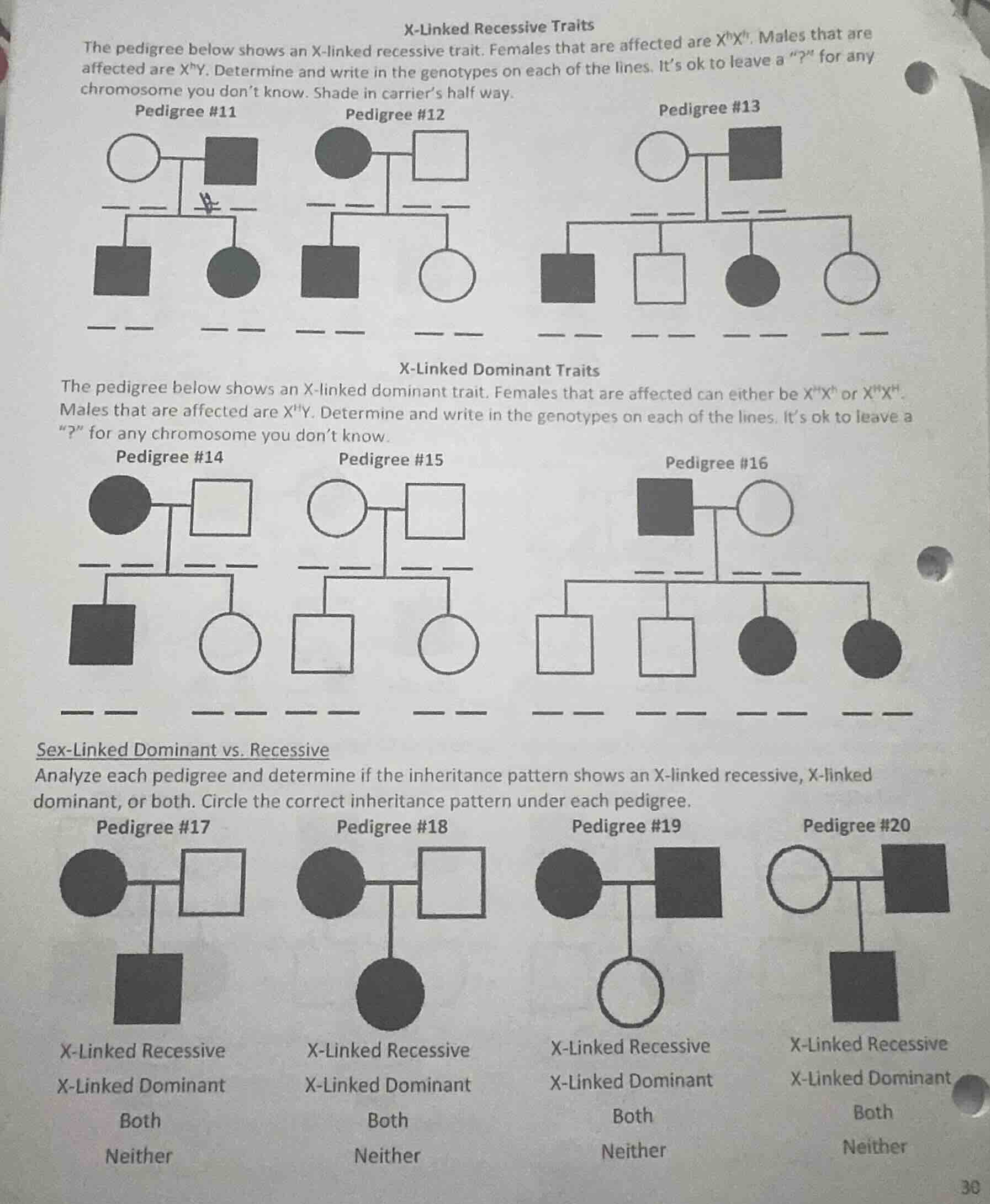
the pedigree below shows an x-linked recessive trait. females that are affected are $x^hx^h$. males that are affected are $x^hy$. determine and write in the genotypes on each of the lines. its ok to leave a \?\ for any chromosome you dont know. shade in carriers half way.
pedigree #11
pedigree #12
pedigree #13
x-linked dominant traits
the pedigree below shows an x-linked dominant trait. females that are affected can either be $x^hx^h$ or $x^hx^h$. males that are affected are $x^hy$. determine and write in the genotypes on each of the lines. its ok to leave a \?\ for any chromosome you dont know.
pedigree #14
pedigree #15
pedigree #16
sex-linked dominant vs. recessive
analyze each pedigree and determine if the inheritance pattern shows an x-linked recessive, x-linked dominant, or both. circle the correct inheritance pattern under each pedigree.
pedigree #17
x-linked recessive
x-linked dominant
both
neither
pedigree #18
x-linked recessive
x-linked dominant
both
neither
pedigree #19
x-linked recessive
x-linked dominant
both
neither
pedigree #20
x-linked recessive
x-linked dominant
both
neither
---
X-Linked Recessive Traits (Pedigrees #11, #12, #13)
Pedigree #11
Step1: Assign father's genotype
Affected male: $X^hY$
Step2: Assign mother's genotype
Unaffected female (carrier, since she has affected children): $X^HX^h$
Step3: Assign son's genotype
Affected male: $X^hY$
Step4: Assign daughter's genotype
Affected female: $X^hX^h$
Pedigree #12
Step1: Assign mother's genotype
Affected female: $X^hX^h$
Step2: Assign father's genotype
Unaffected male: $X^HY$
Step3: Assign son's genotype
Affected male: $X^hY$
Step4: Assign daughter's genotype
Unaffected female (carrier): $X^HX^h$
Pedigree #13
Step1: Assign father's genotype
Affected male: $X^hY$
Step2: Assign mother's genotype
Unaffected female (carrier, since she has affected children): $X^HX^h$
Step3: Assign son 1 genotype
Affected male: $X^hY$
Step4: Assign son 2 genotype
Unaffected male: $X^HY$
Step5: Assign daughter 1 genotype
Affected female: $X^hX^h$
Step6: Assign daughter 2 genotype
Unaffected female (carrier): $X^HX^h$
---
X-Linked Dominant Traits (Pedigrees #14, #15, #16)
Pedigree #14
Step1: Assign mother's genotype
Affected female: $X^HX^h$ (since children are unaffected)
Step2: Assign father's genotype
Unaffected male: $X^hY$
Step3: Assign son's genotype
Affected male: $X^HY$
Step4: Assign daughter's genotype
Unaffected female: $X^hX^h$
Pedigree #15
Step1: Assign mother's genotype
Unaffected female: $X^hX^h$
Step2: Assign father's genotype
Unaffected male: $X^hY$
Step3: Assign son's genotype
Unaffected male: $X^hY$
Step4: Assign daughter's genotype
Unaffected female: $X^hX^h$
Pedigree #16
Step1: Assign father's genotype
Affected male: $X^HY$
Step2: Assign mother's genotype
Unaffected female: $X^hX^h$
Step3: Assign son 1 genotype
Unaffected male: $X^hY$
Step4: Assign son 2 genotype
Unaffected male: $X^hY$
Step5: Assign daughter 1 genotype
Affected female: $X^HX^h$
Step6: Assign daughter 2 genotype
Affected female: $X^HX^h$
---
Sex-Linked Dominant vs. Recessive (Pedigrees #17-#20)
Pedigree #17
Step1: Analyze inheritance pattern
Affected mother passes trait to son; unaffected father cannot pass X-linked recessive to son. This matches X-linked dominant.
Pedigree #18
Step1: Analyze inheritance pattern
Affected mother passes trait to daughter; unaffected father. This matches X-linked dominant (X-linked recessive would require father to be affected for affected daughter).
Pedigree #19
Step1: Analyze inheritance pattern
Affected mother and father have unaffected daughter. X-linked dominant would mean all daughters inherit father's $X^H$, so this cannot be dominant. X-linked recessive: affected mother ($X^hX^h$) and affected father ($X^hY$) would only have affected children, which does not match. So this fits neither.
Pedigree #20
Step1: Analyze inheritance pattern
Unaffected mother and affected father have affected son. X-linked dominant: father would pass $X^H$ to daughters, not sons; X-linked recessive: mother would need to be carrier to pass $X^h$ to son, which is possible. This matches X-linked recessive.
---

Snap & solve any problem in the app
Get step-by-step solutions on Sovi AI
Photo-based solutions with guided steps
Explore more problems and detailed explanations
X-Linked Recessive Genotypes:
- Pedigree #11
- Mother: $X^HX^h$, Father: $X^hY$
- Son: $X^hY$, Daughter: $X^hX^h$
- Pedigree #12
- Mother: $X^hX^h$, Father: $X^HY$
- Son: $X^hY$, Daughter: $X^HX^h$
- Pedigree #13
- Mother: $X^HX^h$, Father: $X^hY$
- Son 1: $X^hY$, Son 2: $X^HY$, Daughter 1: $X^hX^h$, Daughter 2: $X^HX^h$
X-Linked Dominant Genotypes:
- Pedigree #14
- Mother: $X^HX^h$, Father: $X^hY$
- Son: $X^HY$, Daughter: $X^hX^h$
- Pedigree #15
- Mother: $X^hX^h$, Father: $X^hY$
- Son: $X^hY$, Daughter: $X^hX^h$
- Pedigree #16
- Father: $X^HY$, Mother: $X^hX^h$
- Son 1: $X^hY$, Son 2: $X^hY$, Daughter 1: $X^HX^h$, Daughter 2: $X^HX^h$
Sex-Linked Pattern Classification:
- Pedigree #17: X-Linked Dominant
- Pedigree #18: X-Linked Dominant
- Pedigree #19: Neither
- Pedigree #20: X-Linked Recessive
(Note: For carrier females in X-linked recessive pedigrees, their symbols should be shaded halfway.)