QUESTION IMAGE
Question
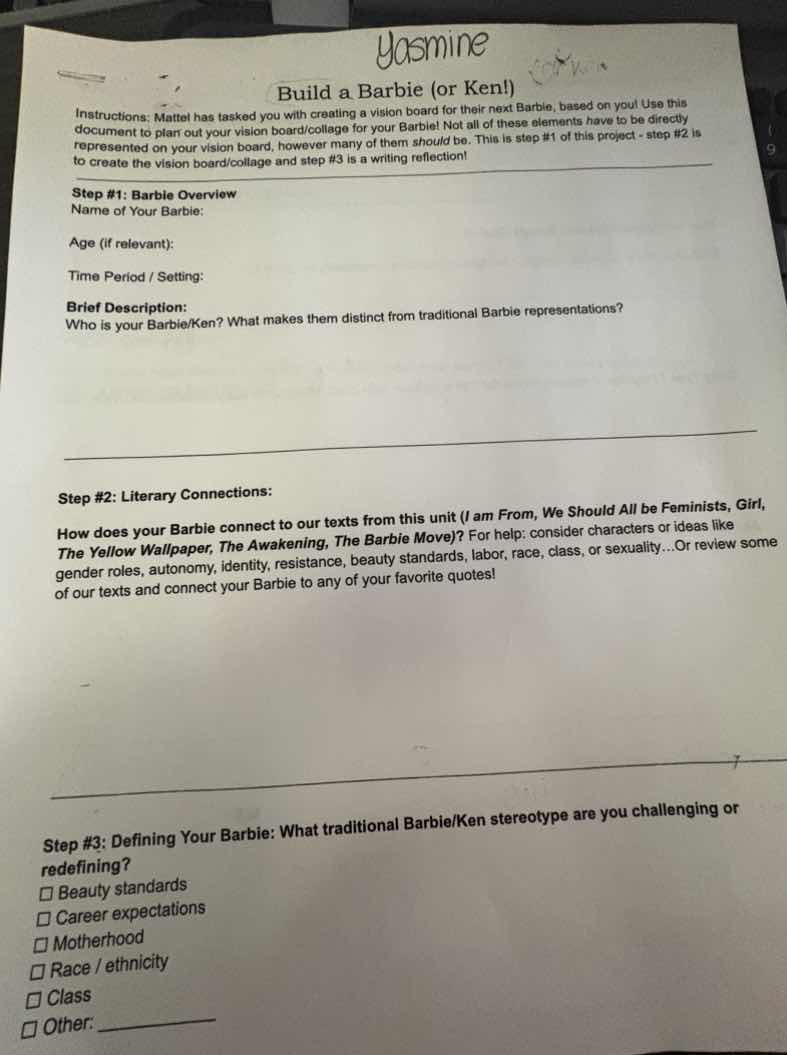
yasmine
build a barbie (or ken!)
instructions: mattel has tasked you with creating a vision board for their next barbie, based on you! use this document to plan out your vision board/collage for your barbie! not all of these elements have to be directly represented on your vision board, however many of them should be. this is step #1 of this project - step #2 is to create the vision board/collage and step #3 is a writing reflection!
step #1: barbie overview
name of your barbie:
age (if relevant):
time period / setting:
brief description:
who is your barbie/ken? what makes them distinct from traditional barbie representations?
step #2: literary connections:
how does your barbie connect to our texts from this unit (i am from, we should all be feminists, girl, the yellow wallpaper, the awakening, the barbie move)? for help: consider characters or ideas like gender roles, autonomy, identity, resistance, beauty standards, labor, race, class, or sexuality...or review some of our texts and connect your barbie to any of your favorite quotes!
step #3: defining your barbie: what traditional barbie/ken stereotype are you challenging or redefining?
☐ beauty standards
☐ career expectations
☐ motherhood
☐ race / ethnicity
☐ class
☐ other: ______
This document is a project outline for creating a vision board and related reflections for a new Barbie/Ken, with steps involving overview, literary connections, and redefining stereotypes. Since it involves literary analysis and connections (Step #2 references texts like "We Should All be Feminists", "The Yellow Wallpaper", etc.), the subfield under Arts is Literature.
Step #1: Barbie Overview (Example Filling)
- Name of Your Barbie: Dr. Amara Barbie
- Age (if relevant): 32
- Time Period / Setting: Modern-day, a bustling urban research lab and community outreach centers
- Brief Description: Dr. Amara Barbie is a biomedical researcher and community health advocate. She’s distinct from traditional Barbies as she’s deeply immersed in STEM (Science, Technology, Engineering, Mathematics) fields, focusing on developing affordable medical technologies for underserved communities. She wears lab coats with colorful, inclusive patches representing different cultures she works with, and her accessories include a miniature microscope, a tablet with medical research data, and a backpack filled with health education materials for community workshops.
Step #2: Literary Connections (Example Filling)
Dr. Amara Barbie connects to “We Should All be Feminists” by Chimamanda Ngozi Adichie through her focus on breaking gender and racial barriers in STEM. Adichie’s text emphasizes the need for women to occupy spaces traditionally dominated by men, and Dr. Amara, as a Black female scientist, embodies this by leading research teams and advocating for equitable healthcare—challenging the idea that STEM is a “male domain” and that beauty standards (like traditional Barbie’s hyper-feminine, often Eurocentric look) should overshadow intellectual and altruistic pursuits. She also mirrors the autonomy and resistance to societal expectations seen in The Awakening’s Edna Pontellier, as both reject confining roles (Edna rejecting domesticity, Amara rejecting the stereotype that women in STEM must downplay their femininity or conform to narrow racial norms).
Step #3: Defining Your Barbie (Example Selection and Explanation)
- Stereotype Challenged/Redefined: ☐ Beauty standards, ☐ Career expectations, ☐ Motherhood, ☑ Race / ethnicity, ☐ Class, ☐ Other:
By choosing “Race / ethnicity”, Dr. Amara Barbie challenges the stereotype that STEM leaders are predominantly white or male. Traditional Barbies have often centered Eurocentric beauty and career narratives (like fashion, modeling, or “girly” professions). Dr. Amara, as a Black woman in biomedical research, redefines what a “successful” Barbie can look like—she has natural hair styled in protective braids, wears cultural jewelry under her lab coat, and prioritizes community care in BIPOC (Black, Indigenous, and People of Color) neighborhoods, showing that racial identity and cultural heritage are assets in science and leadership, not limitations.
If you want to fill it differently (e.g., focusing on beauty standards, career expectations, etc.), here’s another example for “Beauty Standards”:
- Stereotype Challenged/Redefined: ☑ Beauty standards, ☐ Career expectations, ☐ Motherhood, ☐ Race / ethnicity, ☐ Class, ☐ Other:
Dr. Amara Barbie has a muscular build (from lifting lab equipment and doing community outreach in active environments), stretch marks, and vitiligo—challenging the traditional Barbie’s airbrushed, hyper-slim, and “flawless” look. She shows that beauty includes diverse body types, skin conditions, and the strength gained from physical labor in STEM and comm…

Snap & solve any problem in the app
Get step-by-step solutions on Sovi AI
Photo-based solutions with guided steps
Explore more problems and detailed explanations
This document is a project outline for creating a vision board and related reflections for a new Barbie/Ken, with steps involving overview, literary connections, and redefining stereotypes. Since it involves literary analysis and connections (Step #2 references texts like "We Should All be Feminists", "The Yellow Wallpaper", etc.), the subfield under Arts is Literature.
Step #1: Barbie Overview (Example Filling)
- Name of Your Barbie: Dr. Amara Barbie
- Age (if relevant): 32
- Time Period / Setting: Modern-day, a bustling urban research lab and community outreach centers
- Brief Description: Dr. Amara Barbie is a biomedical researcher and community health advocate. She’s distinct from traditional Barbies as she’s deeply immersed in STEM (Science, Technology, Engineering, Mathematics) fields, focusing on developing affordable medical technologies for underserved communities. She wears lab coats with colorful, inclusive patches representing different cultures she works with, and her accessories include a miniature microscope, a tablet with medical research data, and a backpack filled with health education materials for community workshops.
Step #2: Literary Connections (Example Filling)
Dr. Amara Barbie connects to “We Should All be Feminists” by Chimamanda Ngozi Adichie through her focus on breaking gender and racial barriers in STEM. Adichie’s text emphasizes the need for women to occupy spaces traditionally dominated by men, and Dr. Amara, as a Black female scientist, embodies this by leading research teams and advocating for equitable healthcare—challenging the idea that STEM is a “male domain” and that beauty standards (like traditional Barbie’s hyper-feminine, often Eurocentric look) should overshadow intellectual and altruistic pursuits. She also mirrors the autonomy and resistance to societal expectations seen in The Awakening’s Edna Pontellier, as both reject confining roles (Edna rejecting domesticity, Amara rejecting the stereotype that women in STEM must downplay their femininity or conform to narrow racial norms).
Step #3: Defining Your Barbie (Example Selection and Explanation)
- Stereotype Challenged/Redefined: ☐ Beauty standards, ☐ Career expectations, ☐ Motherhood, ☑ Race / ethnicity, ☐ Class, ☐ Other:
By choosing “Race / ethnicity”, Dr. Amara Barbie challenges the stereotype that STEM leaders are predominantly white or male. Traditional Barbies have often centered Eurocentric beauty and career narratives (like fashion, modeling, or “girly” professions). Dr. Amara, as a Black woman in biomedical research, redefines what a “successful” Barbie can look like—she has natural hair styled in protective braids, wears cultural jewelry under her lab coat, and prioritizes community care in BIPOC (Black, Indigenous, and People of Color) neighborhoods, showing that racial identity and cultural heritage are assets in science and leadership, not limitations.
If you want to fill it differently (e.g., focusing on beauty standards, career expectations, etc.), here’s another example for “Beauty Standards”:
- Stereotype Challenged/Redefined: ☑ Beauty standards, ☐ Career expectations, ☐ Motherhood, ☐ Race / ethnicity, ☐ Class, ☐ Other:
Dr. Amara Barbie has a muscular build (from lifting lab equipment and doing community outreach in active environments), stretch marks, and vitiligo—challenging the traditional Barbie’s airbrushed, hyper-slim, and “flawless” look. She shows that beauty includes diverse body types, skin conditions, and the strength gained from physical labor in STEM and community work, not just a polished, unrealistic ideal.