QUESTION IMAGE
Question
yes
no
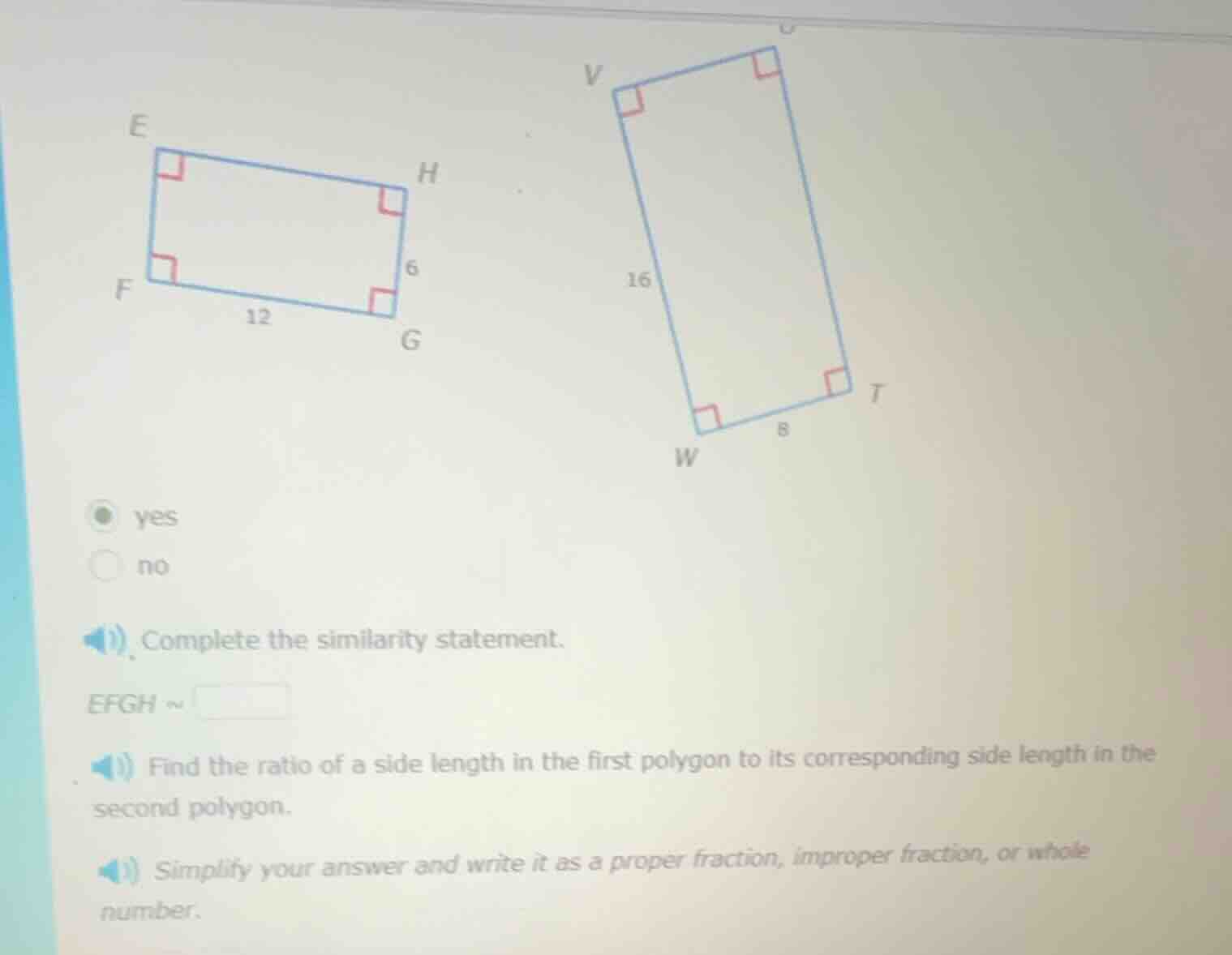
complete the similarity statement.
efgh ~
find the ratio of a side length in the first polygon to its corresponding side length in the second polygon.
simplify your answer and write it as a proper fraction, improper fraction, or whole number.
Part 1: Complete the similarity statement
To determine the similarity statement, we need to match the corresponding sides of the similar rectangles. For rectangle \(EFGH\), the sides are \(12\) (length) and \(6\) (width). For rectangle \(VWTC\) (assuming the vertices are \(V\), \(W\), \(T\), \(C\) with sides \(16\) and \(8\)), we check the ratios. The ratio of \(EFGH\)'s length to \(VWTC\)'s width is \(\frac{12}{8}=\frac{3}{2}\), and the ratio of \(EFGH\)'s width to \(VWTC\)'s length is \(\frac{6}{16}=\frac{3}{8}\)? Wait, no, actually, we need to match corresponding sides. Wait, rectangle \(EFGH\) has length \(12\) and width \(6\), rectangle \(WTVC\) (let's check the sides: \(W\) to \(T\) is \(8\), \(W\) to \(V\) is \(16\)). So the ratio of \(EFGH\)'s length (\(12\)) to \(WTVC\)'s length (\(16\))? No, wait, maybe the correspondence is \(EFGH\) ~ \(WTWV\)? Wait, no, let's see the angles. All rectangles have right angles, so they are similar if the sides are proportional. Let's find the ratio of corresponding sides. For \(EFGH\), sides are \(12\) and \(6\). For the other rectangle, sides are \(8\) and \(16\). Let's check \(\frac{12}{16}=\frac{3}{4}\) and \(\frac{6}{8}=\frac{3}{4}\). Ah, there we go. So \(EFGH\) ~ \(WTWV\)? Wait, the vertices of the second rectangle: \(W\), \(T\), \(C\), \(V\) (assuming \(C\) is the top right). Wait, the second rectangle has vertices \(V\), \(W\), \(T\), \(C\) (with right angles at \(V\), \(W\), \(T\), \(C\)). So the sides: \(VW = 16\), \(WT = 8\), \(TC = 16\), \(CV = 8\)? No, wait, in a rectangle, opposite sides are equal. So \(EFGH\) has \(EF = 6\), \(FG = 12\), \(GH = 6\), \(HE = 12\). The other rectangle: \(VW = 16\), \(WT = 8\), \(TC = 16\), \(CV = 8\). So the ratio of \(EF\) (6) to \(WT\) (8) is \(\frac{6}{8}=\frac{3}{4}\), and \(FG\) (12) to \(VW\) (16) is \(\frac{12}{16}=\frac{3}{4}\). So the correspondence is \(EFGH\) ~ \(WTWV\)? Wait, no, the similarity statement should match the order of vertices. So \(E\) corresponds to \(W\), \(F\) to \(T\), \(G\) to \(V\), \(H\) to \(C\)? Wait, maybe the correct correspondence is \(EFGH\) ~ \(WTWV\) is not right. Wait, let's list the vertices:
Rectangle \(EFGH\): \(E\) (top left), \(F\) (bottom left), \(G\) (bottom right), \(H\) (top right).
Rectangle \(VWTC\): \(V\) (top left), \(W\) (bottom left), \(T\) (bottom right), \(C\) (top right).
So \(E\) (top left) corresponds to \(W\) (bottom left)? No, maybe the other way. Wait, the side \(FG\) is \(12\) (bottom side), \(GH\) is \(6\) (right side). The other rectangle: \(WT\) is \(8\) (bottom side), \(WV\) is \(16\) (left side). So the ratio of \(FG\) (12) to \(WT\) (8) is \(\frac{12}{8}=\frac{3}{2}\), and \(GH\) (6) to \(WV\) (16) is \(\frac{6}{16}=\frac{3}{8}\)? No, that can't be. Wait, maybe I got the sides wrong. Wait, in rectangle \(EFGH\), \(FG = 12\) (length), \(GH = 6\) (width). In the other rectangle, \(WT = 8\) (length), \(WV = 16\) (width). Wait, no, width and length. Wait, maybe the first rectangle has length \(12\) and width \(6\), the second has length \(16\) and width \(8\). Then the ratio of length to length is \(\frac{12}{16}=\frac{3}{4}\), and width to width is \(\frac{6}{8}=\frac{3}{4}\). So the correspondence is \(EFGH\) ~ \(WTWV\)? Wait, no, the similarity statement should be \(EFGH\) ~ \(WTWV\)? Wait, maybe the correct correspondence is \(EFGH\) ~ \(WTVC\) (with \(W\), \(T\), \(V\), \(C\))? Wait, perhaps the second rectangle is \(WTVC\) with \(W\) to \(T\) is \(8\), \(T\) to \(C\) is \(16\), \(C\) to \(V\) is \(8\), \(V\) to \(W\) is \(16\). So then \(EFGH\) (length \(12\), width \(6\)) and \(WTVC\) (length \(16\), width \(8\)…
Step 1: Identify corresponding sides
In rectangle \(EFGH\), let's take side \(FG = 12\) (length) and in the second rectangle (let's say \(WTVC\)), the corresponding side (after rotation) would be \(TV = 16\)? Wait, no, earlier we saw the ratio of width to width or length to length. Wait, \(EFGH\) has width \(6\) and length \(12\), the second rectangle has width \(8\) and length \(16\). So the ratio of \(EFGH\)'s width (\(6\)) to the second rectangle's width (\(8\)) is \(\frac{6}{8}=\frac{3}{4}\), and the ratio of \(EFGH\)'s length (\(12\)) to the second rectangle's length (\(16\)) is \(\frac{12}{16}=\frac{3}{4}\). So we can take either pair of corresponding sides. Let's take \(FG = 12\) (first polygon) and \(TV = 16\) (second polygon)? No, wait, maybe the corresponding sides are \(GH = 6\) (first) and \(WT = 8\) (second). Then the ratio is \(\frac{6}{8}=\frac{3}{4}\), or \(FG = 12\) and \(WV = 16\) (if \(WV\) is the corresponding length), then \(\frac{12}{16}=\frac{3}{4}\).
Step 2: Simplify the ratio
Take the ratio of \(6\) (from \(EFGH\)) to \(8\) (from the second rectangle). \(\frac{6}{8}=\frac{3}{4}\). Or \(12\) to \(16\), which is also \(\frac{3}{4}\).

Snap & solve any problem in the app
Get step-by-step solutions on Sovi AI
Photo-based solutions with guided steps
Explore more problems and detailed explanations
\(EFGH \sim WTVC\) (assuming the second rectangle's vertices are \(W\), \(T\), \(V\), \(C\))