QUESTION IMAGE
Question
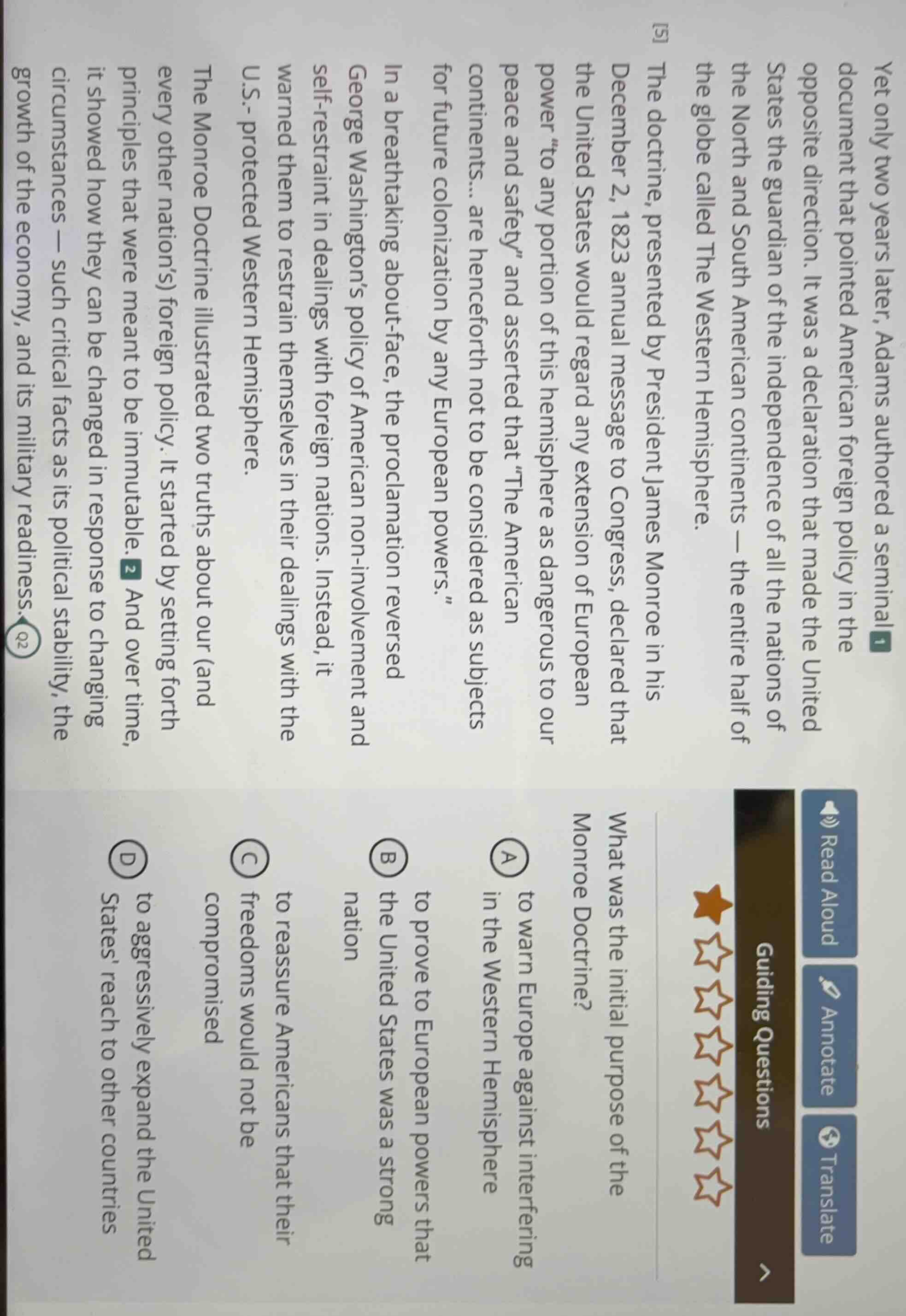
yet only two years later, adams authored a seminal document that pointed american foreign policy in the opposite direction. it was a declaration that made the united states the guardian of the independence of all the nations of the north and south american continents — the entire half of the globe called the western hemisphere. the doctrine, presented by president james monroe in his december 2, 1823 annual message to congress, declared that the united states would regard any extension of european power “to any portion of this hemisphere as dangerous to our peace and safety” and asserted that “the american continents... are henceforth not to be considered as subjects for future colonization by any european powers.” in a breathtaking about - face, the proclamation reversed george washington’s policy of american non - involvement and self - restraint in dealings with foreign nations. instead, it warned them to restrain themselves in their dealings with the u.s. - protected western hemisphere. the monroe doctrine illustrated two truths about our (and every other nation’s) foreign policy. it started by setting forth principles that were meant to be immutable. and over time, it showed how they can be changed in response to changing circumstances — such critical facts as its political stability, the growth of the economy, and its military readiness. guiding questions what was the initial purpose of the monroe doctrine? a to warn europe against interfering in the western hemisphere b to prove to european powers that the united states was a strong nation c to reassure americans that their freedoms would not be compromised d to aggressively expand the united states reach to other countries
The Monroe Doctrine, presented by James Monroe, stated that the US would regard European power extension in the Americas as a danger and that the Americas were not for future European colonization. Option A matches this: it was to warn Europe against interfering in the Western Hemisphere. Option B is incorrect as the doctrine wasn't to prove US strength. Option C is wrong as it's about foreign policy, not domestic freedoms. Option D is incorrect as the doctrine was about non - interference, not aggressive expansion.

Snap & solve any problem in the app
Get step-by-step solutions on Sovi AI
Photo-based solutions with guided steps
Explore more problems and detailed explanations
A. to warn Europe against interfering in the Western Hemisphere