QUESTION IMAGE
Question
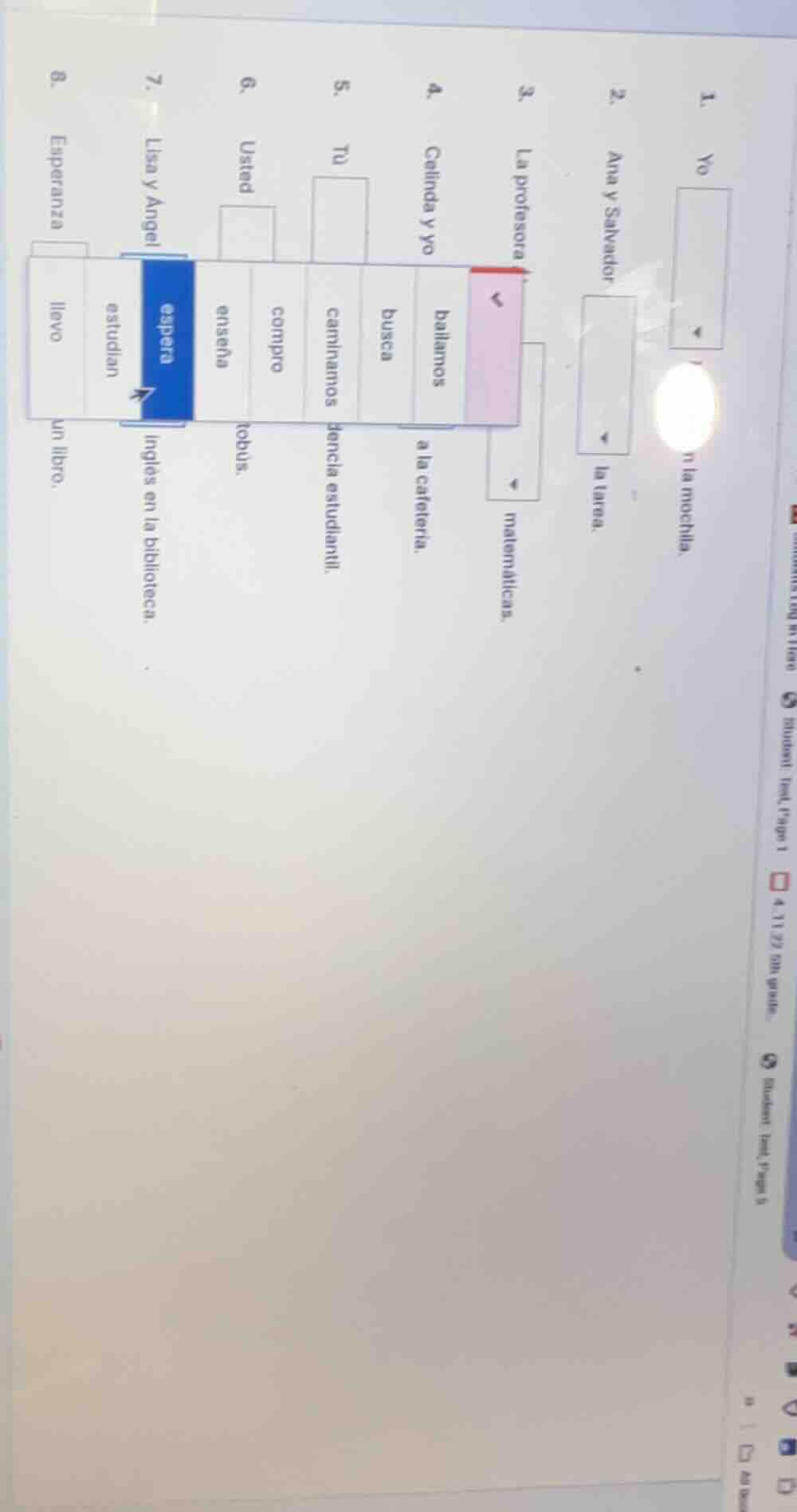
- yo n la mochila.
- ana y salvador la tarea.
- la profesora matemáticas.
- celinda y yo a la cafetería. busc a la cafetería.
- tú caminamos dencia estudiantil. caminamos dencia estudiantil.
- usted enseña compro enseña compro tobus. tobus.
- lisa y ángel espera estudian espera estudian inglés en la biblioteca.
- esperanza llevo estudian llevo estudian un libro.
To solve these Spanish verb - subject agreement problems, we analyze each sentence based on the subject's person (first, second, third) and number (singular, plural), and then select the appropriate verb form.
1. Subject: "Yo" (First - person singular)
The action is related to having something in the backpack. The correct verb for "yo" (I) in the present tense for the verb "llevar" (to carry/have) is "llevo". So the sentence is "Yo llevo un libro en la mochila."
2. Subject: "Ana y Salvador" (Third - person plural, they)
The action is doing the homework. The correct verb for a third - person plural subject (ellos/ellas) for the verb "hacer" (to do) is "hacen". So the sentence is "Ana y Salvador hacen la tarea."
3. Subject: "La profesora" (Third - person singular, she)
The action is teaching mathematics. The correct verb for a third - person singular feminine subject for the verb "enseñar" (to teach) is "enseña". So the sentence is "La profesora enseña matemáticas."
4. Subject: "Celinda y yo" (First - person plural, we)
The action is going to the cafeteria. The correct verb for a first - person plural subject (nosotros/nosotras) for the verb "ir" (to go) is "vamos". Wait, but in the given options, we have "buscamos"? No, wait, the original verb in the box is "busca" (third - person singular) but for "Celinda y yo" (we), it should be "buscamos". Wait, maybe the verb is "buscar" (to look for). So "Celinda y yo buscamos a la cafetería." (But actually, "ir a la cafetería" is "vamos a la cafetería", but based on the given verb "busca", we adjust it to the first - person plural form "buscamos".)
5. Subject: "Tú" (Second - person singular, you)
The action is walking in the student center. The correct verb for "tú" (you, singular) for the verb "caminar" (to walk) is "caminas". Wait, the given verb in the box is "caminamos" (first - person plural). So we correct it. The sentence should be "Tú caminas en la dependencia estudiantil."
6. Subject: "Usted" (Formal second - person singular, you)
The action is buying a bus ticket? Wait, the verb in the box is "compra" (third - person singular, he/she/you formal buys). So "Usted compra un billete de autobús." (Assuming "tobus" is a typo for "autobús").
7. Subject: "Lisa y Ángel" (Third - person plural, they)
The action is waiting? No, the given verb is "espera" (third - person singular) but for "Lisa y Ángel" (they), it should be "esperan". Wait, the original sentence has "espera" highlighted, but that's incorrect. The correct verb is "esperan". So "Lisa y Ángel esperan en la biblioteca." (But the original has "estudian", which is also correct for studying English. Maybe there was a mix - up. If we go with the verb "espera", we need to correct it to "esperan" for the plural subject.)
8. Subject: "Esperanza" (Third - person singular, she)
The action is carrying a book. The correct verb for "Esperanza" (she) for the verb "llevar" (to carry) is "lleva". So the sentence is "Esperanza lleva un libro."
Final Answers (Filling in the blanks):
- llevo
- hacen
- enseña
- buscamos
- caminas
- compra
- esperan (or estudian, depending on the intended action)
- lleva

Snap & solve any problem in the app
Get step-by-step solutions on Sovi AI
Photo-based solutions with guided steps
Explore more problems and detailed explanations
To solve these Spanish verb - subject agreement problems, we analyze each sentence based on the subject's person (first, second, third) and number (singular, plural), and then select the appropriate verb form.
1. Subject: "Yo" (First - person singular)
The action is related to having something in the backpack. The correct verb for "yo" (I) in the present tense for the verb "llevar" (to carry/have) is "llevo". So the sentence is "Yo llevo un libro en la mochila."
2. Subject: "Ana y Salvador" (Third - person plural, they)
The action is doing the homework. The correct verb for a third - person plural subject (ellos/ellas) for the verb "hacer" (to do) is "hacen". So the sentence is "Ana y Salvador hacen la tarea."
3. Subject: "La profesora" (Third - person singular, she)
The action is teaching mathematics. The correct verb for a third - person singular feminine subject for the verb "enseñar" (to teach) is "enseña". So the sentence is "La profesora enseña matemáticas."
4. Subject: "Celinda y yo" (First - person plural, we)
The action is going to the cafeteria. The correct verb for a first - person plural subject (nosotros/nosotras) for the verb "ir" (to go) is "vamos". Wait, but in the given options, we have "buscamos"? No, wait, the original verb in the box is "busca" (third - person singular) but for "Celinda y yo" (we), it should be "buscamos". Wait, maybe the verb is "buscar" (to look for). So "Celinda y yo buscamos a la cafetería." (But actually, "ir a la cafetería" is "vamos a la cafetería", but based on the given verb "busca", we adjust it to the first - person plural form "buscamos".)
5. Subject: "Tú" (Second - person singular, you)
The action is walking in the student center. The correct verb for "tú" (you, singular) for the verb "caminar" (to walk) is "caminas". Wait, the given verb in the box is "caminamos" (first - person plural). So we correct it. The sentence should be "Tú caminas en la dependencia estudiantil."
6. Subject: "Usted" (Formal second - person singular, you)
The action is buying a bus ticket? Wait, the verb in the box is "compra" (third - person singular, he/she/you formal buys). So "Usted compra un billete de autobús." (Assuming "tobus" is a typo for "autobús").
7. Subject: "Lisa y Ángel" (Third - person plural, they)
The action is waiting? No, the given verb is "espera" (third - person singular) but for "Lisa y Ángel" (they), it should be "esperan". Wait, the original sentence has "espera" highlighted, but that's incorrect. The correct verb is "esperan". So "Lisa y Ángel esperan en la biblioteca." (But the original has "estudian", which is also correct for studying English. Maybe there was a mix - up. If we go with the verb "espera", we need to correct it to "esperan" for the plural subject.)
8. Subject: "Esperanza" (Third - person singular, she)
The action is carrying a book. The correct verb for "Esperanza" (she) for the verb "llevar" (to carry) is "lleva". So the sentence is "Esperanza lleva un libro."
Final Answers (Filling in the blanks):
- llevo
- hacen
- enseña
- buscamos
- caminas
- compra
- esperan (or estudian, depending on the intended action)
- lleva