QUESTION IMAGE
Question
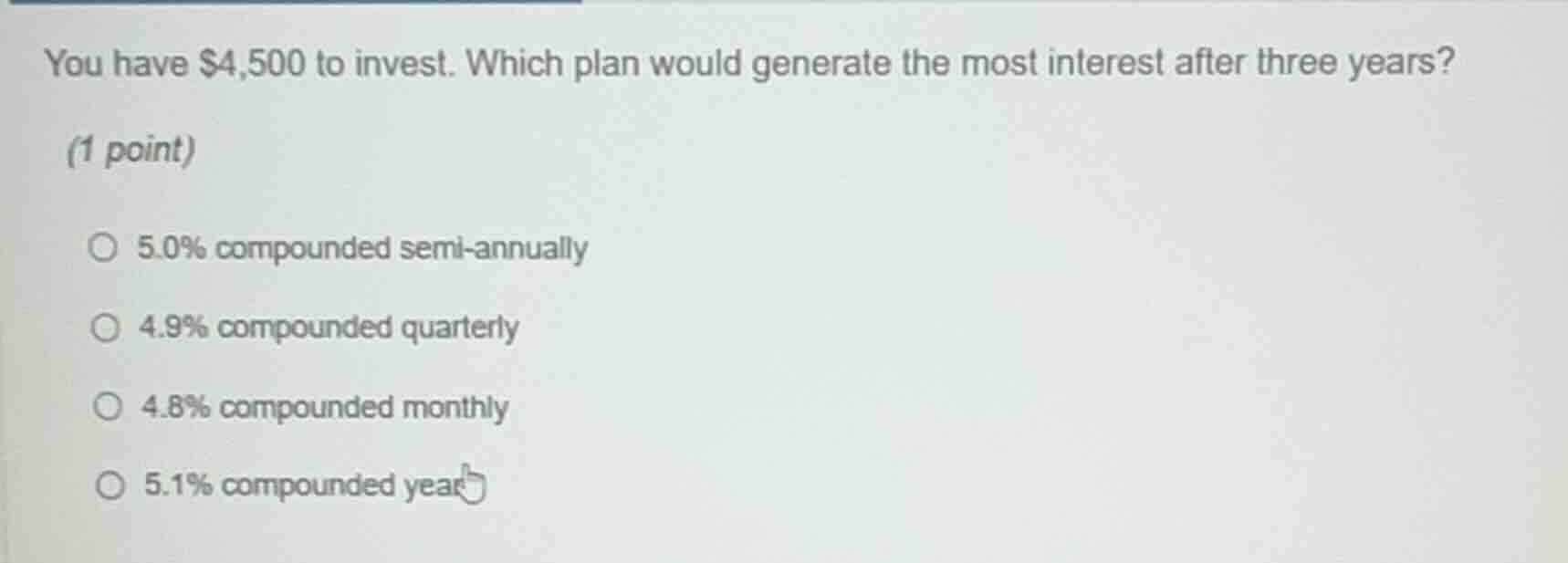
you have $4,500 to invest. which plan would generate the most interest after three years? (1 point) 5.0% compounded semi-annually 4.9% compounded quarterly 4.8% compounded monthly 5.1% compounded year
To determine which investment plan generates the most interest, we use the compound - interest formula $A = P(1+\frac{r}{n})^{nt}$, where $A$ is the amount of money accumulated after $n$ years, including interest, $P$ is the principal amount (the initial amount of money), $r$ is the annual interest rate (in decimal), $n$ is the number of times that interest is compounded per year, and $t$ is the time the money is invested for in years. The interest $I$ is calculated as $I=A - P$. Here, $P = 4500$ and $t = 3$.
Step 1: Analyze the first option (5.0% compounded semi - annually)
- First, convert the percentage to a decimal: $r = 0.05$.
- Since it is compounded semi - annually, $n = 2$.
- Use the compound - interest formula: $A=4500(1 +\frac{0.05}{2})^{2\times3}=4500(1 + 0.025)^{6}=4500\times(1.025)^{6}$.
- Calculate $(1.025)^{6}\approx1.159693418$.
- Then $A = 4500\times1.159693418\approx5218.62$.
- The interest $I_1=5218.62 - 4500 = 718.62$.
Step 2: Analyze the second option (4.9% compounded quarterly)
- Convert the percentage to a decimal: $r = 0.049$.
- Since it is compounded quarterly, $n = 4$.
- Use the compound - interest formula: $A=4500(1+\frac{0.049}{4})^{4\times3}=4500(1 + 0.01225)^{12}$.
- Calculate $(1.01225)^{12}\approx1.15679$.
- Then $A = 4500\times1.15679\approx5205.56$.
- The interest $I_2=5205.56 - 4500=705.56$.
Step 3: Analyze the third option (4.8% compounded monthly)
- Convert the percentage to a decimal: $r = 0.048$.
- Since it is compounded monthly, $n = 12$.
- Use the compound - interest formula: $A=4500(1+\frac{0.048}{12})^{12\times3}=4500(1 + 0.004)^{36}$.
- Calculate $(1.004)^{36}\approx1.15389$.
- Then $A = 4500\times1.15389\approx5192.51$.
- The interest $I_3=5192.51 - 4500 = 692.51$.
Step 4: Analyze the fourth option (5.1% compounded yearly)
- Convert the percentage to a decimal: $r = 0.051$.
- Since it is compounded yearly, $n = 1$.
- Use the compound - interest formula: $A=4500(1+\frac{0.051}{1})^{1\times3}=4500\times(1.051)^{3}$.
- Calculate $(1.051)^{3}\approx1.051\times1.051\times1.051\approx1.159665551$.
- Then $A = 4500\times1.159665551\approx5218.49$.
- The interest $I_4=5218.49 - 4500 = 718.49$.

Snap & solve any problem in the app
Get step-by-step solutions on Sovi AI
Photo-based solutions with guided steps
Explore more problems and detailed explanations
By comparing the interests: $I_1\approx718.62$, $I_2\approx705.56$, $I_3\approx692.51$, $I_4\approx718.49$. The largest interest is generated by the plan with 5.0% compounded semi - annually. So the answer is 5.0% compounded semi - annually.