QUESTION IMAGE
Question
can you conclude that these triangles are congruent?
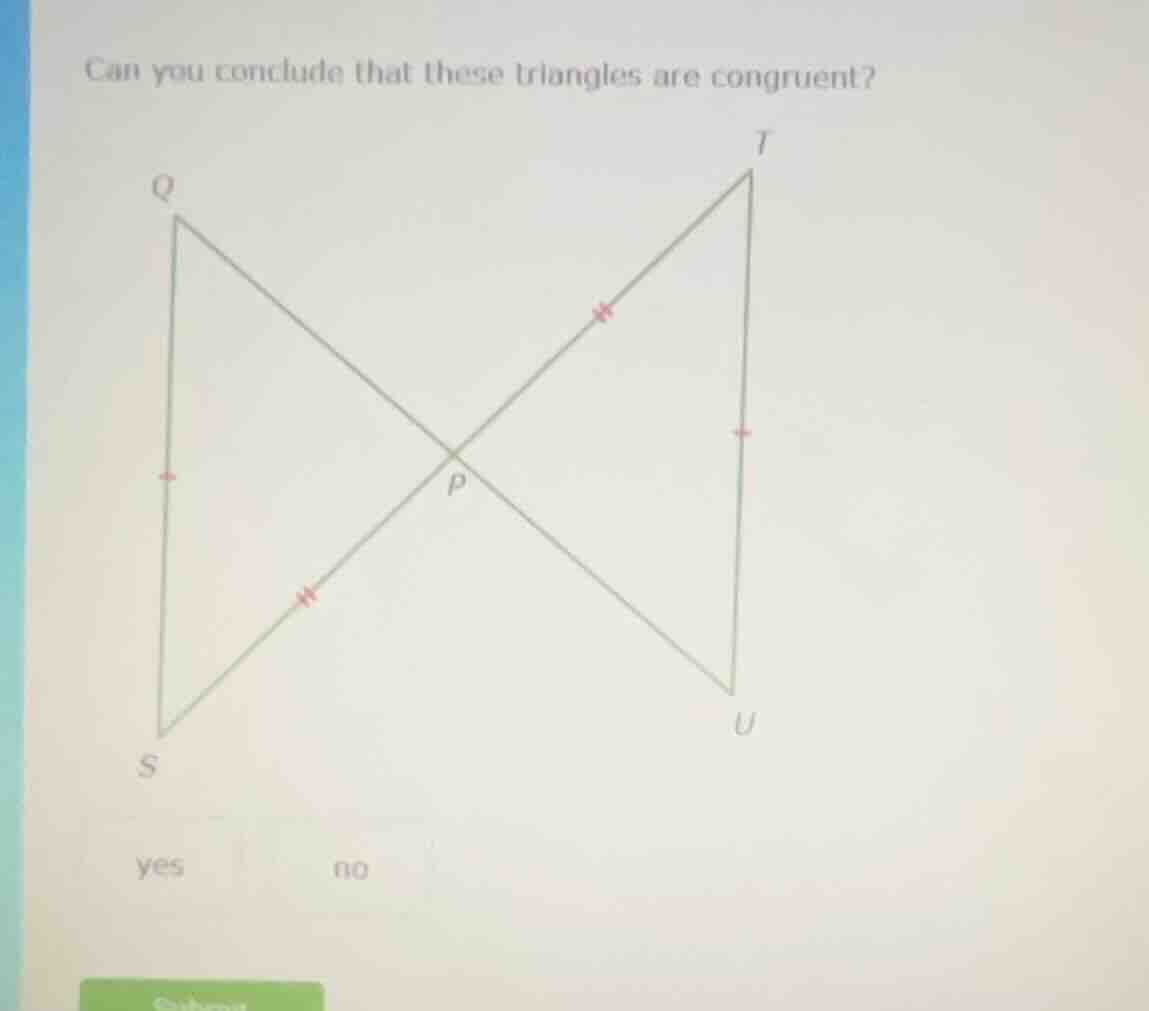
(image of two triangles qps and tpu with intersection at p, marked segments: qs has one mark, qp and tp have two marks, tu has one mark)
yes
no
Step1: Identify vertical angles
Vertical angles at \( P \) are equal, so \( \angle QPS \cong \angle TPU \).
Step2: Check given congruent sides
We have \( QP \cong TP \) (marked with two ticks) and \( SP \cong UP \) (marked with two ticks)? Wait, no, looking at the diagram: one side of \( \triangle QPS \) ( \( QS \) ) has one tick, one side of \( \triangle TPU \) ( \( TU \) ) has one tick? Wait, no, the intersecting sides: \( QP \) and \( TP \) (two ticks), \( SP \) and \( UP \) (two ticks)? Wait, no, the diagram: \( QS \) has one tick, \( TU \) has one tick. Wait, the vertical angles at \( P \): \( \angle QPS \) and \( \angle TPU \) are vertical angles, so congruent. Then, we have \( QP \cong TP \) (two ticks) and \( SP \cong UP \) (two ticks)? Wait, no, the segments: \( QP = TP \) (marked with two congruency marks), \( SP = UP \) (marked with two congruency marks)? Wait, no, maybe I misread. Wait, the triangles are \( \triangle QPS \) and \( \triangle TPU \). The vertical angles \( \angle QPS \) and \( \angle TPU \) are equal. Then, \( QP = TP \) (given by two marks) and \( SP = UP \) (given by two marks)? Wait, no, maybe the sides: \( QS \) has one mark, \( TU \) has one mark. Wait, no, the correct approach: in \( \triangle QPS \) and \( \triangle TPU \), we have \( \angle QPS = \angle TPU \) (vertical angles), \( QP = TP \) (congruent segments, two marks), and \( SP = UP \) (congruent segments, two marks). Wait, no, that would be SAS? Wait, no, SAS requires two sides and the included angle. Wait, the included angle for \( QP \) and \( SP \) is \( \angle QPS \), and for \( TP \) and \( UP \) is \( \angle TPU \), which are equal. So by SAS congruence criterion, \( \triangle QPS \cong \triangle TPU \). Wait, but wait, the other sides: \( QS \) and \( TU \) have one mark, but maybe that's a red herring? Wait, no, let's re-express. The two triangles: vertices \( Q, P, S \) and \( T, P, U \). The sides: \( QP \) and \( TP \) (congruent, two marks), \( SP \) and \( UP \) (congruent, two marks), and the included angle \( \angle QPS \) and \( \angle TPU \) (vertical angles, congruent). So by SAS, the triangles are congruent. Wait, but maybe I made a mistake. Wait, the problem: can we conclude they are congruent? Let's check the congruence criteria. SAS: two sides and included angle. Here, \( QP = TP \), \( SP = UP \), and \( \angle QPS = \angle TPU \) (vertical angles), so SAS applies. Therefore, the triangles are congruent. So the answer is yes.

Snap & solve any problem in the app
Get step-by-step solutions on Sovi AI
Photo-based solutions with guided steps
Explore more problems and detailed explanations
yes