QUESTION IMAGE
Question
have you ever felt heat from a fireplace? or the warm rays of the sun? then youve encountered infrared waves! infrared waves are a type of electromagnetic wave. we cannot see infrared waves, but they are all around us. the unique characteristics of infrared waves have led to their use in tv remote controls, thermal imaging cameras, and devices that monitor earth and space.
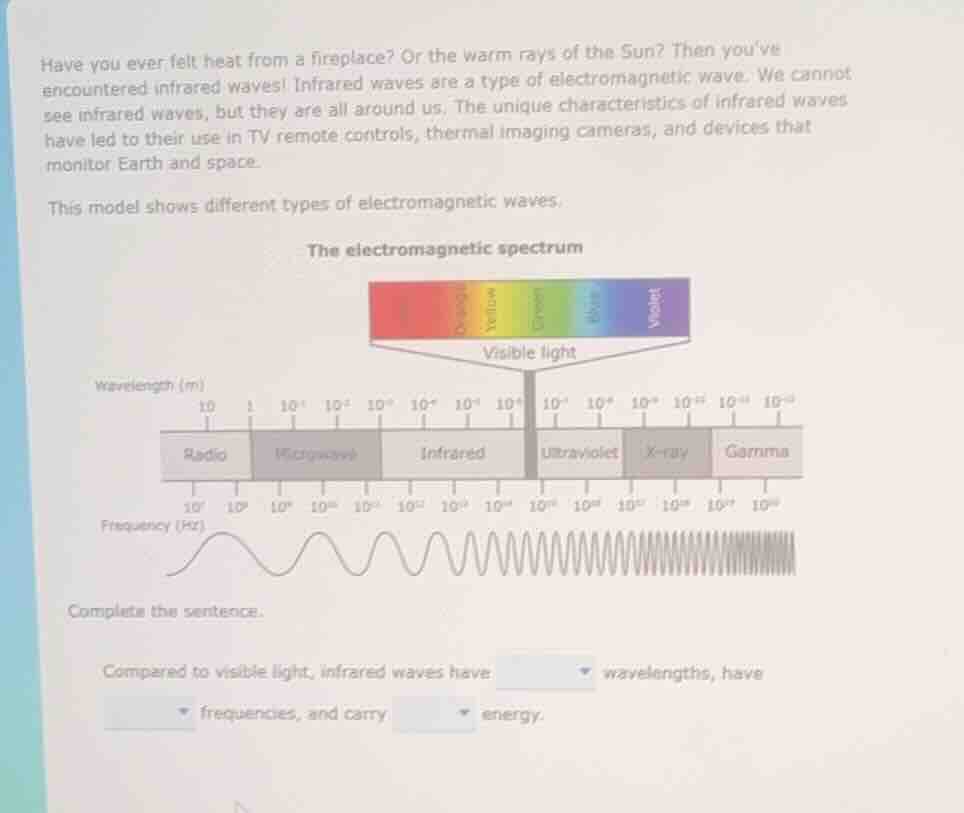
this model shows different types of electromagnetic waves.
the electromagnetic spectrum
wavelength (m)
frequency (hz)
complete the sentence.
compared to visible light, infrared waves have ____ wavelengths, have __ frequencies, and carry ____ energy.
Step1: Compare wavelength values
From the spectrum, infrared wavelength range is $10^{-6}$ to $10^{-3}$ m, visible light is $10^{-7}$ to $10^{-6}$ m. So infrared has longer wavelengths.
Step2: Compare frequency values
Infrared frequency range is $10^{12}$ to $10^{15}$ Hz, visible light is $10^{15}$ to $10^{16}$ Hz. So infrared has lower frequencies.
Step3: Relate frequency to energy
Electromagnetic wave energy follows $E=h
u$ ($h$ = Planck's constant, $
u$ = frequency). Lower frequency means lower energy. So infrared carries less energy.

Snap & solve any problem in the app
Get step-by-step solutions on Sovi AI
Photo-based solutions with guided steps
Explore more problems and detailed explanations
Compared to visible light, infrared waves have longer wavelengths, have lower frequencies, and carry less energy.