QUESTION IMAGE
Question
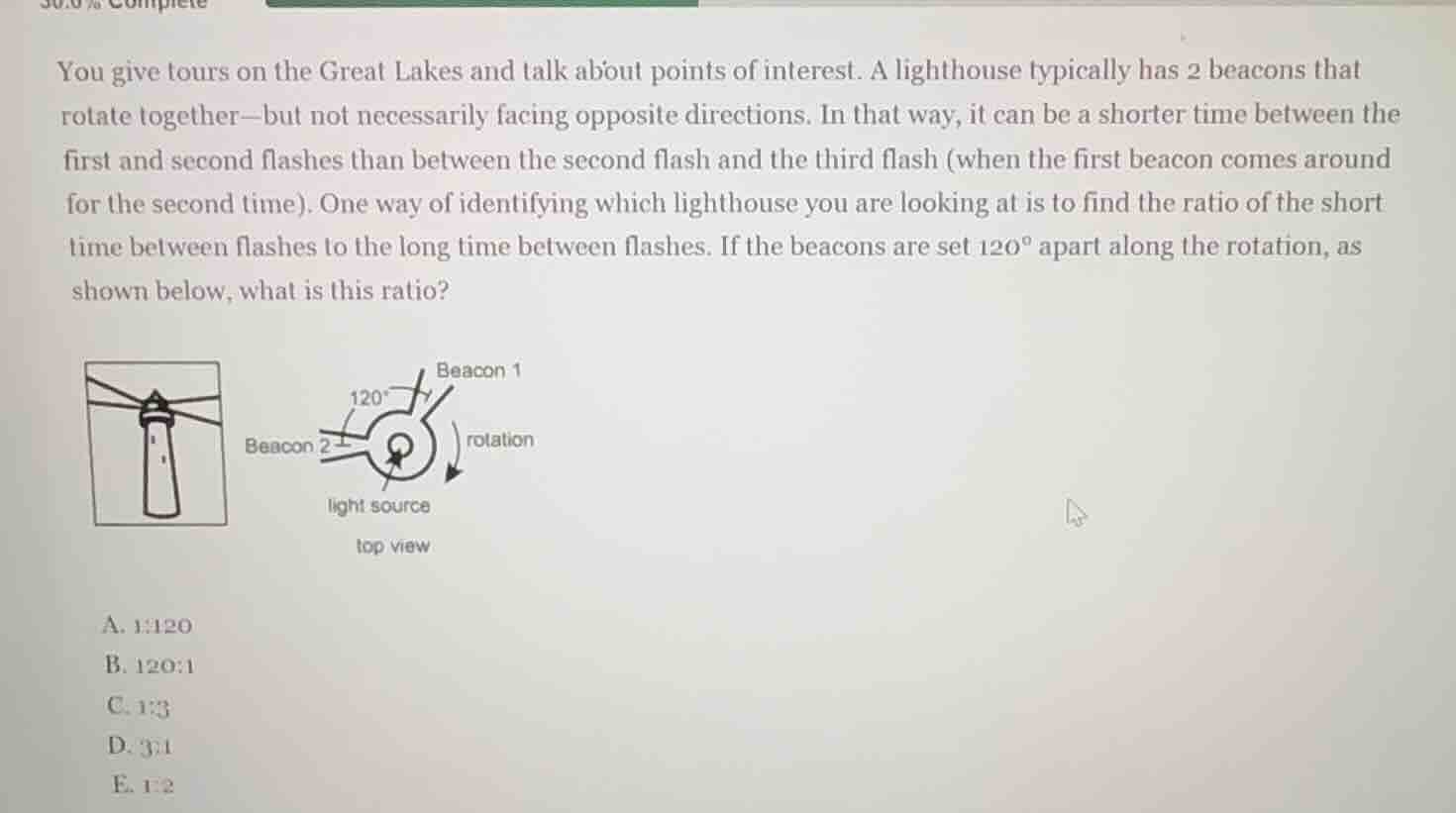
you give tours on the great lakes and talk about points of interest. a lighthouse typically has 2 beacons that rotate together—but not necessarily facing opposite directions. in that way, it can be a shorter time between the first and second flashes than between the second flash and the third flash (when the first beacon comes around for the second time). one way of identifying which lighthouse you are looking at is to find the ratio of the short time between flashes to the long time between flashes. if the beacons are set $120^{circ}$ apart along the rotation, as shown below, what is this ratio?
image of lighthouse and beacon diagram
a. $1:120$
b. $120:1$
c. $1:3$
d. $3:1$
e. $1:2$
Step1: Determine the angles for short and long time
The total angle in a full rotation is \(360^\circ\). The beacons are \(120^\circ\) apart. The short time between flashes corresponds to the \(120^\circ\) angle, and the long time between flashes corresponds to the remaining angle in the full rotation. So the long angle is \(360^\circ - 120^\circ= 240^\circ\).
Step2: Calculate the ratio of short time to long time
The ratio of the short time (corresponding to \(120^\circ\)) to the long time (corresponding to \(240^\circ\)) is \(\frac{120^\circ}{240^\circ}=\frac{1}{2}\)? Wait, no, wait. Wait, the short time is between the two beacons, which is \(120^\circ\), and the long time is when the first beacon comes back, so the angle between the second flash (from beacon 2) and the third flash (from beacon 1 again) is \(360 - 120=240\)? Wait, no, maybe I got it reversed. Wait, the beacons are rotating, so the time between flashes is proportional to the angle between them. So the short angle is \(120^\circ\), the long angle is \(360 - 120 = 240^\circ\)? Wait, no, wait, if the beacons are \(120^\circ\) apart, then when the light rotates, the first flash is beacon 1, then when it rotates \(120^\circ\), it hits beacon 2 (short time), then to get back to beacon 1, it has to rotate \(360 - 120=240^\circ\) (long time). So the ratio of short time to long time is the ratio of their angles, since time is proportional to angle (constant angular speed). So ratio is \(120:240 = 1:2\)? Wait, but let's check again. Wait, the problem says "the ratio of the short time between flashes to the long time between flashes". So short time angle is \(120^\circ\), long time angle is \(360 - 120 = 240^\circ\). So ratio is \(120/240 = 1/2\)? Wait, but the options have E. 1:2. Wait, but let's confirm.
Wait, maybe I made a mistake in the angle. Wait, the beacons are set \(120^\circ\) apart. So the angle between beacon 1 and beacon 2 is \(120^\circ\), so the time between beacon 1 and beacon 2 (short time) is proportional to \(120^\circ\), and the time between beacon 2 and the next beacon 1 (long time) is proportional to \(360 - 120 = 240^\circ\). So the ratio of short time to long time is \(120:240 = 1:2\). Wait, but let's check the options. Option E is 1:2. Wait, but let's re-examine. Wait, maybe the short angle is \(120\) and the long angle is \(360 - 120 = 240\), so ratio is \(120/240 = 1/2\), so 1:2. So the answer should be E. 1:2? Wait, but wait, maybe I had the short and long reversed. Wait, if the beacons are \(120^\circ\) apart, then the time between beacon 1 and beacon 2 is \(120^\circ\) rotation, and the time between beacon 2 and beacon 1 (next time) is \(360 - 120 = 240^\circ\) rotation. So the short time is \(120^\circ\) (smaller angle), long time is \(240^\circ\) (larger angle). So ratio of short to long is \(120/240 = 1/2\), so 1:2. So the correct option is E. 1:2.
Wait, but let's check the options again. The options are A. 1:120, B. 120:1, C. 1:3, D. 3:1, E. 1:2. So yes, E is 1:2. So the ratio is 1:2.

Snap & solve any problem in the app
Get step-by-step solutions on Sovi AI
Photo-based solutions with guided steps
Explore more problems and detailed explanations
E. 1:2