QUESTION IMAGE
Question
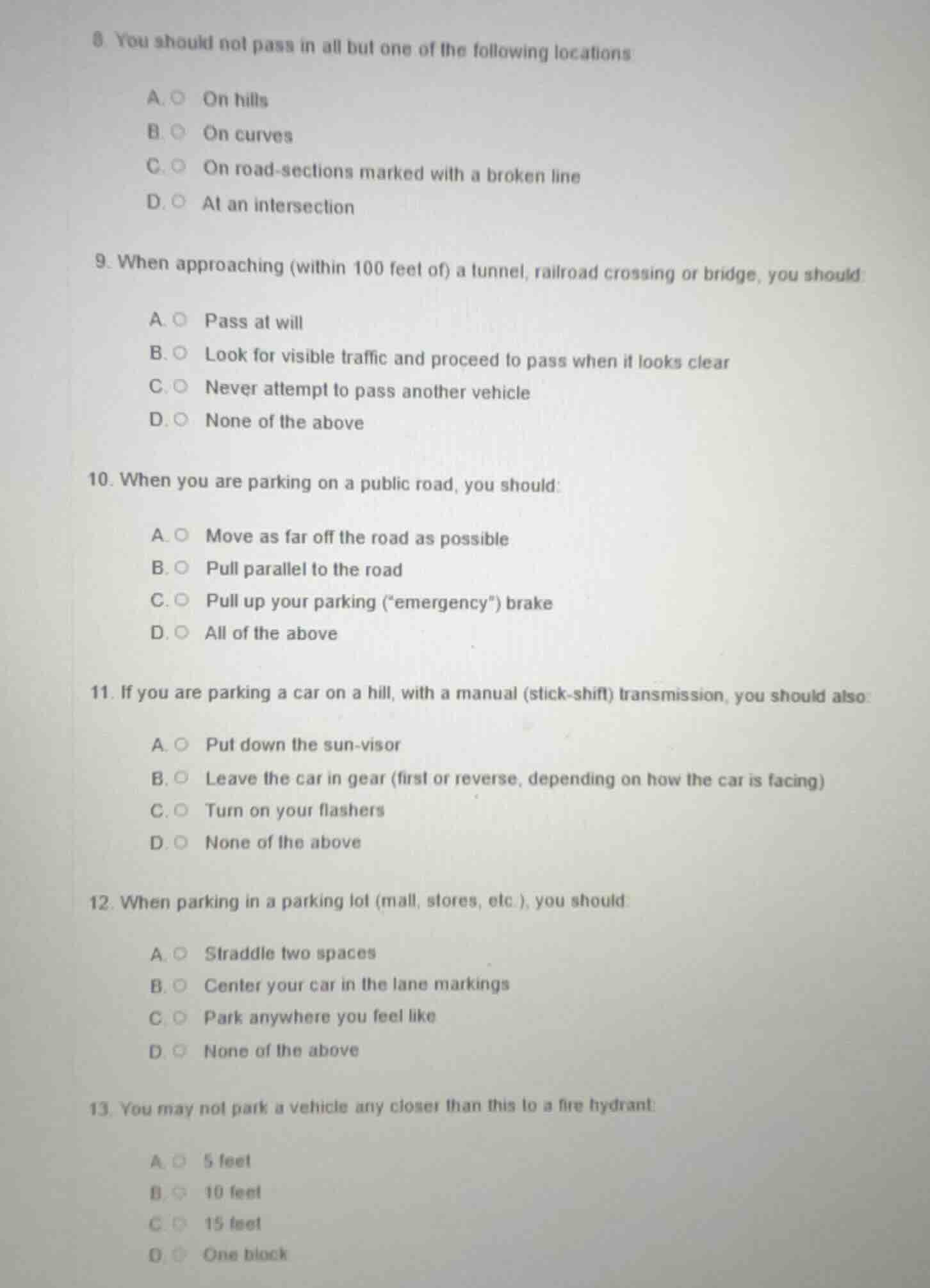
8 you should not pass in all but one of the following locations
a. on hills
b. on curves
c. on road - sections marked with a broken line
d. at an intersection
- when approaching (within 100 feet of) a tunnel, railroad crossing or bridge, you should
a. pass at will
b. look for visible traffic and proceed to pass when it looks clear
c. never attempt to pass another vehicle
d. none of the above
- when you are parking on a public road, you should:
a. move as far off the road as possible
b. pull parallel to the road
c. pull up your parking (\emergency\) brake
d. all of the above
- if you are parking a car on a hill, with a manual (stick - shift) transmission, you should also:
a. put down the sun - visor
b. leave the car in gear (first or reverse, depending on how the car is facing)
c. turn on your flashers
d. none of the above
- when parking in a parking lot (mall, stores, etc.), you should:
a. straddle two spaces
b. center your car in the lane markings
c. park anywhere you feel like
d. none of the above
- you may not park a vehicle any closer than this to a fire hydrant:
a. 5 feet
b. 10 feet
c. 15 feet
d. one block
Question 8
In most traffic laws, passing is prohibited on hills, curves, and at intersections for safety. Road - sections marked with a broken line usually allow passing (as broken lines often indicate that passing is permitted when safe). So the location where you can pass is the one with the broken line, meaning you should not pass in the other three locations (hills, curves, intersections) except the broken - line section.
When approaching a tunnel, railroad crossing, or bridge (within 100 feet), passing another vehicle is extremely dangerous due to reduced visibility, potential for sudden traffic changes, and safety regulations. So you should never attempt to pass another vehicle in these situations. Option A is wrong as you can't pass at will. Option B is wrong as even if it looks clear, passing is not allowed. Option D is wrong as option C is correct.
When parking on a public road, you should move as far off the road as possible to avoid obstructing traffic, pull parallel to the road (for proper parking), and pull up your parking (emergency) brake to secure the vehicle. So all of these actions are correct.

Snap & solve any problem in the app
Get step-by-step solutions on Sovi AI
Photo-based solutions with guided steps
Explore more problems and detailed explanations
C. On road - sections marked with a broken line