QUESTION IMAGE
Question
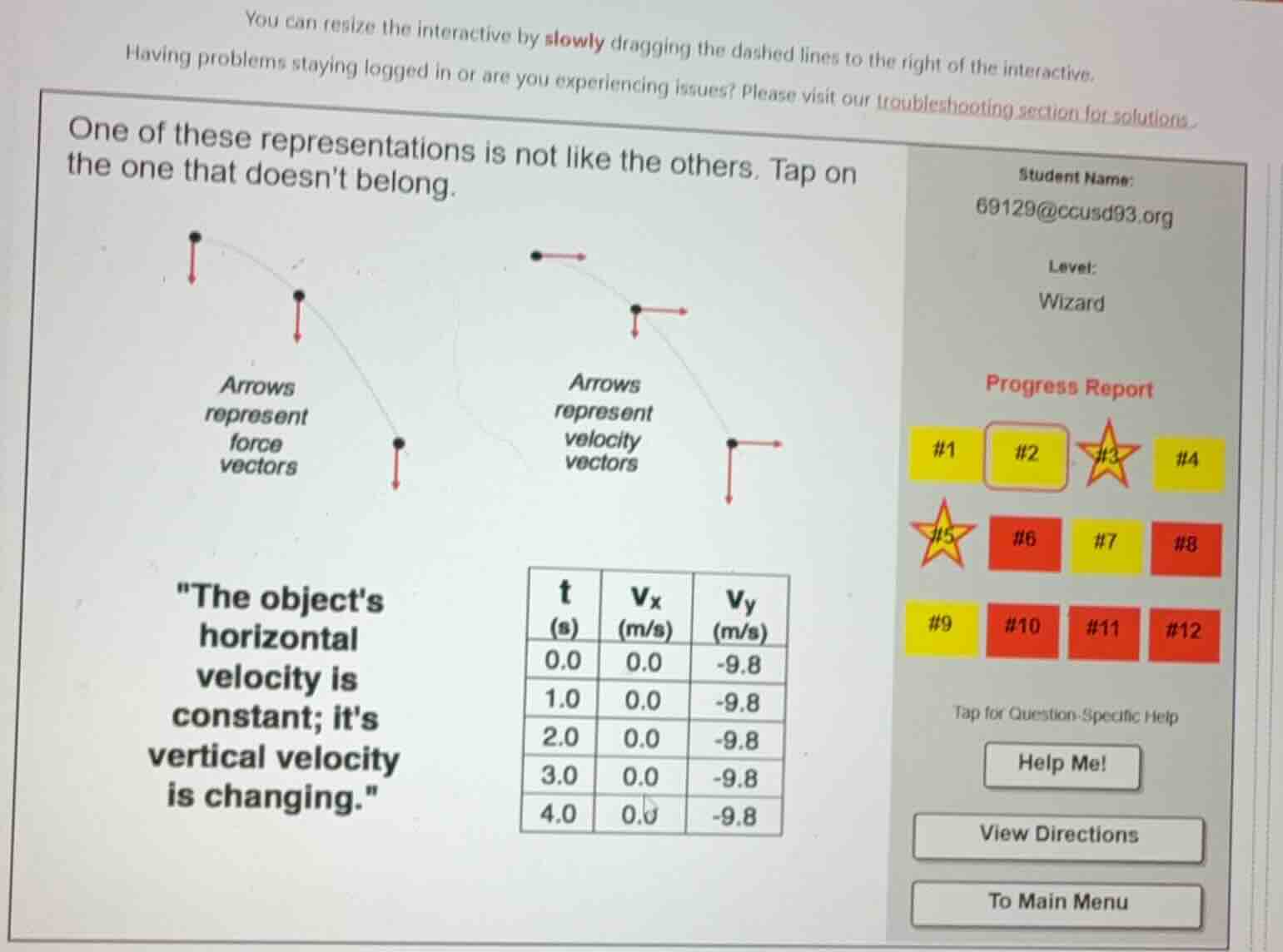
you can resize the interactive by slowly dragging the dashed lines to the right of the interactive. having problems staying logged in or are you experiencing issues? please visit our troubleshooting section for solutions. one of these representations is not like the others. tap on the one that doesnt belong. arrows represent force vectors arrows represent velocity vectors \the objects horizontal velocity is constant; its vertical velocity is changing.\ t (s) vx (m/s) vy (m/s) 0.0 0.0 -9.8 1.0 0.0 -9.8 2.0 0.0 -9.8 3.0 0.0 -9.8 4.0 0.0 -9.8 student name: 69129@ccusd93.org level: wizard progress report #1 #2 #3 #4 #5 #6 #7 #8 #9 #10 #11 #12 tap for question - specific help help me! view directions to main menu
To determine which representation doesn't belong, we analyze each:
- The left - hand diagram with force vectors (gravity, vertical) makes sense for projectile motion (force is constant vertically).
- The statement about horizontal velocity constant (should be constant in projectile motion, but here \(V_x = 0\) always, implying no horizontal motion, but vertical velocity is constant? Wait, no—wait, in normal projectile motion, \(V_x\) is constant (if no air resistance) and \(V_y\) changes. But here, the table shows \(V_x = 0\) (so no horizontal motion, object is in free fall vertically) and \(V_y=- 9.8\) (constant, which would mean no acceleration, but gravity causes acceleration, so \(V_y\) should change. Wait, no—wait, the other representations: the right - hand diagram has velocity vectors (horizontal and vertical? Wait, no, the left diagram: force vectors (all vertical, gravity). The right diagram: velocity vectors—if it's projectile motion, velocity has horizontal (constant) and vertical (changing) components. But the table: \(V_x = 0\) (so no horizontal motion, just vertical free fall), and \(V_y\) is constant (\(-9.8\)), which is impossible because gravity causes acceleration (\(a_y=-9.8\ m/s^2\)), so \(V_y\) should change over time (e.g., \(v_y=v_{y0}+at\)). Wait, no—wait, the statement says "horizontal velocity is constant (here \(V_x = 0\), so constant) and vertical velocity is changing"—but the table shows \(V_y\) constant. So the table is inconsistent. Alternatively, the left diagram: force vectors (all vertical, correct for gravity). The right diagram: velocity vectors—if it's projectile motion, velocity has horizontal (constant) and vertical (changing) components. The statement: if horizontal velocity is constant (okay) and vertical is changing (okay), but the table shows \(V_y\) constant. Wait, no—wait, maybe the table is the odd one. Wait, no—wait, the left diagram: force vectors (vertical, gravity). The right diagram: velocity vectors—maybe the velocity vectors should have horizontal component constant and vertical changing, but in the right diagram, maybe some are horizontal/vertical. Wait, no—let's re - evaluate. The key: in projectile motion, force (gravity) is vertical (so left diagram with vertical force vectors is correct). Velocity has horizontal (constant) and vertical (changing) components. The statement says horizontal velocity constant, vertical changing (correct for projectile motion with \(V_{x0}=0\)? No, if \(V_{x0}=0\), it's free fall. Wait, maybe the table: in the table, \(V_x = 0\) (so no horizontal motion, just vertical), and \(V_y=-9.8\) (constant), which would mean acceleration \(a_y = 0\), but gravity gives \(a_y=-9.8\), so \(V_y\) should be \(v_{y0}+at\). If \(v_{y0}=-9.8\) and \(a=-9.8\), then at \(t = 1\), \(V_y=-19.6\), etc. But the table has \(V_y\) constant. So the table (the one with \(t\), \(V_x\), \(V_y\)) is the one that doesn't belong because it shows vertical velocity constant (contradicting the effect of gravity, which should cause vertical velocity to change), while the other representations (force vectors vertical, velocity vectors with horizontal/vertical, and the statement about horizontal constant/vertical changing) are consistent with projectile motion (or free fall with horizontal velocity zero, but vertical velocity should change). Wait, no—maybe the statement is wrong? No, the question is which is not like the others. Let's check:
- Left diagram: force vectors (vertical, gravity) – correct.
- Right diagram: velocity vectors – if it's projectile motion, velocity has horizonta…

Snap & solve any problem in the app
Get step-by-step solutions on Sovi AI
Photo-based solutions with guided steps
Explore more problems and detailed explanations
The table (with columns \(t\), \(V_x\), \(V_y\)) is the representation that doesn't belong.