QUESTION IMAGE
Question
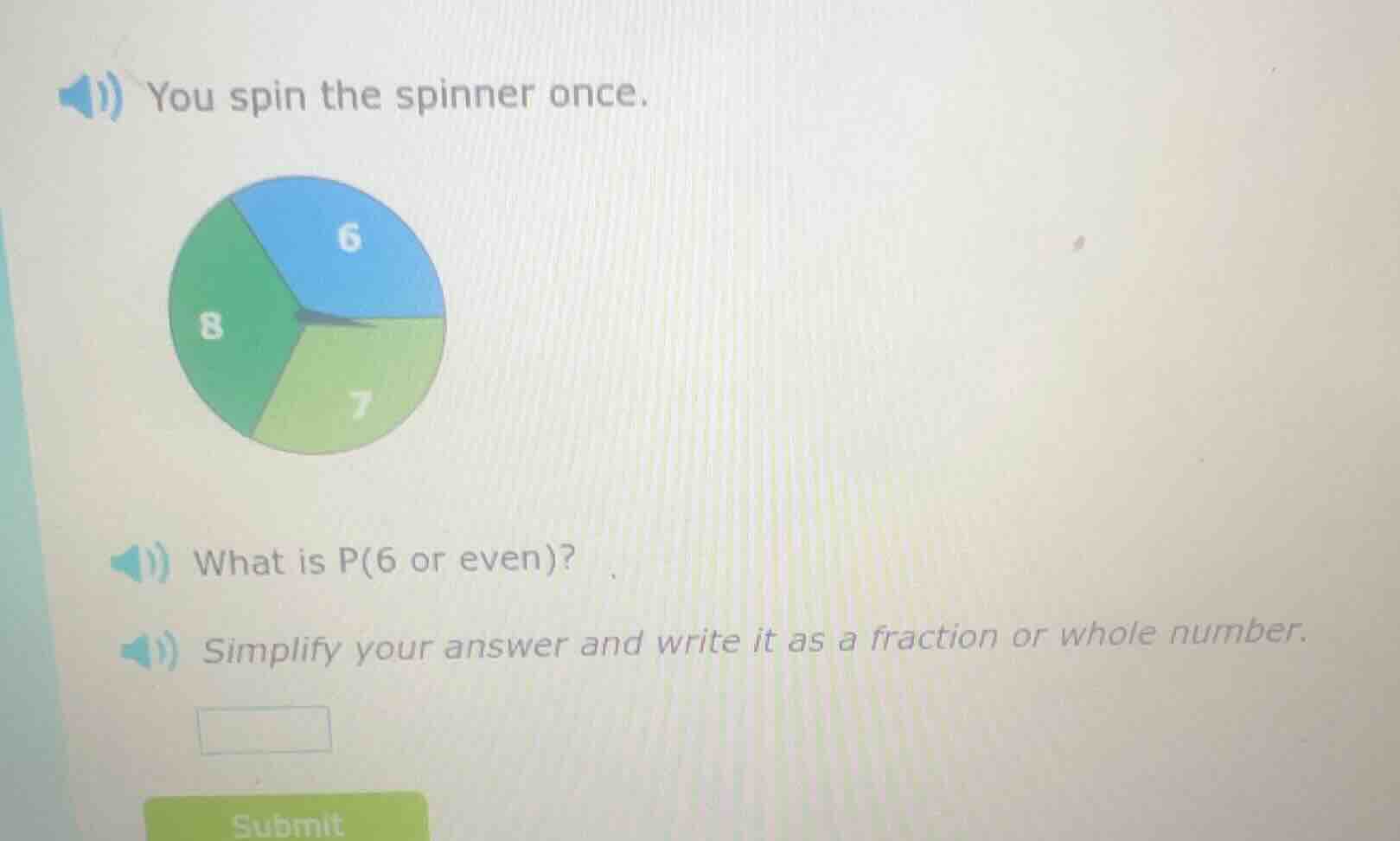
you spin the spinner once.
what is p(6 or even)?
simplify your answer and write it as a fraction or whole number.
Step1: Identify possible outcomes
The spinner has 3 sections: 6, 7, 8. So total outcomes \( n = 3 \).
Step2: Identify favorable outcomes for "6 or even"
Even numbers here are 6 and 8 (since 6 is even, 8 is even; 7 is odd). So favorable outcomes \( m = 2 \) (wait, no: 6 is one, 8 is another, and 6 is included in "6 or even". Wait, "6 or even" – 6 is even, 8 is even. So the favorable outcomes are 6 and 8. Wait, but 6 is one, 8 is another. Wait, the spinner has 3 sections: 6 (blue), 7 (light green), 8 (green). So the numbers are 6,7,8. Even numbers are 6 and 8. So "6 or even" – since 6 is even, the event "6 or even" is the same as "even" (because 6 is already even, so "6 or even" includes 6 and 8). Wait, let's check: the formula for \( P(A \text{ or } B) = P(A) + P(B) - P(A \cap B) \). Here, \( A \) is "6", \( B \) is "even". \( A \cap B \) is "6" (since 6 is even). So \( P(6) = \frac{1}{3} \), \( P(\text{even}) = \frac{2}{3} \) (since 6 and 8 are even, 2 outcomes), \( P(6 \cap \text{even}) = \frac{1}{3} \) (since 6 is in both). So \( P(6 \text{ or even}) = \frac{1}{3} + \frac{2}{3} - \frac{1}{3} = \frac{2}{3} \)? Wait, no, that's wrong. Wait, actually, "6 or even" – 6 is even, so the set of outcomes for "6 or even" is the set of outcomes that are 6 or even. But since 6 is even, this is just the set of even outcomes (6 and 8). Wait, no: 6 is 6, and even numbers are 6 and 8. So "6 or even" is {6,8}, because 6 is in both. So the number of favorable outcomes is 2? Wait, no, the spinner has three sections: 6,7,8. So each section is a possible outcome. So when we spin, we can get 6, 7, or 8. So the possible outcomes are 3. Now, "6 or even" – 6 is one outcome, even numbers are 6 and 8. So the union of {6} and {6,8} is {6,8}, which has 2 outcomes? Wait, no, {6} union {6,8} is {6,8}, so two outcomes? Wait, no, 6 is in both, so the union is {6,8}, which has two elements? Wait, 6 and 8 are two distinct outcomes. So the number of favorable outcomes is 2? Wait, but let's list them: if we spin, the result can be 6 (which is 6 and even), 7 (neither), or 8 (even). So "6 or even" includes 6 (because it's 6) and 8 (because it's even), and 6 is already even. So the favorable outcomes are 6 and 8, so two outcomes. Wait, but the spinner has three sections, each with equal probability? Wait, the spinner looks like three equal sections? The diagram shows three sections: blue (6), light green (7), green (8). So each section is a third of the spinner, so each outcome (6,7,8) has probability \( \frac{1}{3} \). Now, "6 or even" – 6 is an outcome, and even numbers are 6 and 8. So the event "6 or even" is the set of outcomes that are 6 or even. Since 6 is even, this is the set of even outcomes: 6 and 8. So the number of favorable outcomes is 2, total outcomes is 3. Wait, but wait: 6 is one outcome, 8 is another. So two outcomes. So probability is \( \frac{2}{3} \)? Wait, no, wait: let's re-express. The event "6 or even" – 6 is a specific number, and even numbers are 6 and 8. So the union of {6} and {6,8} is {6,8}, which has two elements. So the number of favorable outcomes is 2, total is 3. So \( P(6 \text{ or even}) = \frac{2}{3} \)? Wait, but let's check with the formula. \( P(A \cup B) = P(A) + P(B) - P(A \cap B) \). Here, A is "rolling a 6", B is "rolling an even number". \( P(A) = \frac{1}{3} \), \( P(B) = \frac{2}{3} \) (since 6 and 8 are even, 2 out of 3), \( P(A \cap B) = P(\text{rolling a 6 and an even number}) = \frac{1}{3} \) (since 6 is even). So \( P(A \cup B) = \frac{1}{3} + \frac{2}{3} - \frac{1}{3} = \frac{2}{3} \). Yes, that's correct. So th…

Snap & solve any problem in the app
Get step-by-step solutions on Sovi AI
Photo-based solutions with guided steps
Explore more problems and detailed explanations
\( \frac{2}{3} \)