QUESTION IMAGE
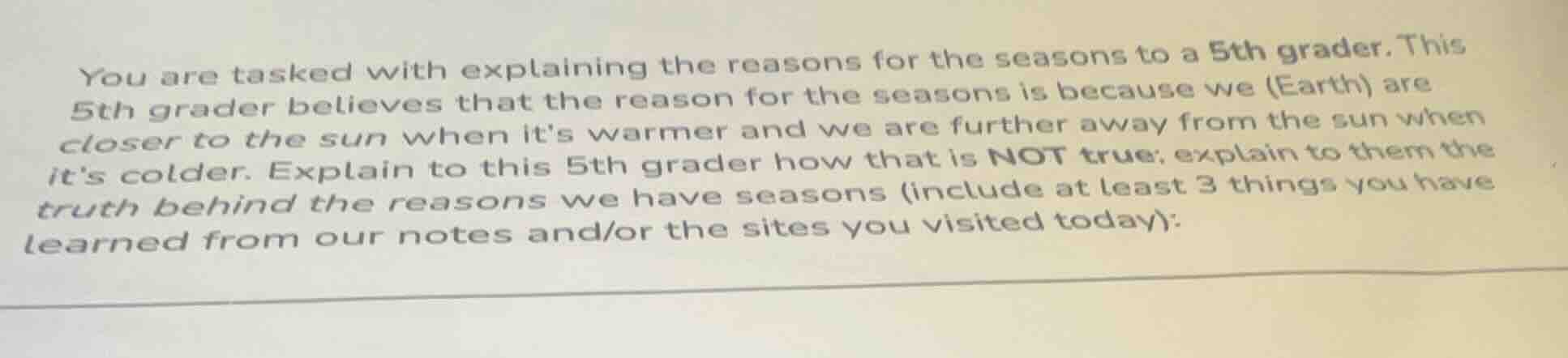
Question
you are tasked with explaining the reasons for the seasons to a 5th grader. this 5th grader believes that the reason for the seasons is because we (earth) are closer to the sun when its warmer and we are further away from the sun when its colder. explain to this 5th grader how that is not true; explain to them the truth behind the reasons we have seasons (include at least 3 things you have learned from our notes and/or the sites you visited today):
- First, correct the distance myth: Earth is actually closest to the Sun in early January (winter for the Northern Hemisphere), which proves distance doesn't cause seasons.
- Explain Earth's tilt: Earth spins on an axis tilted 23.5 degrees, not straight up and down relative to its orbit around the Sun.
- Explain direct vs. indirect sunlight: When a hemisphere is tilted toward the Sun, sunlight hits it more directly (concentrated, warmer, longer days) causing summer. When tilted away, sunlight is spread out (weaker, colder, shorter days) causing winter.
- Add a relatable example: Shine a flashlight straight down on paper (bright, small spot = direct summer sun) vs. at an angle (dim, big spot = indirect winter sun).

Snap & solve any problem in the app
Get step-by-step solutions on Sovi AI
Photo-based solutions with guided steps
Explore more problems and detailed explanations
Hey there! Let's clear up that season myth first: Earth's distance from the Sun doesn't cause seasons—we’re actually closest to the Sun in early January, which is winter for us in the U.S.! Here’s what really causes seasons:
- Earth is tilted like a top, at a 23.5-degree angle, as it circles the Sun.
- When our part of Earth (the Northern Hemisphere) is tilted toward the Sun, sunlight hits us more directly (like a flashlight pointed straight down, making a bright, warm spot). We also get longer days of sunlight, so it's summer.
- When our hemisphere is tilted away from the Sun, sunlight hits us at a slant (like a flashlight held sideways, making a dim, cool spot). We get shorter days too, so it's winter.
- The equinoxes (spring and fall) happen when Earth is tilted neither toward nor away from the Sun, so we get equal amounts of day and night all over the world!