QUESTION IMAGE
Question
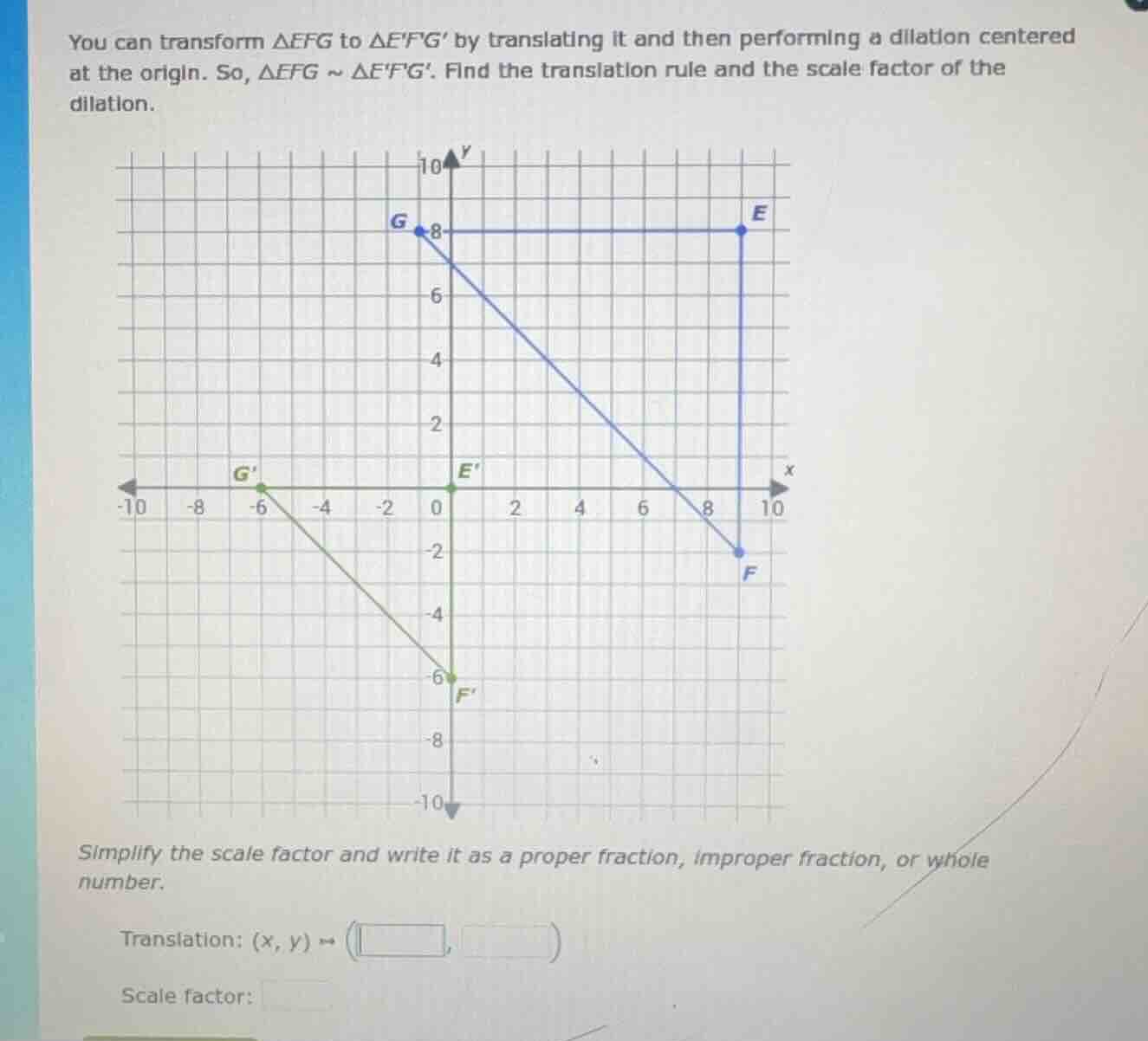
you can transform δefg to δefg by translating it and then performing a dilation centered at the origin. so, δefg ~ δefg. find the translation rule and the scale factor of the dilation.
simplify the scale factor and write it as a proper fraction, improper fraction, or whole number.
translation: (x, y) → (□, □)
scale factor: □
Step1: Identify coordinates of vertices
Coordinates: $E(9,8)$, $F(9,-2)$, $G(-1,8)$; $E'(0,0)$, $F'(0,-6)$, $G'(-6,0)$
Step2: Find translation rule
Solve for shift: $x' = x + h$, $y' = y + k$. Use $E$ to $E'$:
$0 = 9 + h \implies h = -9$
$0 = 8 + k \implies k = -8$
Translation: $(x,y) \to (x-9, y-8)$
Step3: Verify translated vertices
Translated $E$: $(9-9, 8-8)=(0,0)=E'$
Translated $F$: $(9-9, -2-8)=(0,-10)$
Translated $G$: $(-1-9, 8-8)=(-10,0)$
Step4: Calculate scale factor
Use translated $F$ to $F'$: $\text{Scale factor } r = \frac{-6}{-10} = \frac{3}{5}$
Verify with translated $G$ to $G'$: $\frac{-6}{-10} = \frac{3}{5}$

Snap & solve any problem in the app
Get step-by-step solutions on Sovi AI
Photo-based solutions with guided steps
Explore more problems and detailed explanations
Translation: $(x, y) \to (x-9, y-8)$
Scale factor: $\frac{3}{5}$