QUESTION IMAGE
Question
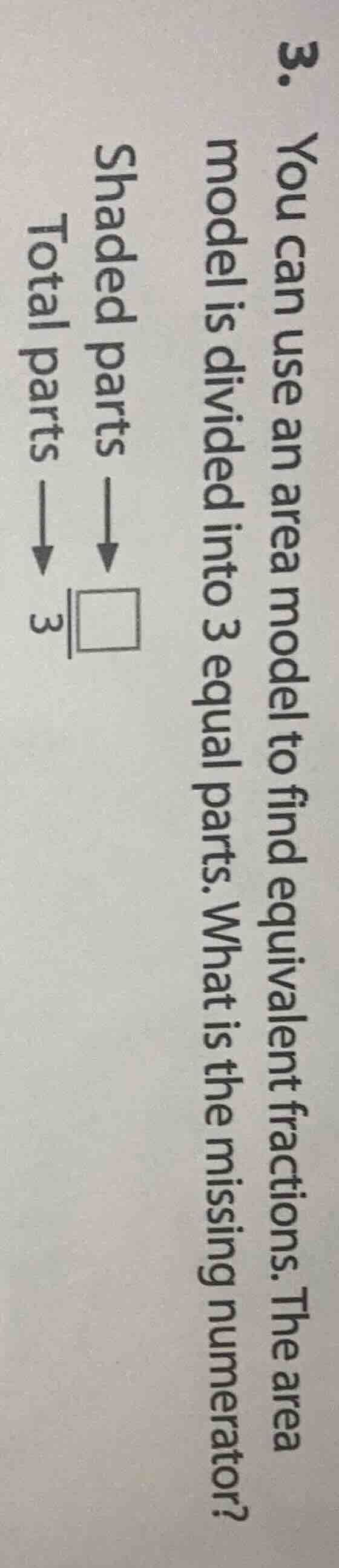
- you can use an area model to find equivalent fractions. the area model is divided into 3 equal parts. what is the missing numerator?
shaded parts →
total parts → \\(\frac{\square}{3}\\)
Step1: Understand the fraction structure
The fraction is in the form $\frac{\text{Shaded parts}}{\text{Total parts}}$, and total parts are 3. Since the area model is divided into 3 equal parts, and we assume the shaded parts would be equal to the total parts if we consider the whole (or maybe the problem implies the fraction representing the whole when divided into 3 equal parts, but likely the numerator is equal to the number of parts when considering the whole, so if total parts are 3, the numerator for the whole would be 3? Wait, no, maybe the problem is about a whole divided into 3 equal parts, so the fraction representing the whole is $\frac{3}{3}$? Wait, no, maybe the question is about a fraction where total parts are 3, and we need to find the numerator. Wait, the problem says "the area model is divided into 3 equal parts. What is the missing numerator?" So the fraction is $\frac{\square}{3}$. If it's the whole, then shaded parts equal total parts, so square is 3? Wait, maybe the model is a whole divided into 3 equal parts, so the fraction is $\frac{3}{3}$? Wait, no, maybe the question is simpler. Let's re-read: "You can use an area model to find equivalent fractions. The area model is divided into 3 equal parts. What is the missing numerator?" The fraction is $\frac{\square}{3}$, with shaded parts and total parts. So if the model is divided into 3 equal parts, and if we consider the whole (all parts shaded), then shaded parts = total parts = 3. So the numerator is 3.
Step2: Confirm the fraction
The fraction is $\frac{\text{Shaded}}{\text{Total}} = \frac{\square}{3}$. Since total parts are 3, and if the shaded parts are equal to total parts (whole), then $\square = 3$.

Snap & solve any problem in the app
Get step-by-step solutions on Sovi AI
Photo-based solutions with guided steps
Explore more problems and detailed explanations
3