QUESTION IMAGE
Question
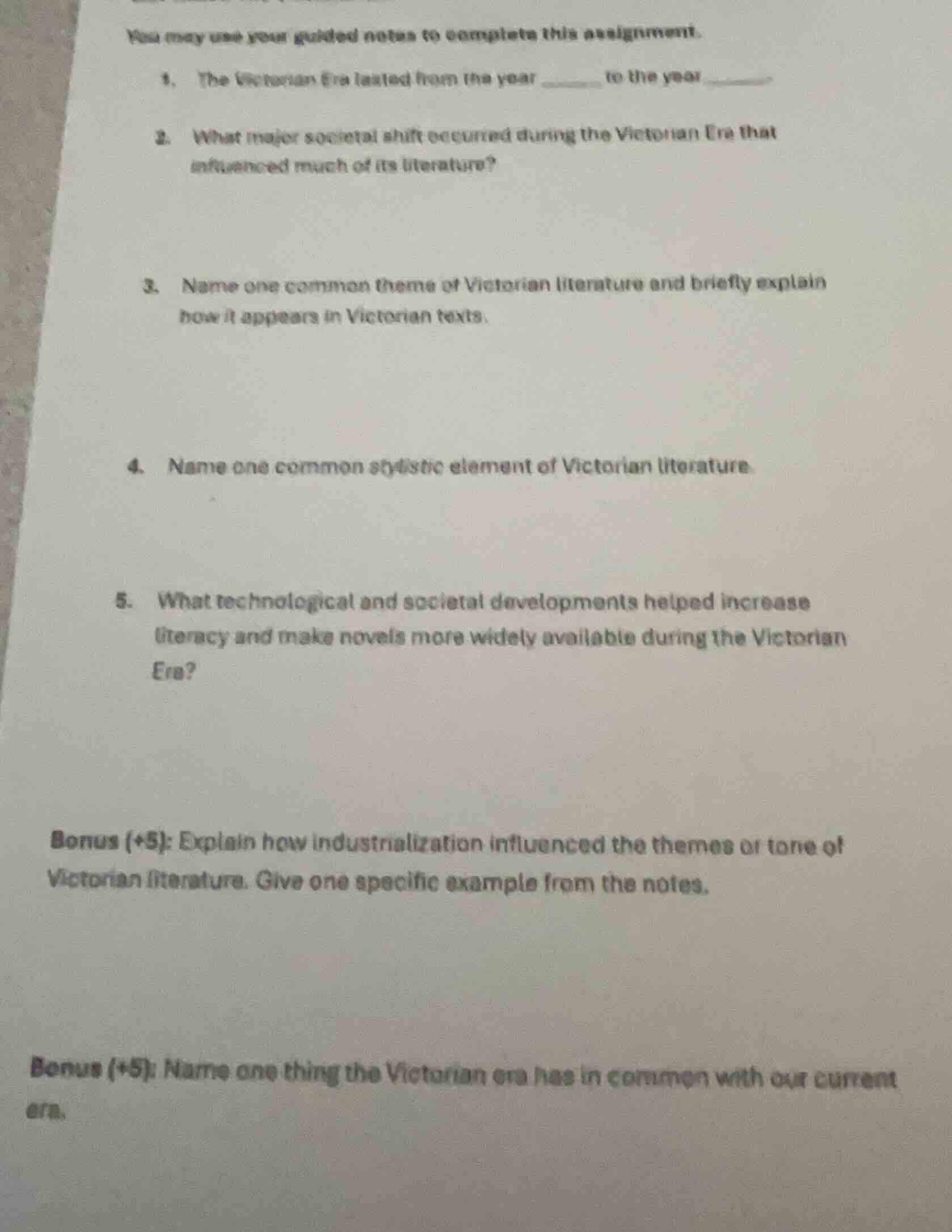
you may use your guided notes to complete this assignment.
- the victorian era lasted from the year ____ to the year ____
- what major societal shift occurred during the victorian era that influenced much of its literature?
- name one common theme of victorian literature and briefly explain how it appears in victorian texts.
- name one common stylistic element of victorian literature.
- what technological and societal developments helped increase literacy and make novels more widely available during the victorian era?
bonus (+5): explain how industrialization influenced the themes or tone of victorian literature. give one specific example from the notes.
bonus (+5): name one thing the victorian era has in common with our current era.
Brief Explanations
- The Victorian Era is defined by the reign of Queen Victoria.
- The Industrial Revolution reshaped work, class, and daily life, which became central to literary exploration.
- Class inequality is a core theme, often shown through depictions of working-class struggle and wealth gaps.
- Victorian writers frequently used elaborate, descriptive prose to detail settings and emotions.
- Reforms expanded public education, and steam-powered printing made books cheaper and more accessible.
- Industrialization spurred critiques of dehumanization, seen in texts like Hard Times.
- Both eras face rapid technological change that disrupts social norms.

Snap & solve any problem in the app
Get step-by-step solutions on Sovi AI
Photo-based solutions with guided steps
Explore more problems and detailed explanations
- 1837; 1901
- The Industrial Revolution, which transformed rural, agrarian societies into urban, industrial ones, upending traditional social structures, work, and living conditions.
- Class inequality: Texts like Charles Dickens' Oliver Twist depict the harsh poverty of working-class characters (e.g., Oliver and the workhouse boys) in contrast to the luxury of wealthy elites, highlighting the systemic gap between social classes and the injustice it created.
- Elaborate, detailed descriptive prose (or serialization, where novels were published in installments in periodicals).
- The expansion of public education (which boosted literacy rates among the working and middle classes) and the invention of steam-powered printing presses (which reduced the cost of producing books, making novels affordable and widely available to a larger audience).
- Industrialization led to themes of dehumanization and social injustice. For example, in Charles Dickens' Hard Times, the factory town of Coketown is depicted as a bleak, mechanized space where workers are treated as interchangeable "hands," reflecting the dehumanizing effects of industrial labor and inspiring a critical, sympathetic tone in the text.
- Both eras experience rapid technological change that disrupts traditional social norms and ways of life (e.g., the Victorian Industrial Revolution vs. modern digital/AI revolution, both of which create new social tensions, economic shifts, and debates about the role of technology in society).