QUESTION IMAGE
Question
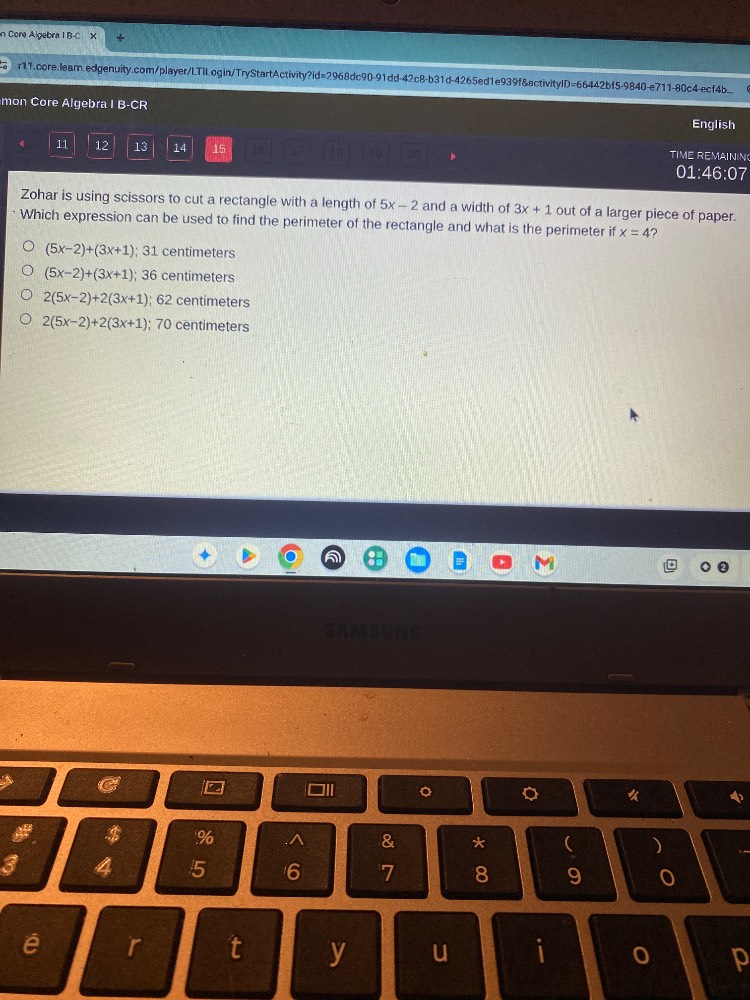
zohar is using scissors to cut a rectangle with a length of $5x - 2$ and a width of $3x + 1$ out of a larger piece of paper. which expression can be used to find the perimeter of the rectangle and what is the perimeter if $x = 4$? \\(\circ\\) $(5x - 2)+(3x + 1)$; 31 centimeters \\(\circ\\) $(5x - 2)+(3x + 1)$; 36 centimeters \\(\circ\\) $2(5x - 2)+2(3x + 1)$; 62 centimeters \\(\circ\\) $2(5x - 2)+2(3x + 1)$; 70 centimeters
Step1: Recall the perimeter formula of a rectangle
The perimeter \( P \) of a rectangle is given by \( P = 2\times(\text{length}+\text{width}) \), which can also be written as \( P = 2\times\text{length}+ 2\times\text{width} \). Given the length is \( 5x - 2 \) and the width is \( 3x + 1 \), the expression for the perimeter should be \( 2(5x - 2)+2(3x + 1) \). So we can eliminate the first two options which use the wrong formula (they use the formula for the sum of length and width, not the perimeter formula).
Step2: Substitute \( x = 4 \) into the perimeter expression
First, substitute \( x = 4 \) into \( 5x - 2 \): \( 5\times4-2=20 - 2=18 \).
Then substitute \( x = 4 \) into \( 3x + 1 \): \( 3\times4+1 = 12 + 1=13 \).
Now use the perimeter formula \( P=2\times18+2\times13 \).
Calculate \( 2\times18 = 36 \) and \( 2\times13=26 \).
Then \( P=36 + 26=62 \)? Wait, no, wait, let's recalculate the expression \( 2(5x - 2)+2(3x + 1) \) directly by expanding first.
Expand \( 2(5x - 2)+2(3x + 1)=10x-4 + 6x+2=16x-2 \).
Now substitute \( x = 4 \) into \( 16x-2 \): \( 16\times4-2=64 - 2 = 62 \)? Wait, but the fourth option says 70. Wait, did I make a mistake?
Wait, let's recalculate the expansion: \( 2(5x - 2)=10x - 4 \), \( 2(3x + 1)=6x + 2 \). Then adding them together: \( 10x-4+6x + 2=16x-2 \). Now \( x = 4 \), so \( 16\times4=64 \), \( 64 - 2=62 \). Wait, but the options are: third option is \( 2(5x - 2)+2(3x + 1) \); 62 centimeters, fourth is 70. Wait, maybe I made a mistake in the expansion? Wait, no, let's check the length and width again. Wait, length is \( 5x - 2 \), width is \( 3x + 1 \). Perimeter is \( 2(l + w)=2[(5x - 2)+(3x + 1)]=2(8x - 1)=16x - 2 \). For \( x = 4 \), \( 16\times4-2=64 - 2 = 62 \). So the third option is \( 2(5x - 2)+2(3x + 1) \); 62 centimeters. Wait, but let's check the options again. The third option is " \( 2(5x - 2)+2(3x + 1) \); 62 centimeters" and the fourth is " \( 2(5x - 2)+2(3x + 1) \); 70 centimeters". So where is the mistake? Wait, maybe I miscalculated the length and width. Wait, \( 5x-2 \) when \( x = 4 \) is \( 20 - 2 = 18 \), \( 3x + 1 \) is \( 13 \). Then perimeter is \( 2\times(18 + 13)=2\times31 = 62 \). Yes, so the correct expression is \( 2(5x - 2)+2(3x + 1) \) and the perimeter when \( x = 4 \) is 62 centimeters. So the third option is correct. Wait, but let's check the options again:
Option 1: \( (5x - 2)+(3x + 1) \); 31 cm (wrong formula, and 31 is length + width, not perimeter)
Option 2: \( (5x - 2)+(3x + 1) \); 36 cm (wrong formula)
Option 3: \( 2(5x - 2)+2(3x + 1) \); 62 cm (correct formula and correct calculation)
Option 4: \( 2(5x - 2)+2(3x + 1) \); 70 cm (wrong calculation)
So the correct option is the third one.

Snap & solve any problem in the app
Get step-by-step solutions on Sovi AI
Photo-based solutions with guided steps
Explore more problems and detailed explanations
C. \( 2(5x - 2)+2(3x + 1) \); 62 centimeters (assuming the options are labeled as A, B, C, D with C being the third option as per the order: first option is A, second B, third C, fourth D)