QUESTION IMAGE
Question
1-6
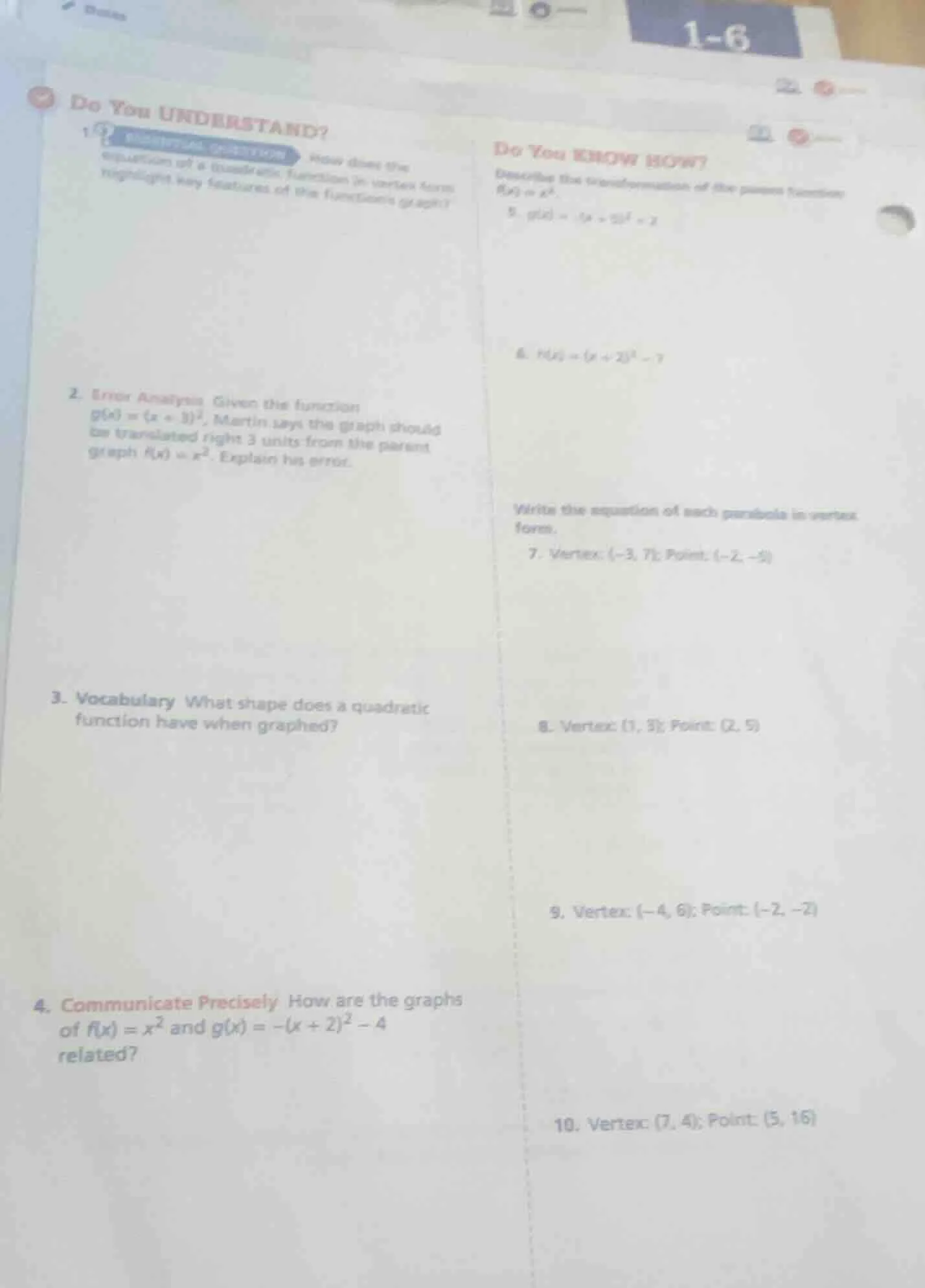
do you understand?
- essential question how does the equation of a quadratic function in vertex form highlight key features of the functions graph?
- error analysis given the function $g(x)=(x+3)^2$, martin says the graph should be translated right 3 units from the parent graph $f(x)=x^2$. explain his error.
- vocabulary what shape does a quadratic function have when graphed?
- communicate precisely how are the graphs of $f(x)=x^2$ and $g(x)=-(x+2)^2-4$ related?
do you know how?
describe the transformation of the parent function $f(x)=x^2$.
- $g(x)=(x+5)^2+2$
- $h(x)=(x-2)^2-7$
write the equation of each parabola in vertex form.
- vertex: $(-3, 7)$; point: $(-2, -5)$
- vertex: $(1, 3)$; point: $(2, 5)$
- vertex: $(-4, 6)$; point: $(-2, -2)$
- vertex: $(7, 4)$; point: $(5, 16)$
Step1: Solve Q1 (Vertex Form Feature)
Vertex form $f(x)=a(x-h)^2+k$ directly gives vertex $(h,k)$ and direction of opening from $a$.
Step2: Solve Q2 (Martin's Error)
For $g(x)=(x+3)^2=(x-(-3))^2$, horizontal shift is left 3 units, not right. Martin misread the sign inside the parentheses: shifts opposite the sign inside $(x-h)$.
Step3: Solve Q3 (Quadratic Graph Shape)
Quadratic functions graph to a parabola (U-shaped curve).
Step4: Solve Q4 (Graph Relationship)
$g(x)=-(x+2)^2-4$: reflect $f(x)=x^2$ over x-axis, shift left 2, down 4.
Step5: Solve Q5 (Transform $g(x)=(x+1)^2+2$)
Parent $f(x)=x^2$: shift left 1, up 2 units.
Step6: Solve Q6 (Transform $h(x)=(x-2)^2-7$)
Parent $f(x)=x^2$: shift right 2, down 7 units.
Step7: Solve Q7 (Vertex Form Equation)
Vertex form: $y=a(x-h)^2+k$, vertex $(-3,7)$ so $y=a(x+3)^2+7$. Substitute $(-2,-5)$:
$-5=a(-2+3)^2+7 \implies -5=a(1)+7 \implies a=-12$. Equation: $y=-12(x+3)^2+7$
Step8: Solve Q8 (Vertex Form Equation)
Vertex $(1,3)$: $y=a(x-1)^2+3$. Substitute $(2,5)$:
$5=a(2-1)^2+3 \implies 5=a+3 \implies a=2$. Equation: $y=2(x-1)^2+3$
Step9: Solve Q9 (Vertex Form Equation)
Vertex $(-4,6)$: $y=a(x+4)^2+6$. Substitute $(-2,-2)$:
$-2=a(-2+4)^2+6 \implies -2=4a+6 \implies 4a=-8 \implies a=-2$. Equation: $y=-2(x+4)^2+6$
Step10: Solve Q10 (Vertex Form Equation)
Vertex $(7,4)$: $y=a(x-7)^2+4$. Substitute $(5,16)$:
$16=a(5-7)^2+4 \implies 16=4a+4 \implies 4a=12 \implies a=3$. Equation: $y=3(x-7)^2+4$

Snap & solve any problem in the app
Get step-by-step solutions on Sovi AI
Photo-based solutions with guided steps
Explore more problems and detailed explanations
- The vertex form $f(x)=a(x-h)^2+k$ directly shows the vertex $(h,k)$ and the direction/width of the parabola from the value of $a$.
- Martin made an error in the direction of the horizontal shift: $g(x)=(x+3)^2=(x-(-3))^2$ is a left 3-unit shift from $f(x)=x^2$, not right. Horizontal shifts are opposite the sign inside the parentheses.
- A quadratic function graphs as a parabola (a symmetric U-shaped or upside-down U-shaped curve).
- The graph of $g(x)=-(x+2)^2-4$ is the graph of $f(x)=x^2$ reflected over the x-axis, shifted 2 units to the left, and shifted 4 units down.
- $g(x)=(x+1)^2+2$ is the parent function $f(x)=x^2$ shifted 1 unit left and 2 units up.
- $h(x)=(x-2)^2-7$ is the parent function $f(x)=x^2$ shifted 2 units right and 7 units down.
- $y=-12(x+3)^2+7$
- $y=2(x-1)^2+3$
- $y=-2(x+4)^2+6$
- $y=3(x-7)^2+4$