QUESTION IMAGE
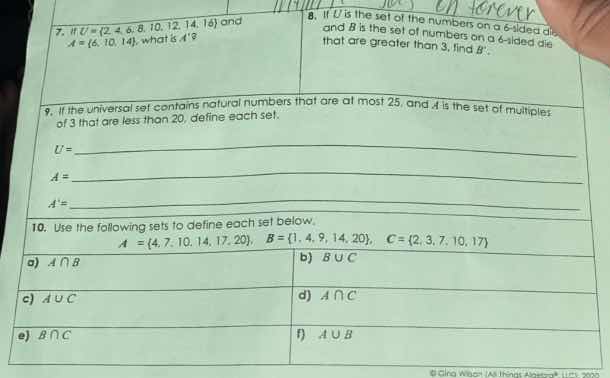
Question
- if ( u = {2, 4, 6, 8, 10, 12, 14} ) and ( a = {6, 10, 14} ), what is ( a )?
- if ( u ) is the set of the numbers on a 6 - sided die and ( b ) is the set of numbers on a 6 - sided die that are greater than 3, find ( b ).
- if the universal set contains natural numbers that are at most 25, and ( a ) is the set of multiples of 3 that are less than 20, define each set.
( u = )
( a = )
( a = )
- use the following sets to define each set below.
( a = {4, 7, 10, 14, 17, 20}, b = {1, 4, 9, 14, 20}, c = {2, 3, 7, 10, 17} )
a) ( a cap b )
b) ( b cup c )
c) ( a cup c )
d) ( a cap c )
e) ( b cap c )
f) ( a cup b )
Problem 7
Step 1: Recall Complement Definition
The complement of a set \( A \) (denoted \( A' \)) is the set of all elements in the universal set \( U \) that are not in \( A \). Given \( U = \{2, 4, 6, 8, 10, 12, 14\} \) and \( A = \{6, 10, 14\} \).
Step 2: Identify Elements in \( U \) Not in \( A \)
Check each element in \( U \):
- \( 2
otin A \), so \( 2 \) is in \( A' \).
- \( 4
otin A \), so \( 4 \) is in \( A' \).
- \( 6 \in A \), so \( 6 \) is not in \( A' \).
- \( 8
otin A \), so \( 8 \) is in \( A' \).
- \( 10 \in A \), so \( 10 \) is not in \( A' \).
- \( 12
otin A \), so \( 12 \) is in \( A' \).
- \( 14 \in A \), so \( 14 \) is not in \( A' \).
So \( A' = \{2, 4, 8, 12\} \).
Step 1: Define Universal Set for Die
A 6 - sided die has numbers \( \{1, 2, 3, 4, 5, 6\} \), so \( U=\{1, 2, 3, 4, 5, 6\} \).
Step 2: Define Set \( B \)
\( B \) is the set of numbers on the die greater than 3. So \( B = \{4, 5, 6\} \).
Step 3: Find Complement of \( B \) (\( B' \))
The complement of \( B \) is the set of elements in \( U \) not in \( B \). Elements in \( U \) not in \( B \) are \( 1, 2, 3 \). So \( B'=\{1, 2, 3\} \).
Step 1: Define Universal Set \( U \)
The universal set \( U \) contains natural numbers that are at most 25. Natural numbers start from 1, so \( U=\{1, 2, 3, \dots, 25\} \).
Step 2: Define Set \( A \)
\( A \) is the set of multiples of 3 that are less than 20. Multiples of 3 less than 20: \( 3\times1 = 3 \), \( 3\times2 = 6 \), \( 3\times3 = 9 \), \( 3\times4 = 12 \), \( 3\times5 = 15 \), \( 3\times6 = 18 \). So \( A = \{3, 6, 9, 12, 15, 18\} \).
Step 3: Define Complement of \( A \) (\( A' \))
\( A' \) is the set of elements in \( U \) not in \( A \). So we list all elements in \( U \) (\( 1, 2, 3, \dots, 25 \)) and remove elements of \( A \). Thus, \( A'=\{1, 2, 4, 5, 7, 8, 10, 11, 13, 14, 16, 17, 19, 20, 21, 22, 23, 24, 25\} \).

Snap & solve any problem in the app
Get step-by-step solutions on Sovi AI
Photo-based solutions with guided steps
Explore more problems and detailed explanations
\( A' = \{2, 4, 8, 12\} \)