QUESTION IMAGE
Question
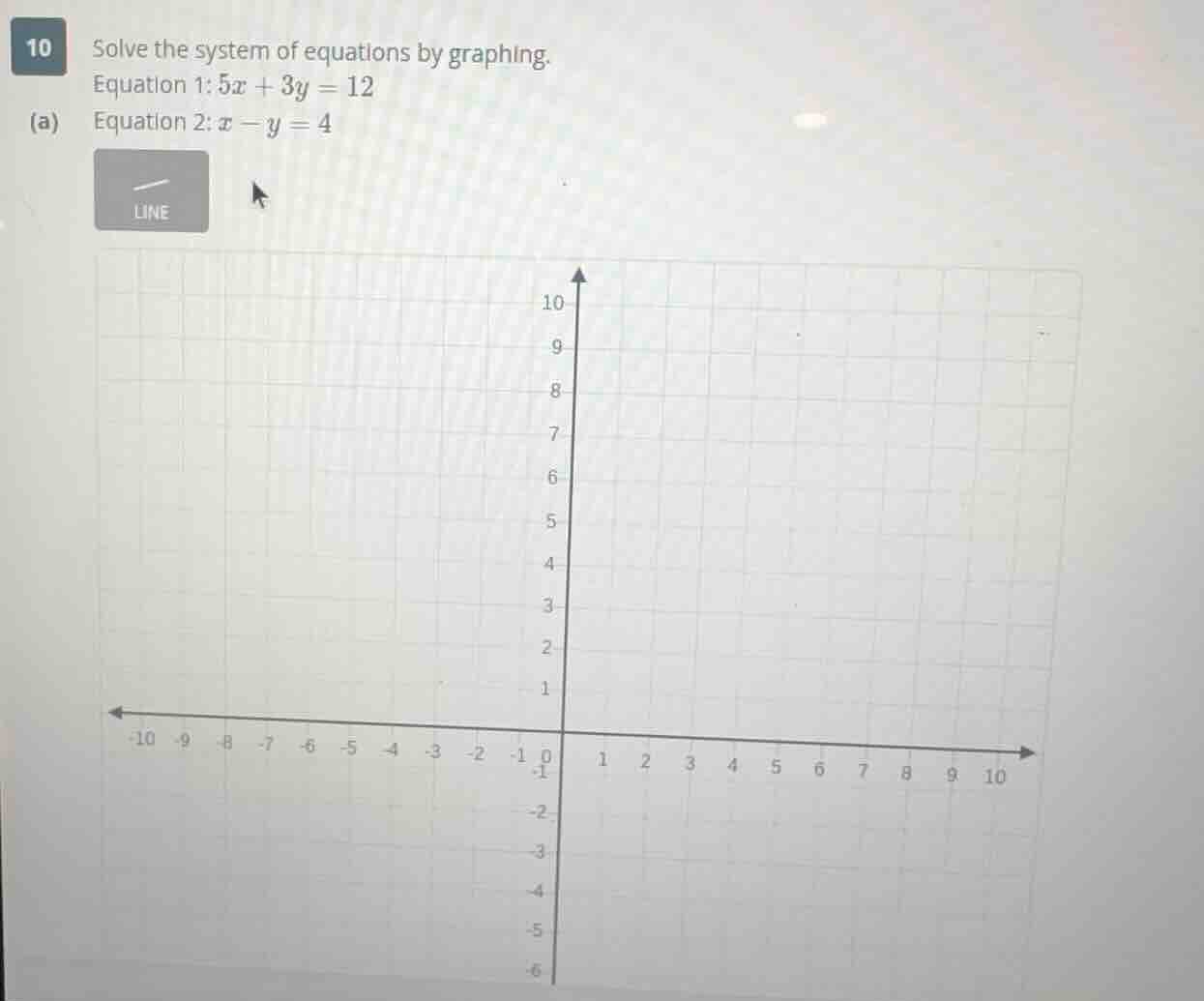
10 (a) solve the system of equations by graphing. equation 1: $5x + 3y = 12$ equation 2: $x - y = 4$
Step1: Rewrite Equation 1 in slope - intercept form
We start with the equation \(5x + 3y=12\). We want to solve for \(y\) in terms of \(x\).
Subtract \(5x\) from both sides: \(3y=- 5x + 12\).
Then divide each term by 3: \(y =-\frac{5}{3}x+4\).
To find two points on this line, we can use the \(y\) - intercept and another point. The \(y\) - intercept is when \(x = 0\), so when \(x = 0\), \(y=4\). Let's find another point. Let \(x = 3\), then \(y=-\frac{5}{3}(3)+4=-5 + 4=-1\). So two points on the line \(5x + 3y = 12\) are \((0,4)\) and \((3,-1)\).
Step2: Rewrite Equation 2 in slope - intercept form
We start with the equation \(x - y=4\). Solve for \(y\):
Subtract \(x\) from both sides: \(-y=-x + 4\).
Multiply both sides by \(- 1\): \(y=x - 4\).
The \(y\) - intercept is when \(x = 0\), so \(y=-4\). Let's find another point. Let \(x = 4\), then \(y=4 - 4=0\). So two points on the line \(x - y = 4\) are \((0,-4)\) and \((4,0)\).
Step3: Graph the two lines
Plot the points for each line. For \(y =-\frac{5}{3}x + 4\), plot \((0,4)\) and \((3,-1)\) and draw the line through them. For \(y=x - 4\), plot \((0,-4)\) and \((4,0)\) and draw the line through them.
Step4: Find the intersection point
The intersection point of the two lines is the solution to the system of equations. By looking at the graph (or by solving the system algebraically, but since we are graphing), we can see that the two lines intersect at the point \((3,-1)\)? Wait, no, let's check algebraically. Let's set the two equations equal to each other:
\(-\frac{5}{3}x + 4=x - 4\)
Add \(\frac{5}{3}x\) to both sides: \(4=\frac{5}{3}x+x - 4\)
Combine like terms: \(4=\frac{5x + 3x}{3}-4\)
\(4=\frac{8x}{3}-4\)
Add 4 to both sides: \(8=\frac{8x}{3}\)
Multiply both sides by \(\frac{3}{8}\): \(x = 3\)
Substitute \(x = 3\) into \(y=x - 4\), we get \(y=3 - 4=-1\)? Wait, no, if we substitute \(x = 3\) into \(y =-\frac{5}{3}x+4\), \(y=-\frac{5}{3}(3)+4=-5 + 4=-1\). And if we substitute \(x = 3\) into \(y=x - 4\), \(y=3 - 4=-1\). Wait, but let's check with the first equation: \(5(3)+3(-1)=15 - 3 = 12\), which is correct. And for the second equation: \(3-(-1)=3 + 1=4\), which is correct. Wait, but when we graph the lines:
For \(y =-\frac{5}{3}x + 4\), when \(x = 0\), \(y = 4\); when \(x=3\), \(y=-1\).
For \(y=x - 4\), when \(x = 0\), \(y=-4\); when \(x = 4\), \(y = 0\).
When we draw these two lines, the intersection point is \((3,-1)\)? Wait, no, let's re - check the equations. Wait, maybe I made a mistake in the graphing points. Let's take another approach. Let's find the intersection by solving the system:
From equation 2: \(x=y + 4\). Substitute into equation 1:
\(5(y + 4)+3y=12\)
\(5y+20 + 3y=12\)
\(8y=12 - 20=-8\)
\(y=-1\)
Then \(x=y + 4=-1 + 4 = 3\). So the solution is \((3,-1)\).

Snap & solve any problem in the app
Get step-by-step solutions on Sovi AI
Photo-based solutions with guided steps
Explore more problems and detailed explanations
The solution to the system of equations is \((3,-1)\)