QUESTION IMAGE
Question
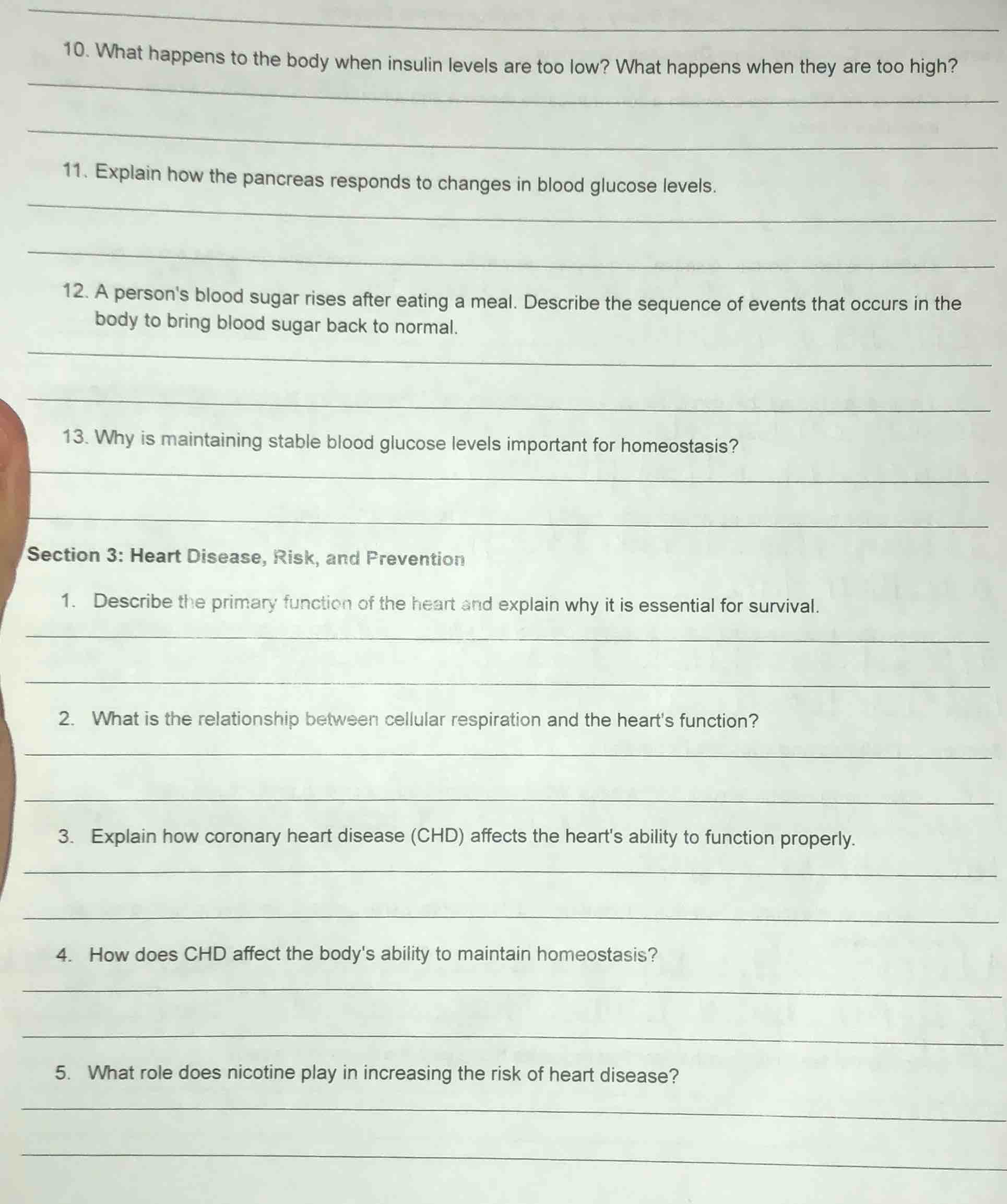
- what happens to the body when insulin levels are too low? what happens when they are too high?
- explain how the pancreas responds to changes in blood glucose levels.
- a persons blood sugar rises after eating a meal. describe the sequence of events that occurs in the body to bring blood sugar back to normal.
- why is maintaining stable blood glucose levels important for homeostasis?
section 3: heart disease, risk, and prevention
- describe the primary function of the heart and explain why it is essential for survival.
- what is the relationship between cellular respiration and the hearts function?
- explain how coronary heart disease (chd) affects the hearts ability to function properly.
- how does chd affect the bodys ability to maintain homeostasis?
- what role does nicotine play in increasing the risk of heart disease?
Brief Explanations
Questions 10-13 (Blood Glucose Regulation)
- Low insulin: Cells can't take up glucose; blood glucose rises (hyperglycemia), cells starve, leading to symptoms like fatigue, frequent urination, and in severe cases, diabetic ketoacidosis. High insulin: Blood glucose drops too low (hypoglycemia), causing shakiness, dizziness, confusion, as cells lack enough glucose for energy.
- The pancreas has islet cells: when blood glucose is high, beta cells secrete insulin; when blood glucose is low, alpha cells secrete glucagon to raise levels.
- 1. Meal digestion raises blood glucose. 2. Pancreas beta cells secrete insulin. 3. Insulin signals cells (liver, muscle, fat) to absorb glucose. 4. Glucose is stored as glycogen (liver/muscle) or fat, lowering blood glucose to normal.
- Glucose is the primary energy source for cells (especially the brain). Stable levels ensure consistent energy supply, prevent damage from high glucose (nerve, blood vessel damage) or low glucose (brain dysfunction), supporting overall organ function and homeostasis.
Section 3: Heart Disease, Risk, and Prevention
- The heart's primary function is to pump oxygen-rich blood to body tissues and oxygen-poor blood to the lungs. It is essential because all cells need oxygen and nutrients delivered by blood, and waste removed; without this, cells die, leading to organ failure and death.
- Cellular respiration uses oxygen to produce ATP (cell energy) from glucose. The heart pumps oxygen-rich blood to cells for this process; in turn, ATP powers the heart muscle's contractions to keep pumping blood.
- CHD narrows coronary arteries (which supply the heart muscle with blood) via plaque buildup. This reduces oxygen and nutrient flow to the heart muscle, causing chest pain (angina), and if arteries are blocked, a heart attack, which damages or kills heart muscle cells, weakening the heart's pumping ability.
- CHD reduces the heart's ability to pump blood effectively. This lowers oxygen delivery to tissues, disrupts nutrient/waste exchange, and impairs the body's ability to regulate blood pressure, temperature, and other critical homeostatic functions.
- Nicotine raises blood pressure and heart rate, increasing the heart's workload. It also damages blood vessel walls, promotes plaque buildup, and reduces oxygen delivery to the heart, all of which increase the risk of CHD, heart attack, and stroke.

Snap & solve any problem in the app
Get step-by-step solutions on Sovi AI
Photo-based solutions with guided steps
Explore more problems and detailed explanations
Questions 10-13
- Low insulin: Hyperglycemia, cell energy shortage, symptoms like fatigue, ketoacidosis. High insulin: Hypoglycemia, symptoms like shakiness, confusion.
- Pancreas uses beta cells (secrete insulin when glucose high) and alpha cells (secrete glucagon when glucose low).
- 1. Meal raises blood glucose. 2. Pancreas releases insulin. 3. Cells absorb glucose. 4. Glucose stored, levels normalize.
- Ensures consistent cell energy, prevents damage from extreme glucose levels, supports organ function.
Section 3
- Primary function: Pump oxygen-rich blood to tissues, oxygen-poor blood to lungs. Essential: Delivers oxygen/nutrients, removes waste; cells die without it.
- Cellular respiration needs oxygen from heart-pumped blood to make ATP; ATP powers heart contractions.
- Narrows coronary arteries, reduces oxygen to heart muscle; causes angina, heart attacks, weakens heart function.
- Reduces blood flow to tissues, impairs oxygen/nutrient/waste exchange, disrupts blood pressure and other homeostatic regulation.
- Raises blood pressure/heart rate, damages blood vessels, promotes plaque buildup, increasing CHD risk.