QUESTION IMAGE
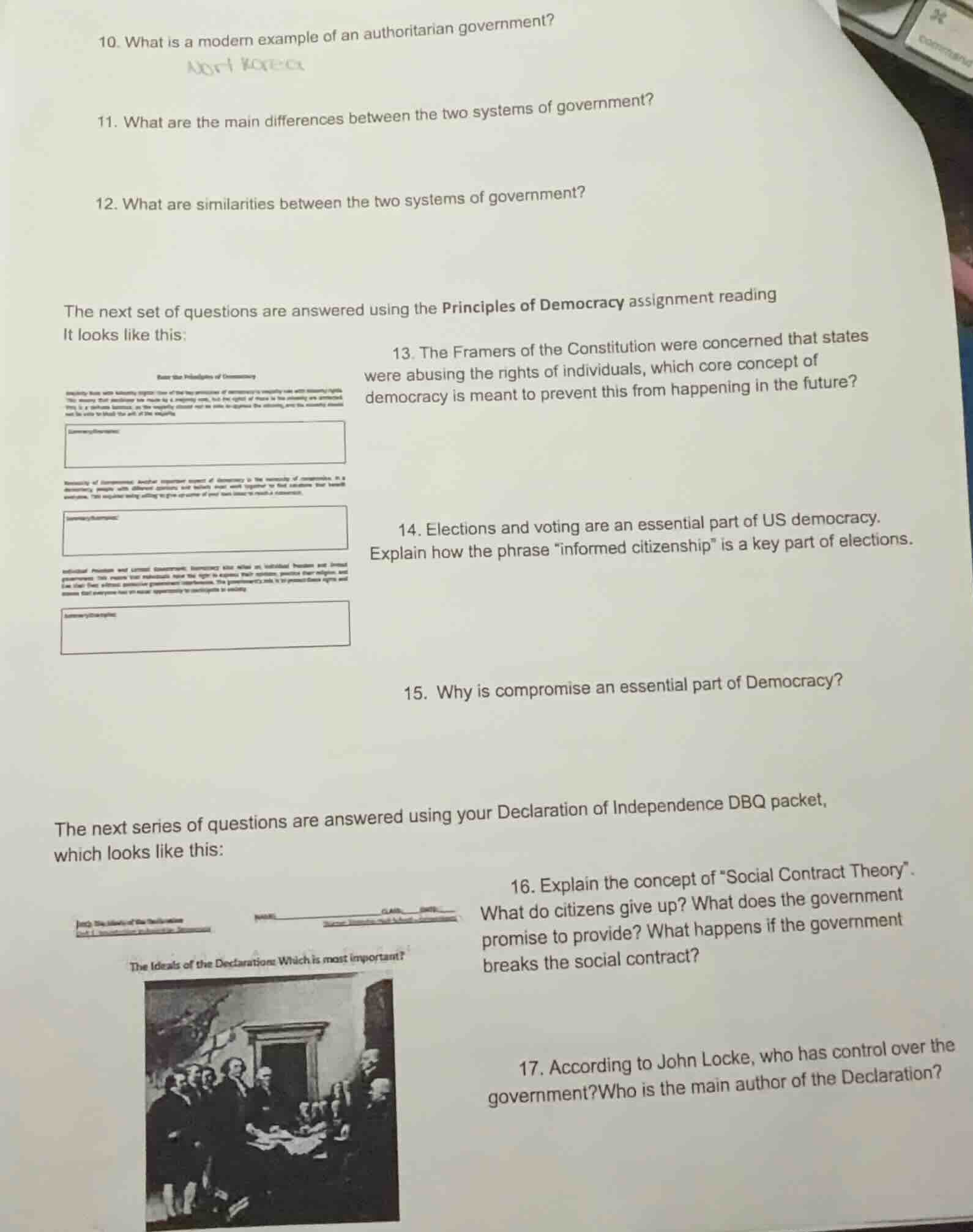
Question
- what is a modern example of an authoritarian government?
- what are the main differences between the two systems of government?
- what are similarities between the two systems of government?
the next set of questions are answered using the principles of democracy assignment reading
it looks like this:
- the framers of the constitution were concerned that states were abusing the rights of individuals, which core concept of democracy is meant to prevent this from happening in the future?
- elections and voting are an essential part of us democracy. explain how the phrase \informed citizenship\ is a key part of elections.
- why is compromise an essential part of democracy?
the next series of questions are answered using your declaration of independence dbq packet, which looks like this:
- explain the concept of \social contract theory\. what do citizens give up? what does the government promise to provide? what happens if the government breaks the social contract?
- according to john locke, who has control over the government?who is the main author of the declaration?
Brief Explanations
- Identifies a current authoritarian state with centralized, unaccountable rule.
- Compares authority source, citizen rights, and accountability.
- Notes shared goal of governing a population.
- References democracy's core check on majority overreach.
- Links informed choices to legitimate election outcomes.
- Explains compromise's role in reconciling diverse democratic views.
- Breaks down the social contract's core components and consequences.
- Cites Locke's theory and historical authorship fact.

Snap & solve any problem in the app
Get step-by-step solutions on Sovi AI
Photo-based solutions with guided steps
Explore more problems and detailed explanations
- North Korea (a modern state with centralized, non-democratic, authoritarian control over all aspects of society, limited political freedoms, and no free elections)
- - Source of power: Authoritarian governments concentrate power in a single leader/elite group; democratic governments derive power from the people via elections.
- Citizen rights: Authoritarian systems restrict political freedoms (free speech, assembly, opposition parties); democratic systems protect these rights and enable citizen participation.
- Accountability: Authoritarian leaders face no meaningful checks or electoral accountability; democratic leaders are accountable to voters and independent institutions.
- - Both systems exist to maintain order and govern a territory and population.
- Both establish rules, laws, and institutions to manage societal functions (e.g., infrastructure, public services).
- The core concept of limited government (and protection of individual rights against the tyranny of the majority) – this ensures states cannot overstep their authority and violate individual liberties, as the Constitution sets boundaries on government power.
- Informed citizenship means voters research candidates, policy positions, and election issues. This ensures votes are based on understanding rather than misinformation, leading to legitimate, representative election outcomes that reflect the public's actual interests, which is foundational to democratic elections.
- Democracy includes diverse groups with competing interests. Compromise allows these groups to reach mutually acceptable solutions, prevents gridlock, ensures minority voices are considered, and maintains stability by avoiding the imposition of a single group's will on all others.
- - Social Contract Theory: An agreement between citizens and their government where citizens surrender some individual freedoms to the state in exchange for protection and order.
- What citizens give up: Unrestricted personal freedom (e.g., the right to act without consequence for harming others).
- What the government promises to provide: Protection of natural rights (life, liberty, property), public order, and access to basic societal services.
- If the government breaks the contract: Citizens have the right to revolt, replace the government, or resist its authority, as the government's legitimacy depends on upholding its end of the agreement.
- - According to John Locke, the people (citizens) have control over the government; the government's power is derived from the consent of the governed.
- The main author of the Declaration of Independence is Thomas Jefferson.