QUESTION IMAGE
Question
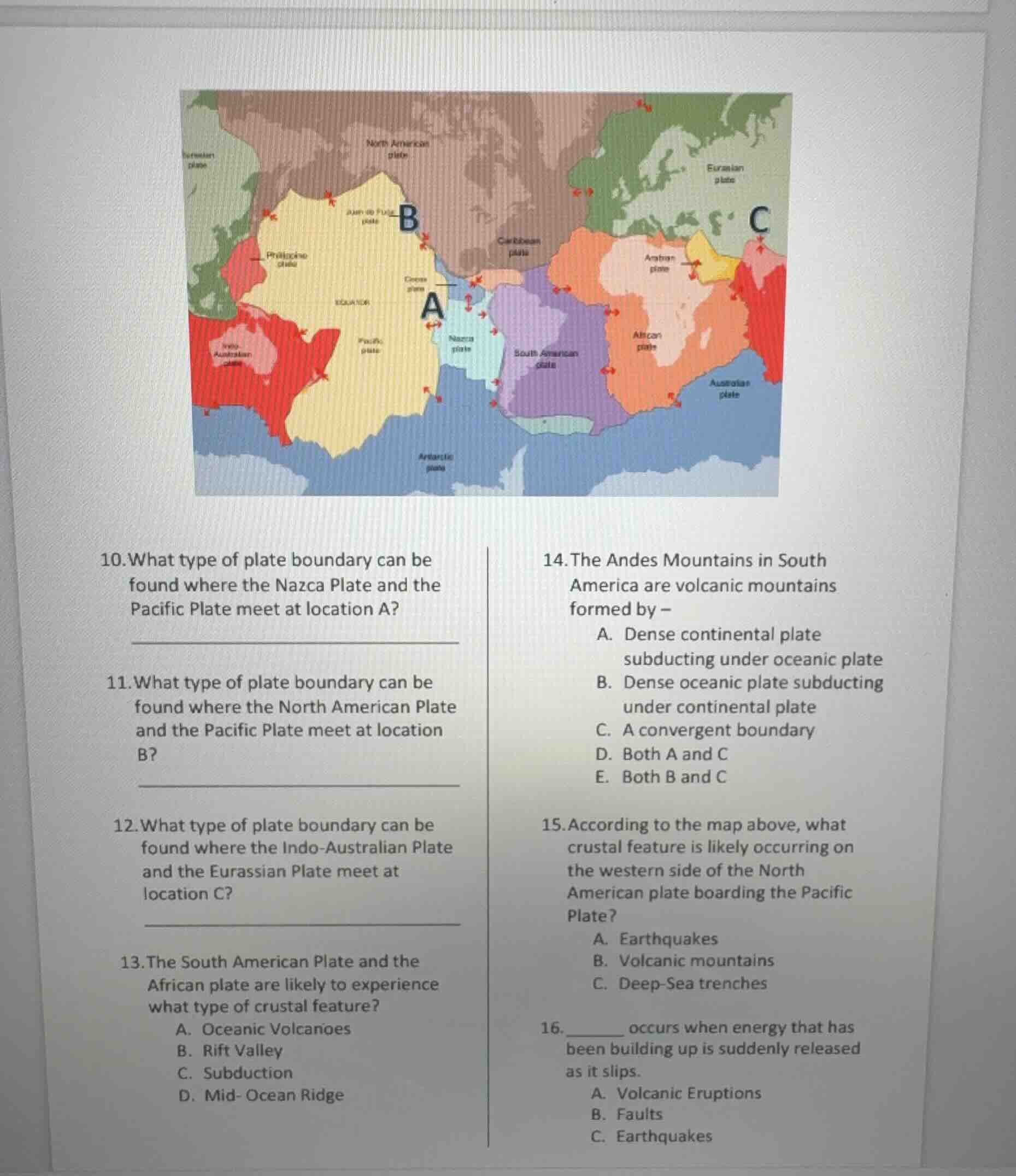
- what type of plate boundary can be found where the nazca plate and the pacific plate meet at location a?
- what type of plate boundary can be found where the north american plate and the pacific plate meet at location b?
- what type of plate boundary can be found where the indo - australian plate and the eurasian plate meet at location c?
- the south american plate and the african plate are likely to experience what type of crustal feature?
a. oceanic volcanoes
b. rift valley
c. subduction
d. mid - ocean ridge
- the andes mountains in south america are volcanic mountains formed by –
a. dense continental plate subducting under oceanic plate
b. dense oceanic plate subducting under continental plate
c. a convergent boundary
d. both a and c
e. both b and c
- according to the map above, what crustal feature is likely occurring on the western side of the north american plate boarding the pacific plate?
a. earthquakes
b. volcanic mountains
c. deep - sea trenches
- ______ occurs when energy that has been building up is suddenly released as it slips.
a. volcanic eruptions
b. faults
c. earthquakes
Question 10
The Nazca Plate and Pacific Plate at location A are moving apart (divergent boundary? Wait, no—wait, Nazca and Pacific: actually, the Nazca Plate and Pacific Plate meet at a convergent boundary? Wait, no, the Nazca Plate is oceanic, and when two oceanic plates meet, or Nazca and Pacific: wait, the Nazca Plate is being subducted? No, wait, the boundary between Nazca and Pacific: actually, the Nazca Plate and Pacific Plate have a convergent boundary? Wait, no, the correct type here: the Nazca Plate and Pacific Plate meet at a convergent boundary? Wait, no, the Nazca Plate is moving towards the South American Plate, but at location A (between Nazca and Pacific), actually, the Nazca Plate and Pacific Plate: the Nazca Plate is oceanic, and when two oceanic plates converge, one subducts. But wait, the arrows: if the arrows are moving towards each other? Wait, the map shows arrows. Wait, the Nazca Plate and Pacific Plate at location A: the correct plate boundary type is convergent? Wait, no, maybe I got it wrong. Wait, the Nazca Plate and Pacific Plate: the boundary between them is a convergent boundary? Wait, no, the Nazca Plate is subducting under the South American Plate, but at location A (between Nazca and Pacific), maybe it's a convergent boundary? Wait, no, the correct answer for Q10: the boundary between Nazca and Pacific Plate is a convergent boundary? Wait, no, let's recall: the Nazca Plate and Pacific Plate meet at a convergent boundary (subduction zone), but actually, the Nazca Plate is oceanic, and when two oceanic plates converge, one subducts. But the question is about Nazca and Pacific. Wait, maybe the correct type is convergent (subduction) or divergent? Wait, no, the Nazca Plate is moving towards the east, and the Pacific Plate is moving towards the west? Wait, no, the arrows: if the arrows at location A are pointing towards each other, then it's convergent. Wait, the correct answer for Q10 is convergent boundary? Wait, no, maybe I'm mixing up. Wait, the Nazca Plate and Pacific Plate: the boundary between them is a convergent boundary (subduction zone), so the type is convergent (or more specifically, ocean - ocean convergent, subduction). But the question is asking for the type. So the answer is convergent boundary (or subduction zone, but the general type is convergent). Wait, no, let's check: the Nazca Plate and Pacific Plate meet at a convergent boundary (subduction), so the type is convergent. Wait, no, maybe the correct answer is convergent boundary (subduction). But let's confirm: plate boundaries: divergent (moving apart), convergent (moving together), transform (sliding past). At location A, between Nazca and Pacific, the plates are moving towards each other (convergent), so the type is convergent boundary (specifically, ocean - ocean convergent, subduction). So the answer is convergent boundary (or subduction zone, but the general type is convergent).
The North American Plate and Pacific Plate at location B: this is the San Andreas Fault area, which is a transform boundary (plates slide past each other). The arrows at location B: if they are sliding past (transform), then the type is transform boundary.
The Indo - Australian Plate and Eurasian Plate at location C: these are two continental plates converging (since both are continental), so the boundary type is convergent (continental - continental convergent), which forms mountains (like the Himalayas). So the type is convergent boundary (continental - continental).

Snap & solve any problem in the app
Get step-by-step solutions on Sovi AI
Photo-based solutions with guided steps
Explore more problems and detailed explanations
Convergent boundary (or more specifically, ocean - ocean convergent/subduction zone)