QUESTION IMAGE
Question
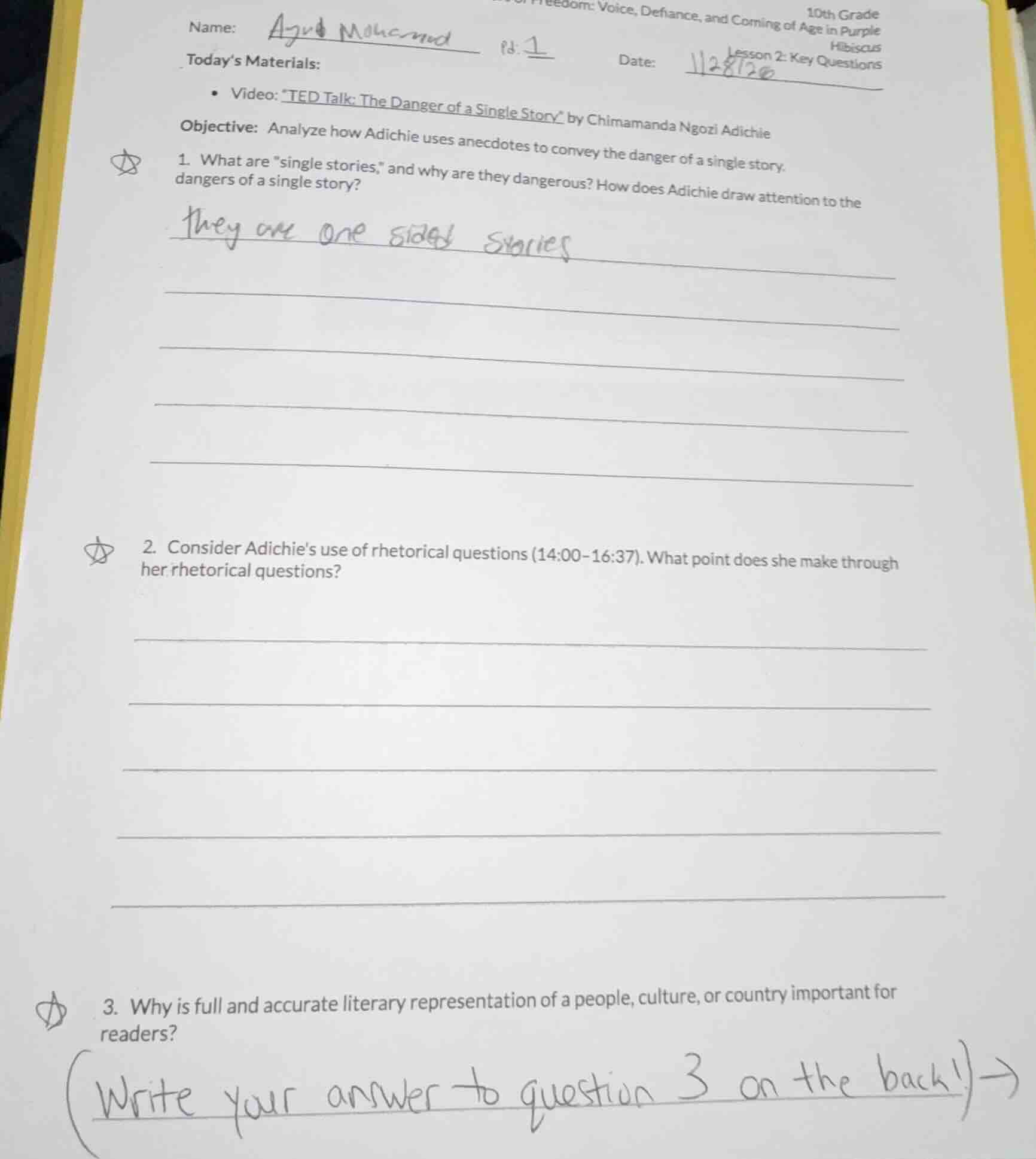
10th grade
om: voice, defiance, and coming of age in purple
hibiscus
lesson 2: key questions
name:
pd: 1
date:
today’s materials:
- video: “ted talk: the danger of a single story” by chimamanda ngozi adichie
objective: analyze how adichie uses anecdotes to convey the danger of a single story.
- what are \single stories,\ and why are they dangerous? how does adichie draw attention to the dangers of a single story?
- consider adichies use of rhetorical questions (14:00 - 16:37). what point does she make through her rhetorical questions?
- why is full and accurate literary representation of a people, culture, or country important for readers?
Question 1
A “single story” is a one - dimensional, stereotyped narrative about a group, person, or place. It’s dangerous because it reduces complexity, creates stereotypes, and erases the full humanity and diversity of the subject. Adichie draws attention to this danger by sharing her own anecdotes (like her experience with her houseboy’s family and her early views of literature) to show how single stories form and the harm they cause.
In the 14:00 - 16:37 section, Adichie’s rhetorical questions (e.g., about how people see Africa) make the audience reflect on their own single stories. She uses them to highlight the narrowness of single - story thinking and to push the audience to recognize the need for multiple, accurate narratives.
Full and accurate literary representation is important because it helps readers develop empathy, understand the true diversity of people/cultures/countries, and avoid the harm of single stories. It allows readers to see the full humanity, complexity, and uniqueness of the represented group, rather than being limited by stereotypes.

Snap & solve any problem in the app
Get step-by-step solutions on Sovi AI
Photo-based solutions with guided steps
Explore more problems and detailed explanations
A “single story” is a one - sided, stereotyped narrative about a group, person, or place. It is dangerous as it creates stereotypes, ignores complexity, and erases the full identity of the subject. Adichie uses her own anecdotes (e.g., about her houseboy’s family, her early literary views) to show how single stories form and their harmful effects.