QUESTION IMAGE
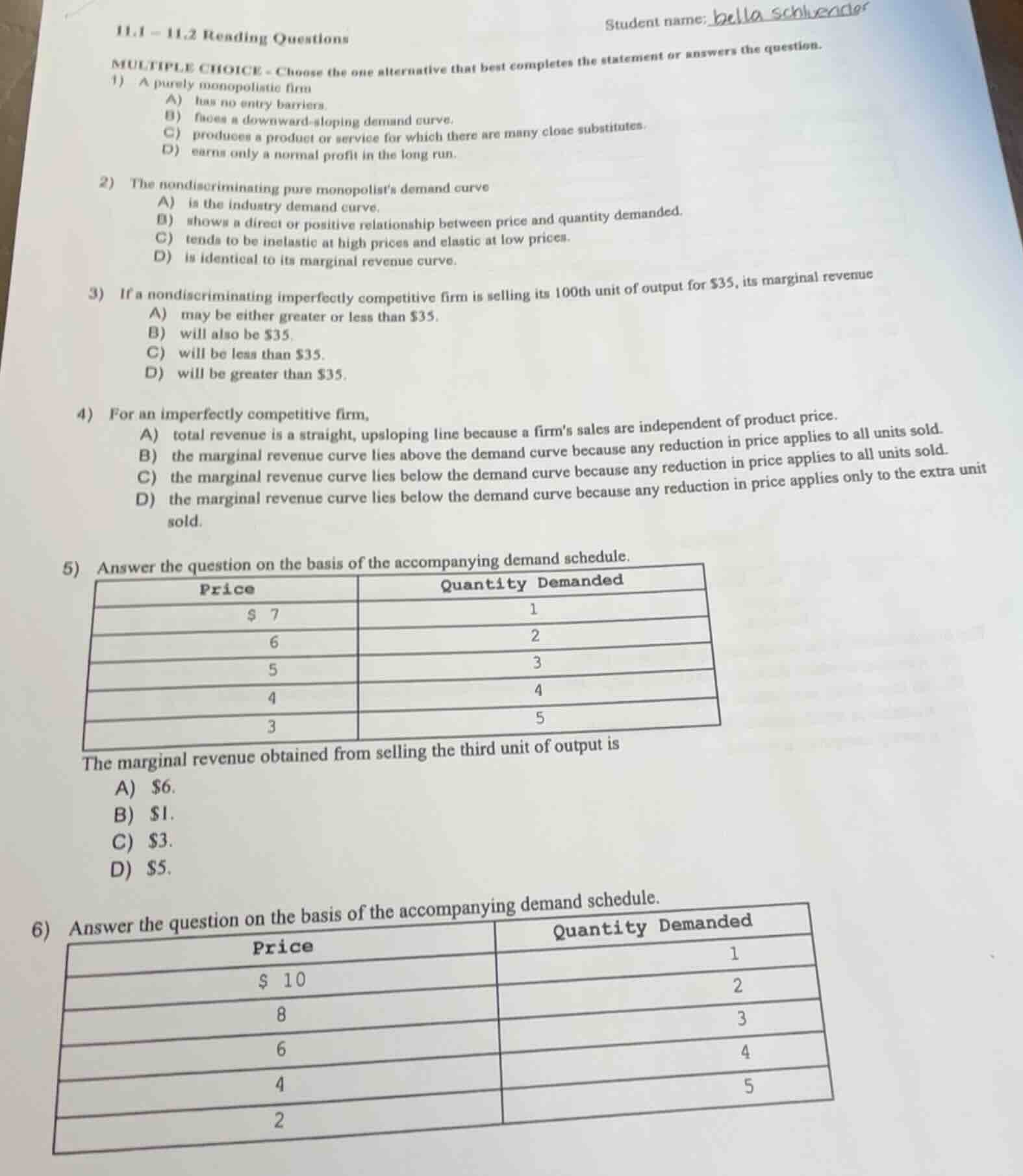
Question
11.1 - 11.2 reading questions
student name: bella schlender
multiple choice - choose the one alternative that best completes the statement or answers the question.
- a purely monopolistic firm
a) has no entry barriers.
b) faces a downward - sloping demand curve.
c) produces a product or service for which there are many close substitutes.
d) earns only a normal profit in the long run.
- the nondiscriminating pure monopolists demand curve
a) is the industry demand curve.
b) shows a direct or positive relationship between price and quantity demanded.
c) tends to be inelastic at high prices and elastic at low prices.
d) is identical to its marginal revenue curve.
- if a nondiscriminating imperfectly competitive firm is selling its 100th unit of output for $35, its marginal revenue
a) may be either greater or less than $35.
b) will also be $35.
c) will be less than $35.
d) will be greater than $35.
- for an imperfectly competitive firm,
a) total revenue is a straight, upsloping line because a firms sales are independent of product price.
b) the marginal revenue curve lies above the demand curve because any reduction in price applies to all units sold.
c) the marginal revenue curve lies below the demand curve because any reduction in price applies only to the extra unit
d) the marginal revenue curve lies below the demand curve because any reduction in price applies only to the extra unit sold.
- answer the question on the basis of the accompanying demand schedule.
| price | quantity demanded |
|---|---|
| 6 | 2 |
| 5 | 3 |
| 4 | 4 |
| 3 | 5 |
the marginal revenue obtained from selling the third unit of output is
a) $6.
b) $1.
c) $3.
d) $5.
- answer the question on the basis of the accompanying demand schedule.
| price | quantity demanded |
|---|---|
| 8 | 2 |
| 6 | 3 |
| 4 | 4 |
| 2 | 5 |
Question 1
A pure monopoly has a downward - sloping demand curve because it is the sole seller, and to sell more, it must lower the price. Option A is wrong as monopolies have high entry barriers. Option C is wrong as there are no close substitutes. Option D is wrong as monopolies can earn economic profits in the long run.
A non - discriminating pure monopolist's demand curve is the industry demand curve since it is the only firm in the industry. Option B is wrong as demand curve has an inverse relationship (price and quantity demanded). Option C is wrong about elasticity. Option D is wrong as MR curve is below the demand curve.
For a non - discriminating imperfectly competitive firm (like a monopolistically competitive or oligopolistic firm), the marginal revenue is less than the price when selling an additional unit because to sell more, the firm has to lower the price for all units, not just the additional one. So if the 100th unit is sold for $35, MR will be less than $35.

Snap & solve any problem in the app
Get step-by-step solutions on Sovi AI
Photo-based solutions with guided steps
Explore more problems and detailed explanations
B. faces a downward - sloping demand curve.