QUESTION IMAGE
Question
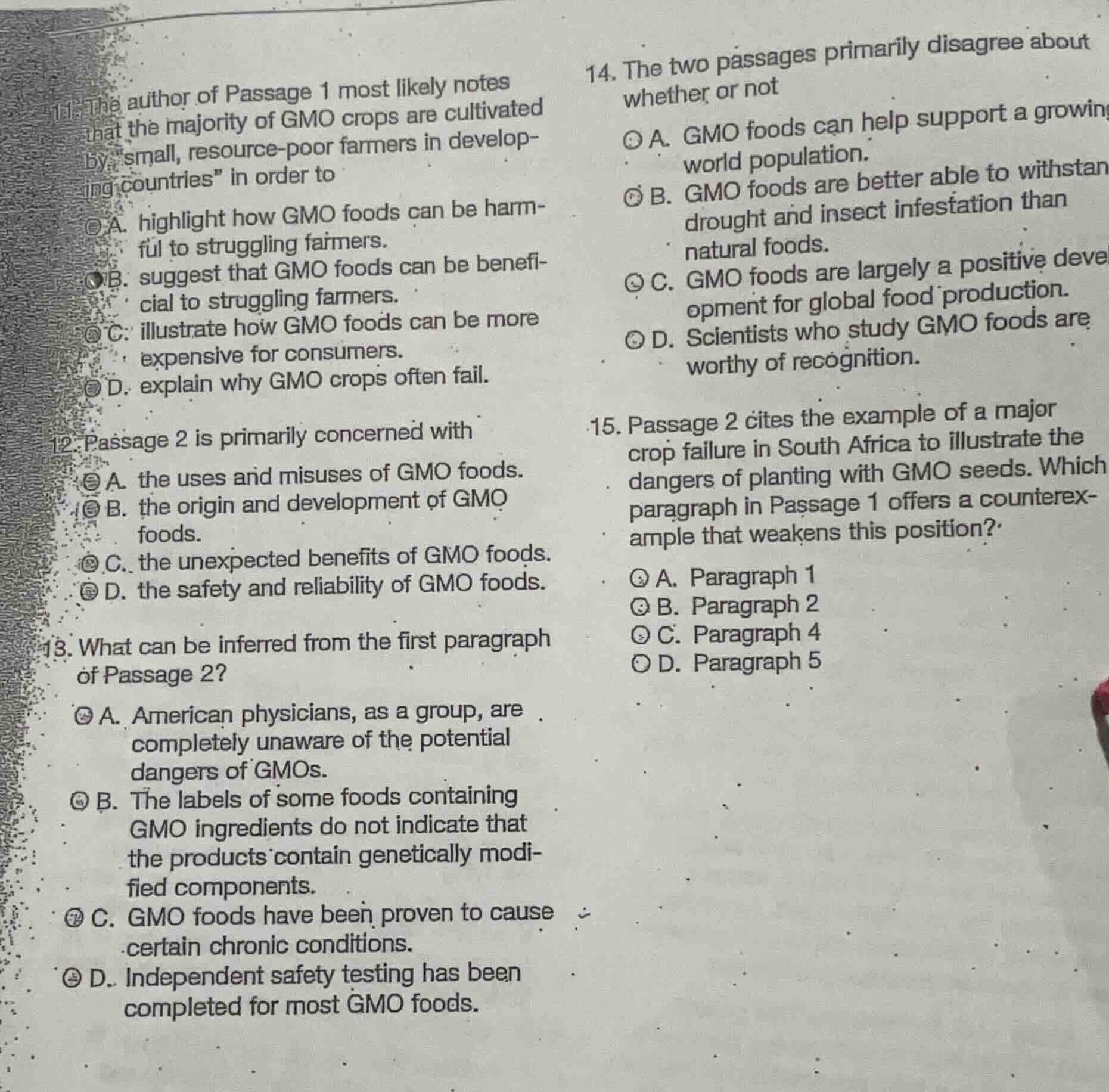
- the author of passage 1 most likely notes that the majority of gmo crops are cultivated by “small, resource - poor farmers in developing countries” in order to
a. highlight how gmo foods can be harmful to struggling farmers.
b. suggest that gmo foods can be beneficial to struggling farmers.
c. illustrate how gmo foods can be more expensive for consumers.
d. explain why gmo crops often fail.
- passage 2 is primarily concerned with
a. the uses and misuses of gmo foods.
b. the origin and development of gmo foods.
c. the unexpected benefits of gmo foods.
d. the safety and reliability of gmo foods.
- what can be inferred from the first paragraph of passage 2?
a. american physicians, as a group, are completely unaware of the potential dangers of gmos.
b. the labels of some foods containing gmo ingredients do not indicate that the products contain genetically modified components.
c. gmo foods have been proven to cause certain chronic conditions.
d. independent safety testing has been completed for most gmo foods.
- the two passages primarily disagree about whether or not
a. gmo foods can help support a growing world population.
b. gmo foods are better able to withstand drought and insect infestation than natural foods.
c. gmo foods are largely a positive development for global food production.
d. scientists who study gmo foods are worthy of recognition.
- passage 2 cites the example of a major crop failure in south africa to illustrate the dangers of planting with gmo seeds. which paragraph in passage 1 offers a counterexample that weakens this position?
a. paragraph 1
b. paragraph 2
c. paragraph 4
d. paragraph 5
Question 11
The author notes GMO crops are cultivated by small, resource - poor farmers in developing countries. Option A says it's to show harm, but cultivating by such farmers is more likely to show benefit. Option C is about cost, not related. Option D is about failure, not supported. So the purpose is to suggest benefit to struggling farmers.
Passage 2's main concern: Option A is about uses and misuses, but the options about safety (D), origin (B), or unexpected benefits (C) - if it's about safety and reliability (like concerns or support), D fits. The other options: A is too broad, B is about origin (not likely), C is about unexpected benefits (not the main focus). So it's about safety and reliability of GMO foods.
From Passage 2's first paragraph: Option A is extreme ("completely unaware"). Option C says GMOs cause chronic conditions, but the passage may not assert that. Option D says independent testing is done for most, not supported. Option B: if labels don't indicate GMO ingredients, that's a possible inference. So B is correct.

Snap & solve any problem in the app
Get step-by-step solutions on Sovi AI
Photo-based solutions with guided steps
Explore more problems and detailed explanations
B. suggest that GMO foods can be beneficial to struggling farmers.