QUESTION IMAGE
Question
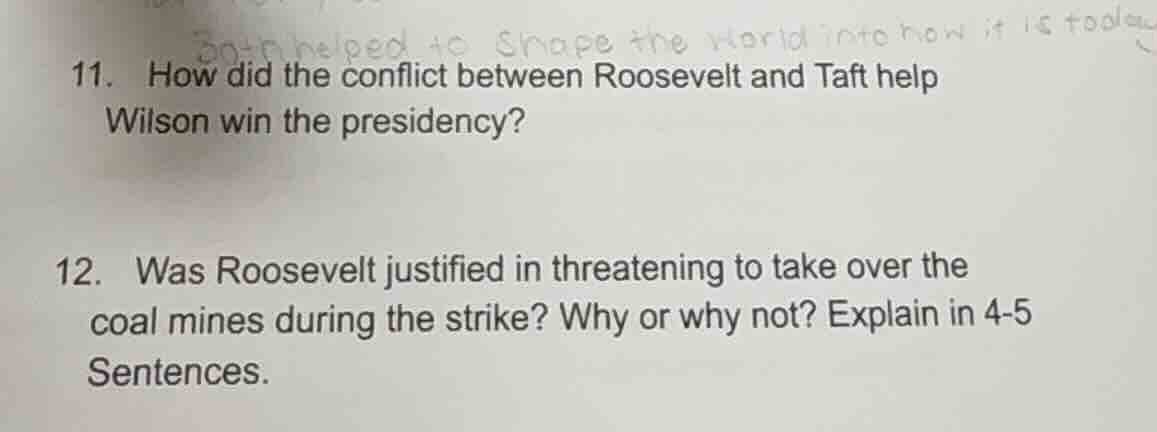
- how did the conflict between roosevelt and taft help wilson win the presidency?
- was roosevelt justified in threatening to take over the coal mines during the strike? why or why not? explain in 4-5 sentences.
For Question 11:
Roosevelt, a former Republican president, split from the GOP after losing the 1912 Republican nomination to Taft. He formed the Progressive (Bull Moose) Party, which siphoned conservative and progressive Republican voters away from Taft. This split divided the Republican vote, allowing Democratic candidate Woodrow Wilson to win a majority in the Electoral College with a plurality of the popular vote.
For Question 12:
Roosevelt was justified in threatening to take over the 1902 coal mines strike. The strike left millions of Americans without heat as winter approached, creating a public health and safety crisis. Mine owners refused to negotiate with union workers, rejecting calls for better pay, shorter hours, and recognition of the union. By threatening federal seizure, Roosevelt forced both sides to the negotiating table, establishing a precedent for federal intervention to protect public welfare during labor disputes, which ultimately led to a compromise that benefited workers and resolved the crisis.

Snap & solve any problem in the app
Get step-by-step solutions on Sovi AI
Photo-based solutions with guided steps
Explore more problems and detailed explanations
- The conflict between Roosevelt and Taft split the Republican Party: Roosevelt ran as a third-party (Progressive/Bull Moose) candidate against Republican incumbent Taft, dividing the Republican vote. This split allowed Democratic candidate Woodrow Wilson to win the 1912 presidential election with a plurality of the popular vote and a majority in the Electoral College, as the anti-Wilson vote was split between two candidates.
- Yes, Roosevelt was justified. The 1902 coal strike left millions of Americans facing a winter without heat, a critical public welfare crisis. Mine owners refused to negotiate with unionized workers, rejecting demands for fair pay and safer conditions. By threatening federal takeover of the mines, Roosevelt pressured both sides to negotiate, resulting in a compromise that protected public health and set a precedent for federal intervention to safeguard the public good during labor conflicts.