QUESTION IMAGE
Question
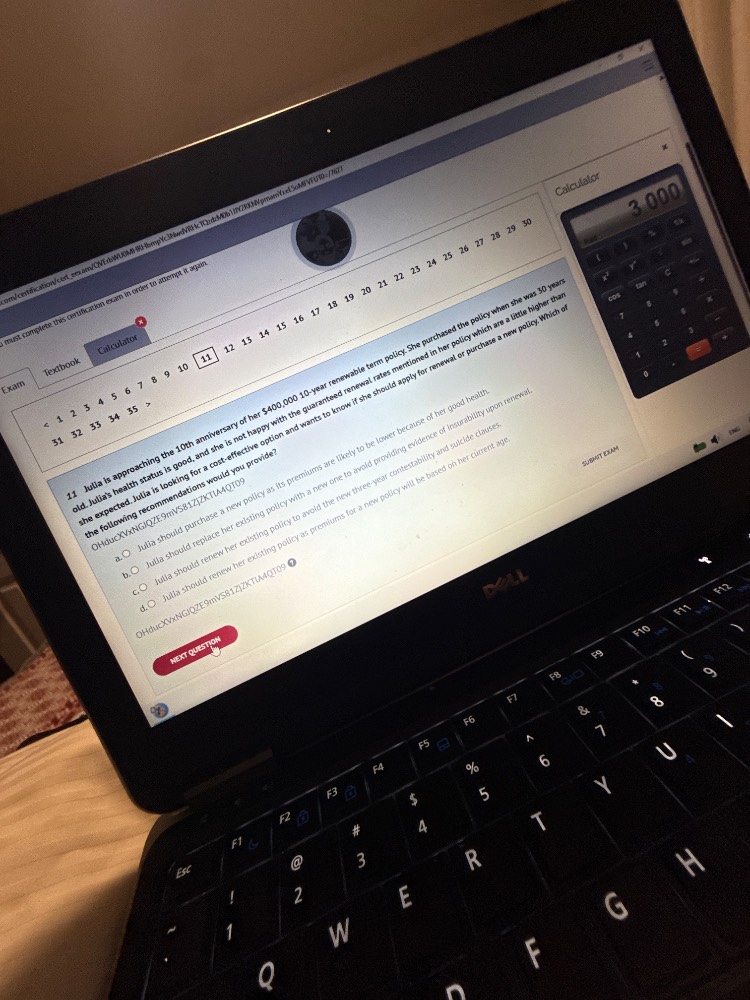
11 julia is approaching the 10th anniversary of her $400,000 10 - year renewable term policy. she purchased the policy when she was 30 years old. julias health status is good, and she is not happy with the guaranteed renewal term mentioned in the policy which are a little higher than she expected. julia is looking for a cost - effective option and wants to know if she should apply for renewal or purchase a new policy. which of the following recommendations would you provide? ohdcxwmoq2p3mvs1jz827txuakd79 a. julia should purchase a new policy as premiums are likely to be lower because of her good health. b. julia should replace her existing policy with a new one to avoid providing evidence of insurability upon renewal. c. julia should renew her existing policy to avoid the new ones three - year contestability and suicide clauses. d. julia should not do anything as premiums for a new policy will be based on her current age. next question
To solve this insurance - related problem, we analyze the situation based on insurance principles:
Step 1: Understand the Insurance Context
Julia has a 10 - year renewable term life insurance policy. When she purchased it, she was 30 years old and in good health. Now, as she approaches the 10 - year renewal, we need to consider the factors affecting insurance premiums.
Step 2: Analyze Each Option
- Option a: If Julia purchases a new policy, since she is now older (approaching 40, as she was 30 when she bought the 10 - year policy) and her health status may change over time (even though it's good now, there's a risk of future health issues), the premiums for a new policy are likely to be higher. So this option is not correct.
- Option b: Replacing the existing policy with a new one doesn't make sense from a cost - effectiveness perspective because, as mentioned, a new policy at her current age (closer to 40) will have higher premiums. So this option is incorrect.
- Option c: Renewing her existing policy is a better choice. Most renewable term life insurance policies offer the option to renew at the end of the term without a new medical exam. This means she can lock in the renewal at her original age (30 - year - old age - related premium structure, in a sense) or at least avoid the potential increase in premiums due to aging and possible future health problems. The policy's guaranteed renewal feature is designed to provide this continuity and affordability upon renewal. So this option is correct.
- Option d: There's no indication that Julia's policy will be locked in at her current age if she renews. The guaranteed renewal is about the right to renew without a medical exam, not necessarily locking in the age - based premium at the current age. And also, renewing is a better option than letting it lapse as letting it lapse would mean she loses the coverage and would have to go through the process of getting a new policy with potentially higher costs. So this option is incorrect.

Snap & solve any problem in the app
Get step-by-step solutions on Sovi AI
Photo-based solutions with guided steps
Explore more problems and detailed explanations
c. Julia should renew her existing policy to avoid the new one's potentially higher premiums due to her current age (and to take advantage of the guaranteed renewal without a new medical exam for continuity and affordability).