QUESTION IMAGE
Question
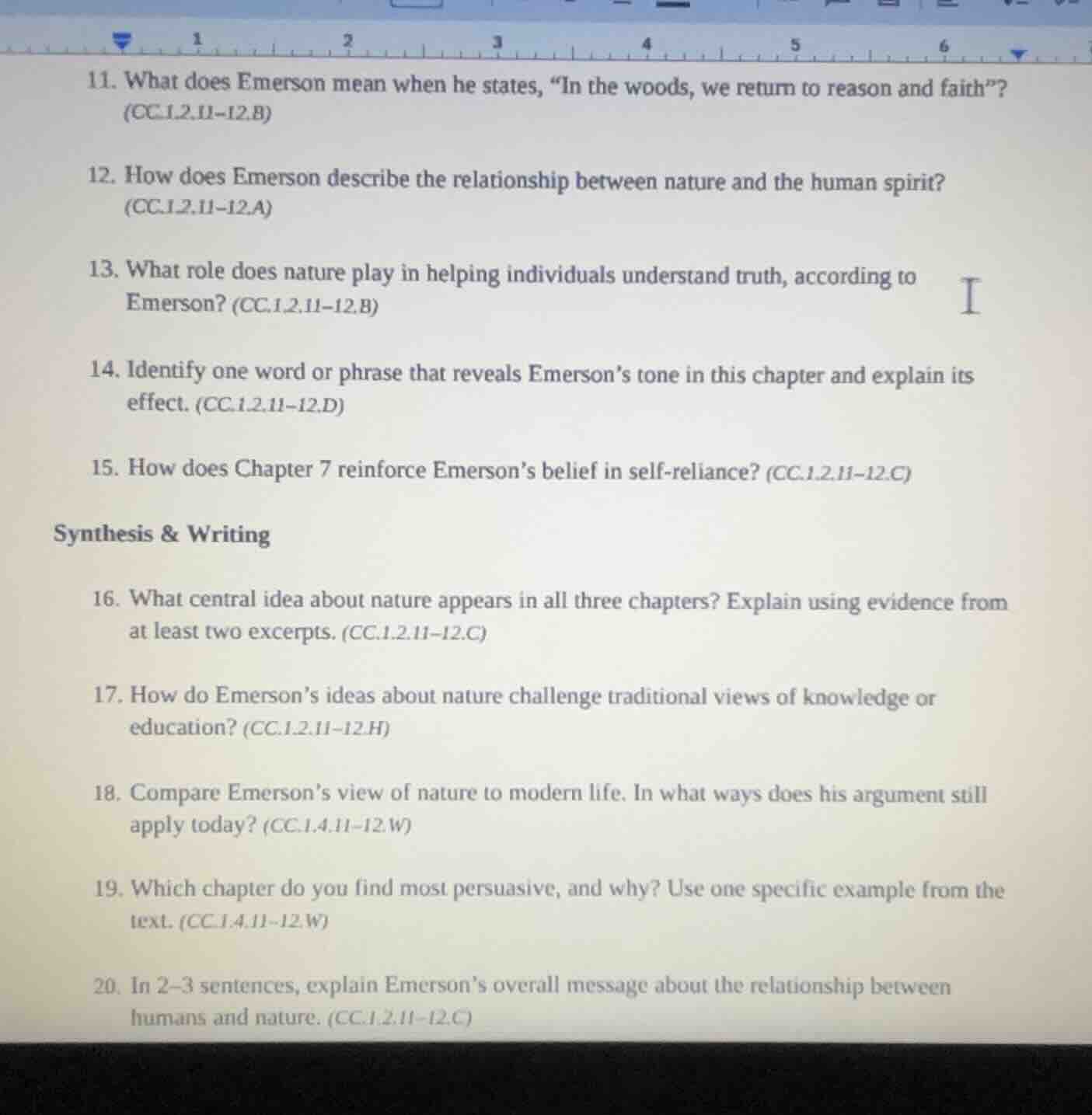
- what does emerson mean when he states, “in the woods, we return to reason and faith”? (cc.1.2.11-12.b)
- how does emerson describe the relationship between nature and the human spirit? (cc.1.2.11-12.a)
- what role does nature play in helping individuals understand truth, according to emerson? (cc.1.2.11-12.b)
- identify one word or phrase that reveals emerson’s tone in this chapter and explain its effect. (cc.1.2.11-12.d)
- how does chapter 7 reinforce emerson’s belief in self-reliance? (cc.1.2.11-12.c)
synthesis & writing
- what central idea about nature appears in all three chapters? explain using evidence from at least two excerpts. (cc.1.2.11-12.c)
- how do emerson’s ideas about nature challenge traditional views of knowledge or education? (cc.1.2.11-12.h)
- compare emerson’s view of nature to modern life. in what ways does his argument still apply today? (cc.1.4.11-12.w)
- which chapter do you find most persuasive, and why? use one specific example from the text. (cc.1.4.11-12.w)
- in 2-3 sentences, explain emerson’s overall message about the relationship between humans and nature. (cc.1.2.11-12.c)
Brief Explanations
These questions focus on Ralph Waldo Emerson's transcendentalist ideas, primarily from his work Nature and essays like Self-Reliance. Below are targeted, evidence-based answers for each:
- Emerson means nature strips away artificial social pressures, letting people reconnect with their innate moral compass (reason) and spiritual core (faith), free from societal dogma.
- He frames nature as a mirror for the human spirit: nature's beauty and order reflect the individual's inner divinity, and a harmonious connection to nature nurtures spiritual growth.
- Nature acts as a universal, unmediated teacher. It reveals eternal truths directly to the individual, bypassing formal learning, by aligning the person with cosmic order.
- A key phrase is "transparent eyeball" (from Nature). It conveys a tone of profound, mystical unity, emphasizing the dissolution of self to merge with nature, creating an intimate, reverent tone.
- Chapter 7 (of Self-Reliance) reinforces self-reliance by arguing that nature itself exemplifies self-sufficiency (e.g., plants grow independently), urging individuals to trust their own instincts as nature does its own course.
- The central idea is that nature is a source of spiritual and intellectual renewal, and a direct link to universal truth. In Nature, Emerson writes that nature "is not fixed but fluid" to reflect inner spiritual states; in Self-Reliance, he uses nature's self-sufficiency as a model for human self-trust.
- Traditional views held that knowledge comes from formal education or religious authority. Emerson argues truth is found directly in nature and one's own intuition, challenging the need for external mediators of knowledge.
- His argument still applies today: in an era of digital overstimulation, nature remains a space to escape societal noise, reconnect with personal values, and foster self-reliance (e.g., people seeking nature for mental health and mindfulness, aligning with his idea of nature as a restorative force).
- (Example) Chapter 1 of Nature is most persuasive. The "transparent eyeball" metaphor vividly illustrates the transcendent connection between self and nature, making the abstract idea of spiritual unity tangible and emotionally resonant.
- Emerson’s overall message is that humans and nature are inherently interconnected: nature is not just a physical space but a spiritual and intellectual companion that reflects our inner selves, teaches us self-reliance, and allows us to access universal truth when we embrace this intimate bond.

Snap & solve any problem in the app
Get step-by-step solutions on Sovi AI
Photo-based solutions with guided steps
Explore more problems and detailed explanations
- Emerson means nature frees people from societal constraints, allowing them to reconnect with their innate moral reason and spiritual faith, unclouded by human-made dogma.
- Emerson describes nature as a mirror for the human spirit: nature's order and beauty reflect the individual's inner divinity, and connecting with nature nurtures spiritual and intellectual growth.
- Nature acts as an unmediated, universal teacher, revealing eternal truths directly to individuals through personal experience, bypassing formal or institutional sources of knowledge.
- Phrase: "transparent eyeball" (from Nature). It creates a tone of mystical reverence, emphasizing the dissolution of self to merge fully with nature, making the spiritual connection feel intimate and tangible.
- Chapter 7 reinforces self-reliance by using nature's inherent self-sufficiency (e.g., plants growing independently) as a model, urging individuals to trust their own instincts and judgment as nature follows its own unguided, successful course.
- Central idea: Nature is a core source of spiritual renewal, self-understanding, and direct access to universal truth. Evidence 1: In Nature, Emerson writes that nature "is the vehicle of thought" that aligns humans with cosmic order. Evidence 2: In Self-Reliance, he uses nature's self-sufficiency to argue that individuals should reject conformity and trust their own inner voice.
- Traditional views framed knowledge as coming from formal education, religious texts, or authority figures. Emerson challenges this by claiming truth is found directly in nature and one's own intuition, arguing individuals do not need external mediators to access wisdom.
- Emerson’s argument applies today as nature remains a critical escape from digital and societal overstimulation; modern mindfulness and nature-based mental health practices echo his idea that nature restores clarity, fosters self-trust, and reconnects people to their core values.
- (Example) Chapter 1 of Nature is most persuasive. The "transparent eyeball" metaphor concretely illustrates the transcendent, unifying bond between the self and nature, turning an abstract spiritual concept into a vivid, relatable image that makes his argument feel immediate and powerful.
- Emerson’s overall message is that humans and nature are deeply, spiritually interconnected: nature reflects the inner divinity of the human spirit, serves as a teacher of self-reliance, and provides direct access to universal truth when individuals embrace this intimate, unmediated relationship.