QUESTION IMAGE
Question
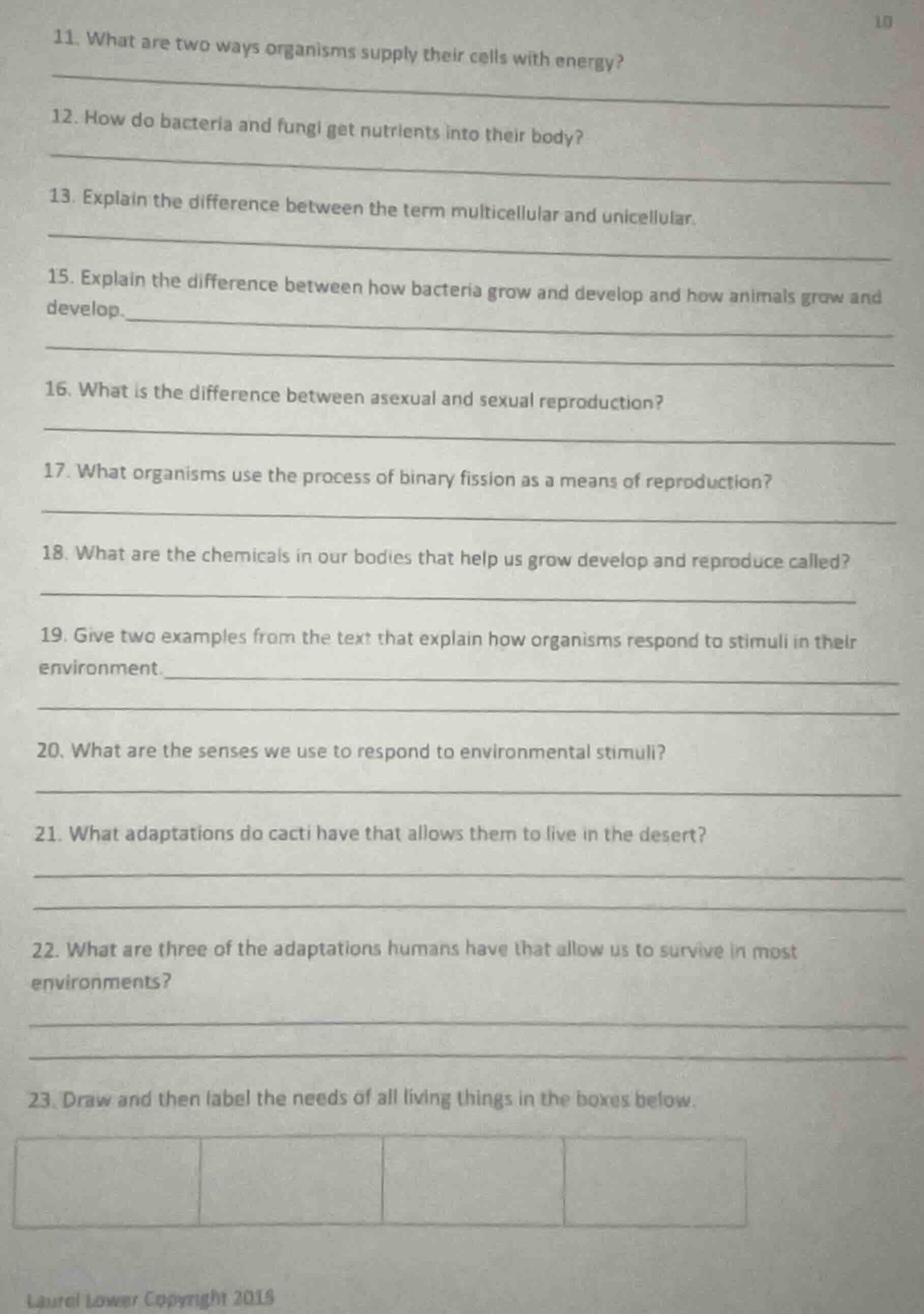
- what are two ways organisms supply their cells with energy?
- how do bacteria and fungi get nutrients into their body?
- explain the difference between the term multicellular and unicellular.
- explain the difference between how bacteria grow and develop and how animals grow and develop.
- what is the difference between asexual and sexual reproduction?
- what organisms use the process of binary fission as a means of reproduction?
- what are the chemicals in our bodies that help us grow develop and reproduce called?
- give two examples from the text that explain how organisms respond to stimuli in their environment.
- what are the senses we use to respond to environmental stimuli?
- what adaptations do cacti have that allows them to live in the desert?
- what are three of the adaptations humans have that allow us to survive in most environments?
- draw and then label the needs of all living things in the boxes below.
Brief Explanations
- Identifies the two core energy pathways for cells.
- Describes the heterotrophic nutrient acquisition method of these organisms.
- Contrasts organism structure based on cell count.
- Compares growth/development mechanisms of prokaryotes and animals.
- Differentiates reproduction based on genetic input.
- Names organisms using this asexual prokaryotic reproduction.
- Identifies the regulatory chemicals for growth/reproduction.
- Provides common examples of environmental stimulus responses.
- Lists the human sensory organs for stimulus detection.
- Outlines desert-specific survival traits of cacti.
- Highlights key human traits for broad environmental survival.
- Labels the universal requirements for living organisms.

Snap & solve any problem in the app
Get step-by-step solutions on Sovi AI
Photo-based solutions with guided steps
Explore more problems and detailed explanations
- Cellular respiration (using glucose to produce ATP) and photosynthesis (converting light energy to chemical energy, used by autotrophs)
- They are heterotrophs; they secrete digestive enzymes into their environment to break down organic matter, then absorb the dissolved nutrients into their cells.
- Unicellular organisms are made of a single cell that carries out all life functions, while multicellular organisms are made of many specialized cells that work together to perform different life functions.
- Bacteria grow and develop via binary fission (asexual cell division that produces identical clones, increasing their population size) with no distinct embryonic stages. Animals grow via mitotic cell division, develop through specialized embryonic stages, and cells differentiate into distinct tissues and organs.
- Asexual reproduction requires only one parent, produces genetically identical offspring, and involves no gamete fusion. Sexual reproduction requires two parents, produces genetically unique offspring, and involves the fusion of male and female gametes.
- Prokaryotic organisms such as bacteria, as well as some single-celled eukaryotes like amoebas and paramecia.
- Hormones
- Example 1: A plant's roots grow toward water (hydrotropism, response to water stimulus). Example 2: A rabbit runs away when it hears a loud noise (response to auditory stimulus to avoid danger).
- Sight (eyes), hearing (ears), touch (skin), smell (nose), and taste (tongue)
- - Thick, waxy cuticles and spines (instead of leaves) to reduce water loss
- Enlarged, fleshy stems to store water
- Shallow, widespread root systems to quickly absorb rainwater
- - Opposable thumbs for grasping and manipulating objects
- Complex brain for problem-solving and tool use
- Ability to regulate body temperature (endothermy) and adapt clothing/shelter to different climates
23.
| Water | Food/Energy | Living Space | Stable Internal Conditions (Homeostasis) |
|---|