QUESTION IMAGE
Question
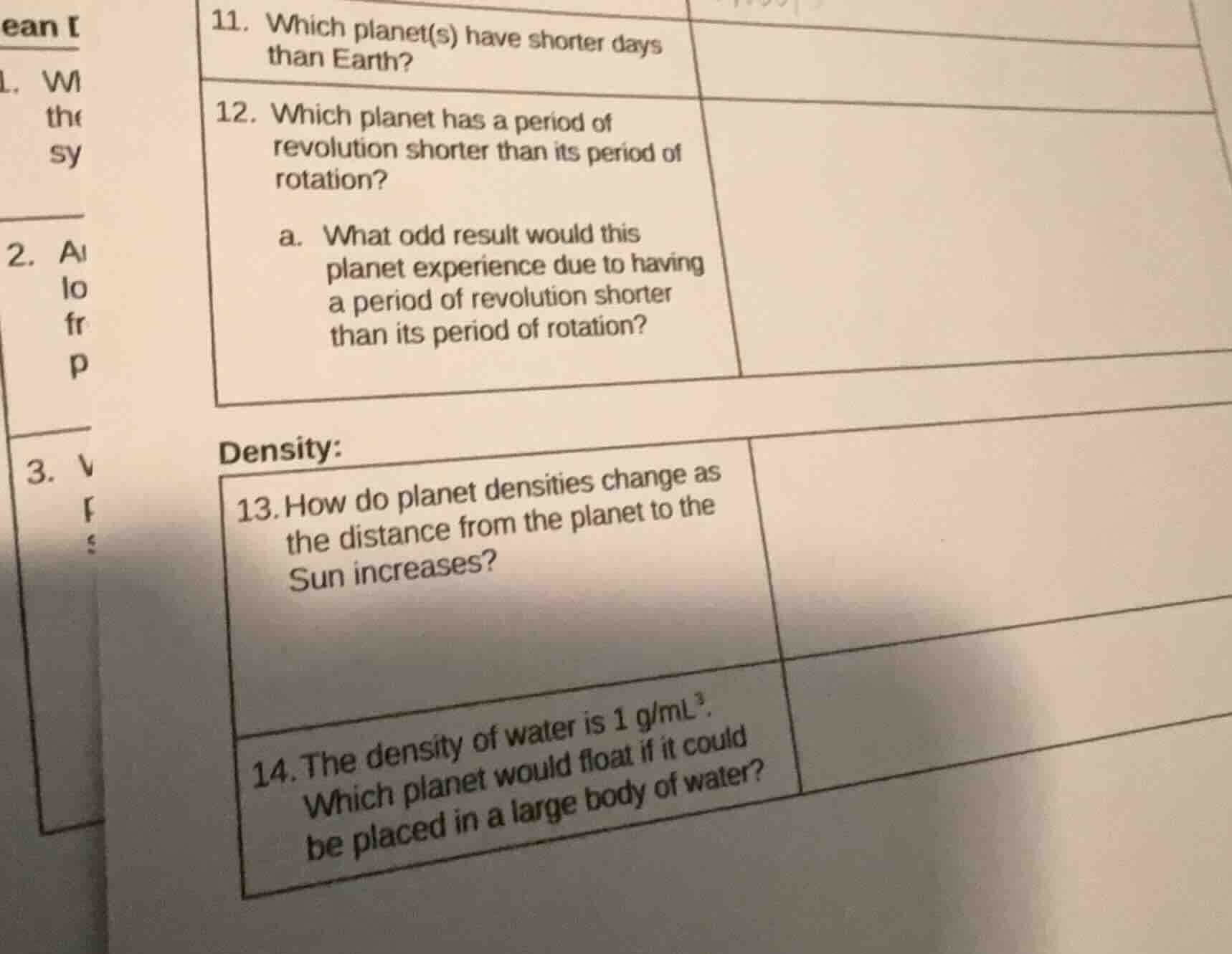
- which planet(s) have shorter days than earth?
- which planet has a period of revolution shorter than its period of rotation?
a. what odd result would this planet experience due to having a period of revolution shorter than its period of rotation?
density:
- how do planet densities change as the distance from the planet to the sun increases?
- the density of water is 1 g/ml³. which planet would float if it could be placed in a large body of water?
Question 11
To determine which planets have shorter days (shorter rotational periods) than Earth, we recall the rotational periods of planets. Earth's rotational period is about 24 hours. Planets like Jupiter (≈9.9 hours), Saturn (≈10.7 hours), Uranus (≈17.2 hours), and Neptune (≈16.1 hours) have shorter rotational periods (shorter days) than Earth. Also, Mercury has a rotational period of about 58.6 days (longer than Earth's day), Venus has a rotational period of about 243 days (longer than Earth's day). So Jupiter, Saturn, Uranus, Neptune have shorter days than Earth.
The period of revolution is the time to orbit the Sun, and period of rotation is the time to spin on its axis. Venus has a period of revolution (≈225 days) shorter than its period of rotation (≈243 days).
If a planet's revolution period is shorter than its rotation period, it means the planet orbits the Sun faster than it spins on its axis. For Venus, this leads to a retrograde (backward - relative to other planets) apparent motion of the Sun in its sky, and also means that a "day" (time from one sunrise to the next) on Venus is longer than its year (period of revolution).

Snap & solve any problem in the app
Get step-by-step solutions on Sovi AI
Photo-based solutions with guided steps
Explore more problems and detailed explanations
Jupiter, Saturn, Uranus, Neptune (planets with rotational periods shorter than Earth's 24 - hour day)