QUESTION IMAGE
Question
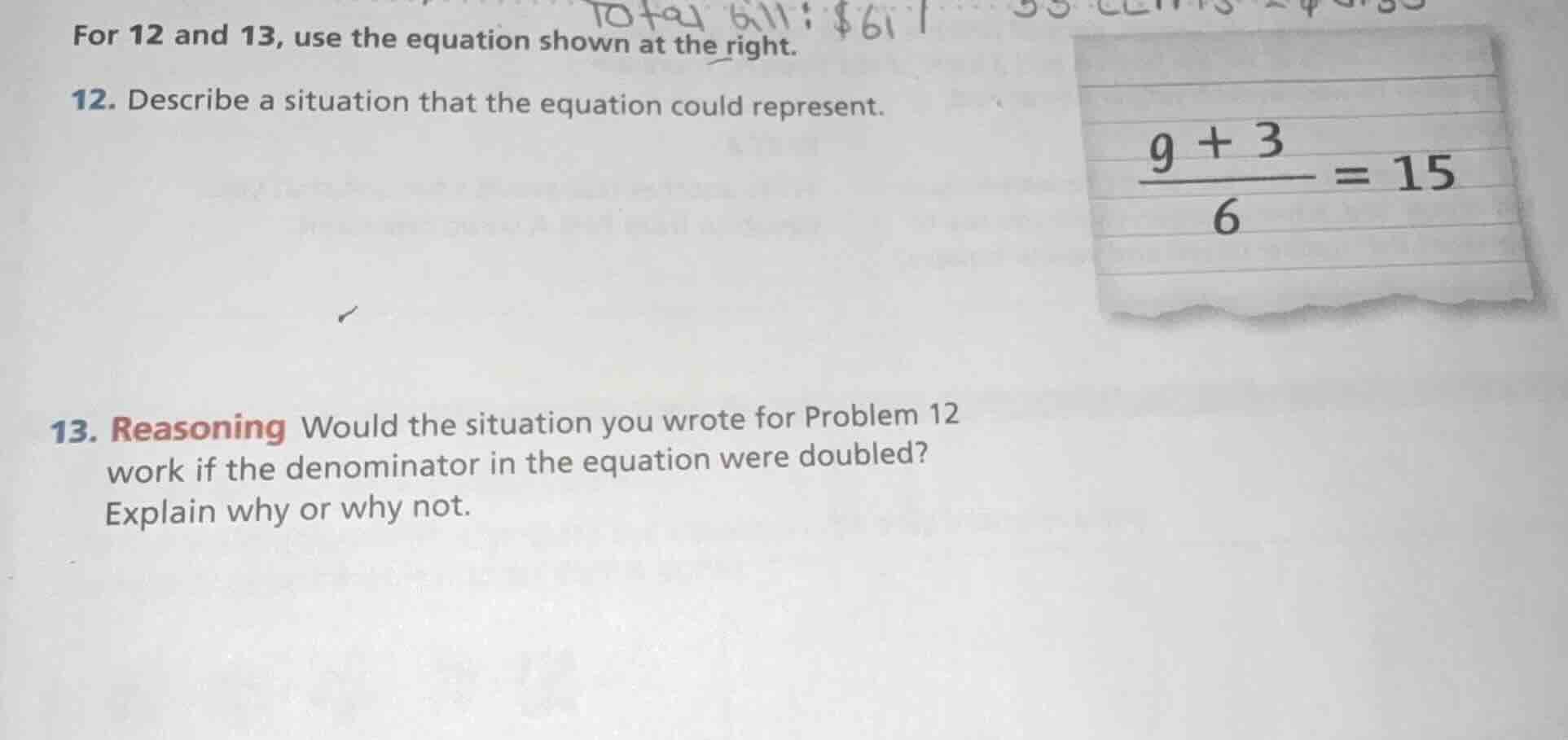
for 12 and 13, use the equation shown at the right.
- describe a situation that the equation could represent.
$\frac{g + 3}{6} = 15$
- reasoning would the situation you wrote for problem 12 work if the denominator in the equation were doubled? explain why or why not.
For Question 12:
Create a real-world scenario matching the equation's structure: a total (g + 3) split into 6 equal parts equals 15. Example: A group of g friends plus 3 more people split 6 identical pizza orders, and each person gets 15 slices total.
For Question 13:
First, identify the original denominator is 6; doubling it gives 12. Analyze if the scenario fits: the original scenario uses 6 equal groups. Doubling the denominator changes the number of equal parts, which would require adjusting the scenario (e.g., splitting into 12 groups instead of 6) to make logical sense, so the original situation does not work without modification.

Snap & solve any problem in the app
Get step-by-step solutions on Sovi AI
Photo-based solutions with guided steps
Explore more problems and detailed explanations
- Example situation: You have \(g\) video game controllers, and you buy 3 more. You split all the controllers equally between 6 of your friends, and each friend gets 15 controllers.
- No, the original situation would not work. Doubling the denominator changes the number of equal groups from 6 to 12. The original scenario is based on splitting the total controllers between 6 friends, so splitting between 12 friends would mean each friend gets fewer than 15 controllers, which contradicts the equation's result of 15. The scenario would need to be adjusted to involve 12 equal groups instead of 6 to be logical.