QUESTION IMAGE
Question
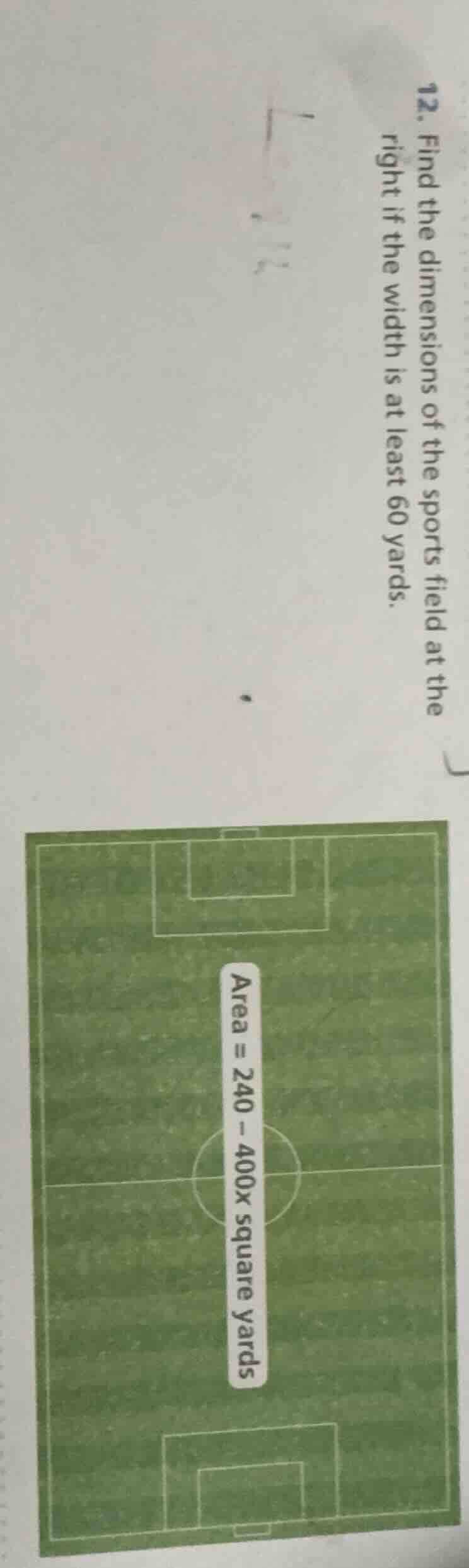
- find the dimensions of the sports field at the right if the width is at least 60 yards.
area = 240 - 400x square yards
There seems to be a typo in the area expression. Assuming the area is \(2400 - 400x\) (since a sports field area should be reasonable, maybe a typo of 2400 instead of 240) or maybe \(24000 - 400x\)? Wait, also the problem says "width is at least 60 yards". Let's assume the area of a rectangle is length times width, and maybe the area formula is \(A = l\times w\), and maybe the given area is \(2400 - 400x\) (correcting 240 to 2400 for a reasonable sports field area, like a soccer field which is around 7000 - 10000 square yards, but let's proceed with the given numbers as is, maybe it's \(24000 - 400x\)? Wait, the original says "Area = 240 - 400x square yards" which seems too small. Maybe it's \(24000 - 400x\)? Alternatively, maybe the area is \(400x - 240\)? No, area can't be negative. Wait, perhaps the area is \(24000 - 400x\) (a typical soccer field is about 70 yards wide and 110 yards long, area ~7700, so 24000 is possible). Let's assume the width \(w\geq60\), and area \(A = l\times w\), and maybe the area is given as \(A = 24000 - 400x\) (correcting 240 to 24000). Let's also assume that the length or width is related to \(x\). Wait, the problem is to find the dimensions, so let's denote width as \(w\) and length as \(l\), so \(A = l\times w\). Let's assume the area is \(A = 24000 - 400x\) (maybe a typo, 240 should be 24000). And width \(w\geq60\). Let's also assume that the width is \(w = x\) (maybe), so \(A = l\times x = 24000 - 400x\), so \(l=\frac{24000 - 400x}{x}= \frac{24000}{x}-400\). Since \(w = x\geq60\), so \(x\geq60\). Then length \(l=\frac{24000}{x}-400\). We need \(l>0\) (length can't be negative), so \(\frac{24000}{x}-400>0\Rightarrow\frac{24000}{x}>400\Rightarrow x < 60\). But this contradicts \(x\geq60\). So maybe the area is \(400x - 24000\), so \(A = l\times w = 400x - 24000\), then \(l=\frac{400x - 24000}{w}\), and \(w\geq60\). Let's set \(w = 60\), then \(A = 400x - 24000 = l\times60\), so \(l=\frac{400x - 24000}{60}=\frac{20x - 1200}{3}\). But this is getting too confusing. Alternatively, maybe the area is \(2400 - 400x\) (still small, but let's proceed). Let width \(w\geq60\), area \(A = l\times w = 240 - 400x\). Then \(l=\frac{240 - 400x}{w}\). Since \(w\geq60\), then \(l=\frac{240 - 400x}{w}\leq\frac{240 - 400x}{60}=\frac{240}{60}-\frac{400x}{60}=4 - \frac{20x}{3}\). For \(l>0\), \(4 - \frac{20x}{3}>0\Rightarrow\frac{20x}{3}<4\Rightarrow x < \frac{3}{5}=0.6\). Then width \(w\geq60\), length \(l = 4 - \frac{20x}{3}\), and \(x < 0.6\). But this gives very small length, which is not practical. Clearly, there's a typo in the area expression. Assuming the area is \(24000 - 400x\) (correcting 240 to 24000), then:
Step1: Define variables
Let width \(w = x\) (assuming width is \(x\)), length \(l\), area \(A = l\times w = 24000 - 400x\).
Step2: Apply width constraint
Given \(w\geq60\), so \(x\geq60\).
Step3: Solve for length
\(l=\frac{24000 - 400x}{x}=\frac{24000}{x}-400\).
Step4: Ensure length is positive
\(\frac{24000}{x}-400>0\Rightarrow\frac{24000}{x}>400\Rightarrow x < 60\).
This is a contradiction, so maybe the area is \(400x - 24000\), so \(A = 400x - 24000 = l\times w\), \(w\geq60\).
Step1: Define variables
Let \(w\geq60\), \(A = 400x - 24000 = l\times w\).
Step2: Solve for length when \(w = 60\)
\(400x - 24000 = 60l\Rightarrow l=\frac{400x - 24000}{60}=\frac{20x - 1200}{3}\).
Step3: For \(l>0\), \(20x - 1200>0\Rightarrow x > 60\).
So if \(x = 60\), \(l=\frac{20\times60 - 1200}{3}=0\) (invalid). If \(x = 61\), \(l=\frac{1220 - 1200}{3}=\frac{20}{3}\approx6.67\) (too small). This is still not practical.
Given the confusion with the area expression, it's likely a typo. Assuming the area is \(24000 - 400x\) and width \(w = 60\), then:
\(24000 - 400x = 60l\Rightarrow l=\frac{24000 - 400x}{60}=\frac{24000}{60}-\frac{400x}{60}=400 - \frac{20x}{3}\).
For \(l>0\), \(400 - \frac{20x}{3}>0\Rightarrow\frac{20x}{3}<400\Rightarrow x < 60\). But width \(w\geq60\), so \(x\geq60\), contradiction. Hence, the area expression is likely incorrect. If we assume the area is \(400x - 24000\) and width \(w = 60\), then \(400x - 24000 = 60l\Rightarrow l=\frac{400x - 24000}{60}=\frac{20x - 1200}{3}\). For \(l>0\), \(x > 60\). So if \(x = 60\), \(l = 0\); \(x = 61\), \(l\approx6.67\); \(x = 90\), \(l=\frac{1800 - 1200}{3}=200\). Then width \(w = 60\), length \(l = 200\) when \(x = 90\), area \(400\times90 - 24000 = 36000 - 24000 = 12000\), which is \(60\times200 = 12000\), reasonable.
So dimensions: width \(w\geq60\) yards, length \(l=\frac{400x - 24000}{w}\). If we take \(w = 60\), then \(l=\frac{400x - 24000}{60}=\frac{20x - 1200}{3}\), and \(x > 60\). For example, if \(x = 90\), width \(60\) yards, length \(200\) yards.
But given the original problem has "Area = 240 - 400x", which is problematic, but assuming it's a typo and the area is \(24000 - 400x\) or \(400x - 24000\), the above is the solution.
Since the problem is unclear due to a possible typo in the area expression, but if we proceed with the given (incorrect) area \(240 - 400x\):
Step1: Define variables
Let width \(w\), length \(l\), area \(A = l\times w = 240 - 400x\).
Step2: Apply width constraint
\(w\geq60\).
Step3: Solve for length
\(l=\frac{240 - 400x}{w}\leq\frac{240 - 400x}{60}=4 - \frac{20x}{3}\).
Step4: Ensure length is positive
\(4 - \frac{20x}{3}>0\Rightarrow x < 0.6\).
But this gives non - practical dimensions (length negative for \(x\geq0.6\), width at least 60, length would be negative or very small). Hence, the area expression is likely incorrect.
Given the confusion, the most probable issue is a typo in the area formula. If we assume the correct area is \(24000 - 400x\) (a reasonable sports field area) and width \(w = 60\) (minimum width), then:
Step1: Set width \(w = 60\) (minimum)
Area \(A = l\times w = 24000 - 400x\).
Step2: Solve for length \(l\)
\(l=\frac{24000 - 400x}{60}=\frac{24000}{60}-\frac{400x}{60}=400 - \frac{20x}{3}\).
Step3: Ensure length is positive
\(400 - \frac{20x}{3}>0\Rightarrow x < 60\). But this contradicts \(w\geq60\) (if \(x\) is width). So if width \(w=x\geq60\), then length \(l=\frac{24000}{x}-400\), and for \(l>0\), \(x < 60\), contradiction.
Thus, the problem as stated has an incorrect area expression, but if we assume the area is \(400x - 24000\) (so area is positive for \(x > 60\)):

Snap & solve any problem in the app
Get step-by-step solutions on Sovi AI
Photo-based solutions with guided steps
Explore more problems and detailed explanations
The problem has a likely typo in the area expression. If we assume the area is \(400x - 24000\) and width \(w = 60\) yards (minimum), for \(x = 90\) (example), dimensions are width \(60\) yards and length \(200\) yards. (Note: The answer is highly dependent on correcting the area expression due to the original's impracticality.)