QUESTION IMAGE
Question
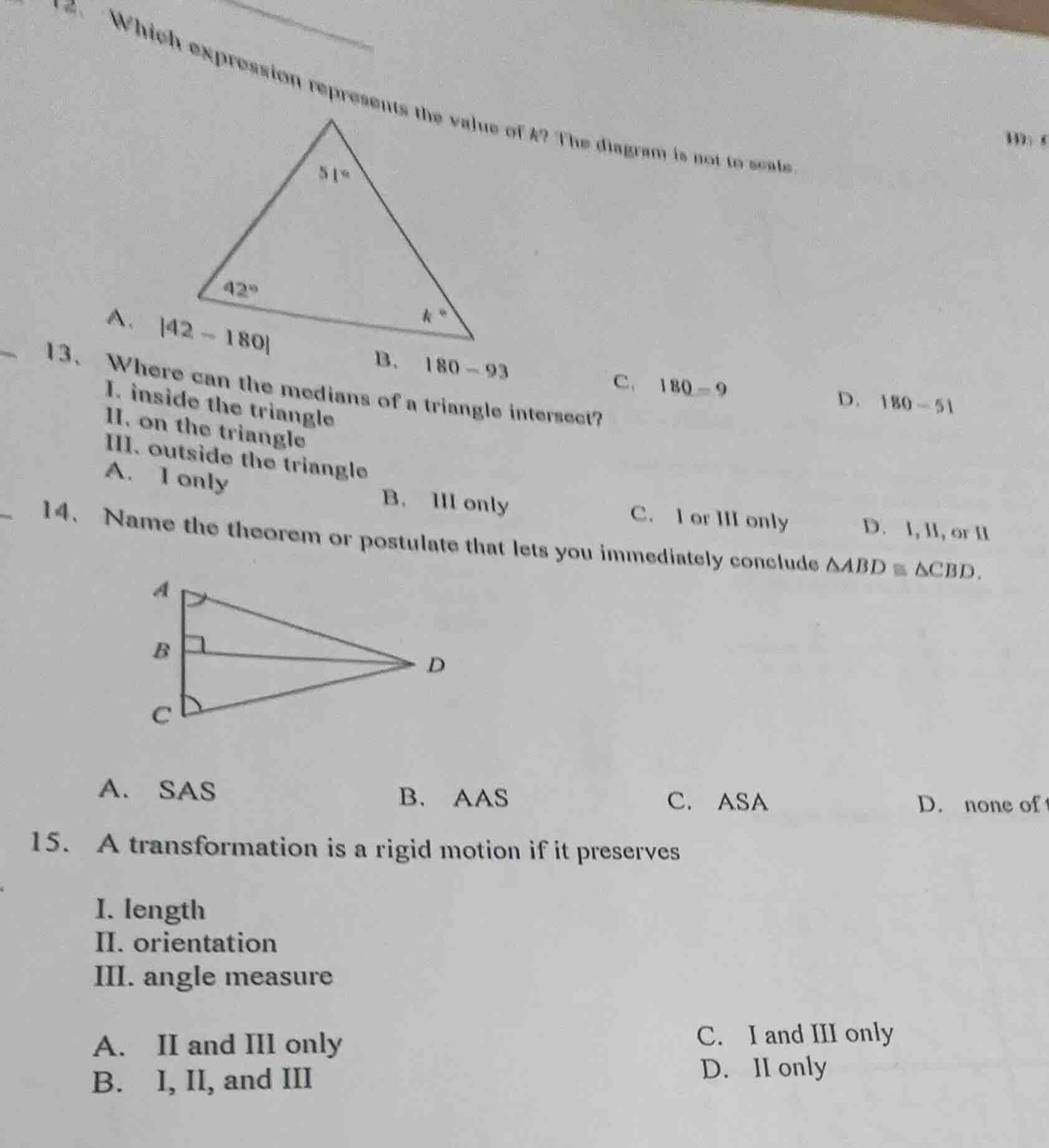
- which expression represents the value of k? the diagram is not to scale.
a. |42 - 180| b. 180 - 93 c. 180 - 9 d. 180 - 51
- where can the medians of a triangle intersect?
i. inside the triangle
ii. on the triangle
iii. outside the triangle
a. i only b. iii only c. i or iii only d. i, ii, or iii
- name the theorem or postulate that lets you immediately conclude δabd ≅ δcbd.
a. sas b. aas c. asa d. none of t
- a transformation is a rigid motion if it preserves
i. length
ii. orientation
iii. angle measure
a. ii and iii only b. i, ii, and iii c. i and iii only d. ii only
Question 12
Step1: Recall triangle angle sum
The sum of angles in a triangle is \(180^\circ\). So, we first find the sum of the two given angles: \(51^\circ + 42^\circ = 93^\circ\).
Step2: Calculate \(k\)
To find \(k\), we subtract the sum of the two known angles from \(180^\circ\), so \(k = 180 - 93\).
The medians of a triangle are segments from a vertex to the midpoint of the opposite side. By the property of medians, they always intersect inside the triangle, regardless of the type of triangle (acute, obtuse, right). They never intersect on or outside the triangle.
Looking at \(\triangle ABD\) and \(\triangle CBD\): \(\angle A = \angle C\) (given), \(\angle ABD=\angle CBD = 90^\circ\) (right angles), and \(BD\) is common to both triangles. So, we have two angles and a non - included side (AAS) congruent. So the AAS postulate can be used to conclude \(\triangle ABD\cong\triangle CBD\).

Snap & solve any problem in the app
Get step-by-step solutions on Sovi AI
Photo-based solutions with guided steps
Explore more problems and detailed explanations
B. \(180 - 93\)