QUESTION IMAGE
Question
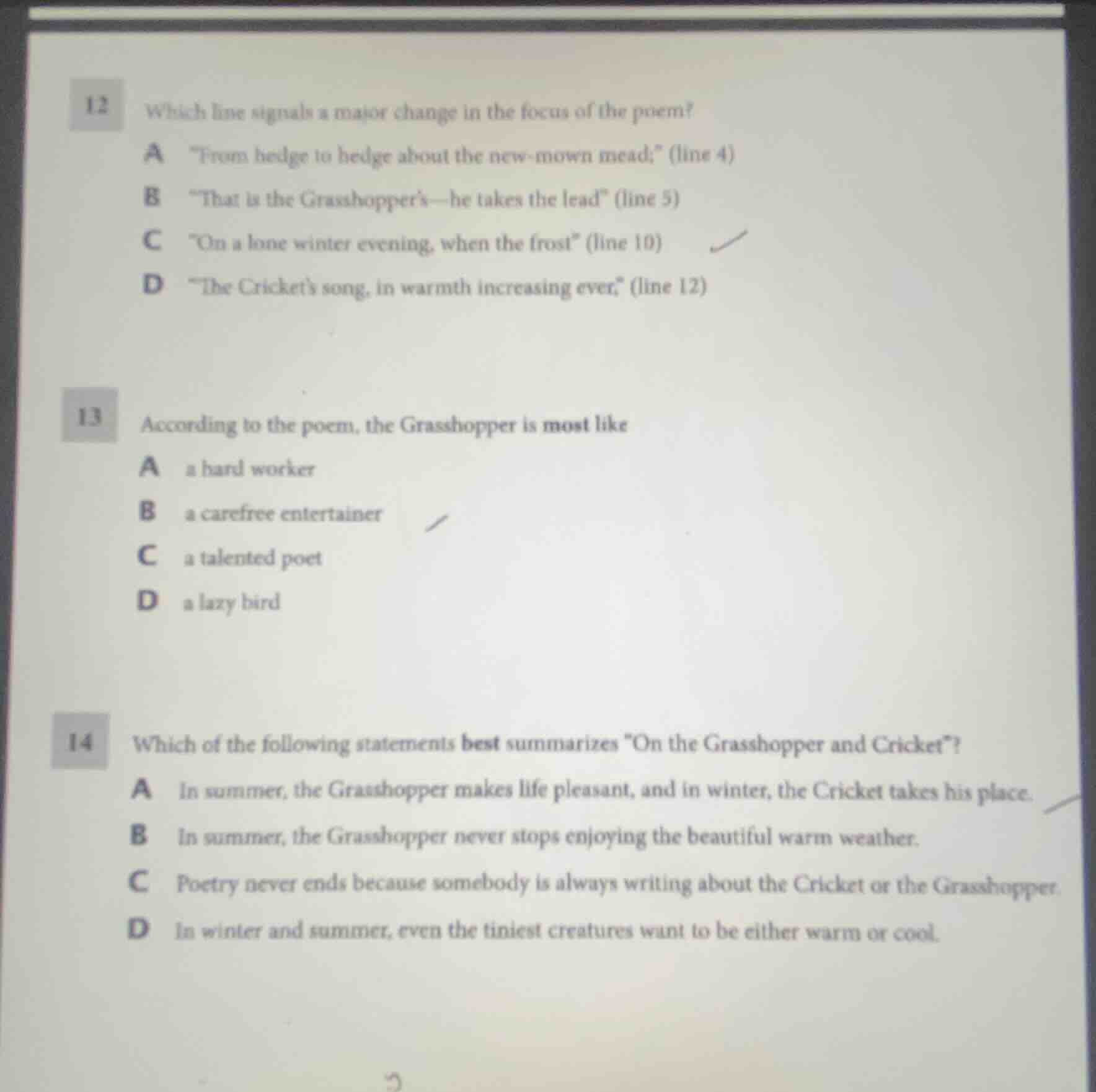
12 which line signals a major change in the focus of the poem? a \from hedge to hedge about the new - mown mead;\ (line 4) b \that is the grasshoppers—he takes the lead\ (line 5) c \on a lone winter evening, when the frost\ (line 10) d \the crickets song, in warmth increasing ever,\ (line 12) 13 according to the poem, the grasshopper is most like a a hard worker b a carefree entertainer c a talented poet d a lazy bird 14 which of the following statements best summarizes \on the grasshopper and cricket\? a in summer, the grasshopper makes life pleasant, and in winter, the cricket takes his place. b in summer, the grasshopper never stops enjoying the beautiful warm weather. c poetry never ends because somebody is always writing about the cricket or the grasshopper. d in winter and summer, even the tiniest creatures want to be either warm or cool.
Question 12
To determine the line signaling a major focus change, we analyze the poem's structure. Lines 1 - 9 likely focus on summer (Grasshopper), and line 10 ("On a lone winter evening, when the frost") introduces winter, shifting focus to the Cricket. Other options (A, B, D) relate to summer or the Cricket's song without a season shift.
In the poem, the Grasshopper is active in summer, singing and leading, suggesting a carefree, entertaining role. "Hard worker" (A) is incorrect as it's about enjoyment, not labor. "Talented poet" (C) misinterprets its role, and "lazy bird" (D) is irrelevant (Grasshopper, not a bird).
The poem contrasts summer (Grasshopper's pleasant presence) and winter (Cricket taking over to bring warmth/joy). Option A matches this. B focuses only on summer, C misinterprets the poem's theme (not about poetry writing), D is about creatures' temperature desires, not the poem's focus.

Snap & solve any problem in the app
Get step-by-step solutions on Sovi AI
Photo-based solutions with guided steps
Explore more problems and detailed explanations
C. "On a lone winter evening, when the frost" (line 10)